Lignins, the complex molecules that make plants sturdy and allow them to grow tall, are not as random as once thought. A new international study led by Prof. Edouard Pesquet at the Department of Ecology, Environment and Plant Sciences, Stockholm University, uncovers how lignins’ chemistry and structure vary between cell types to meet plants' physiological needs. The paper, published as a Tansley Review in the journal New Phytologist, highlights how this molecular diversity has been key to plants' success on land.
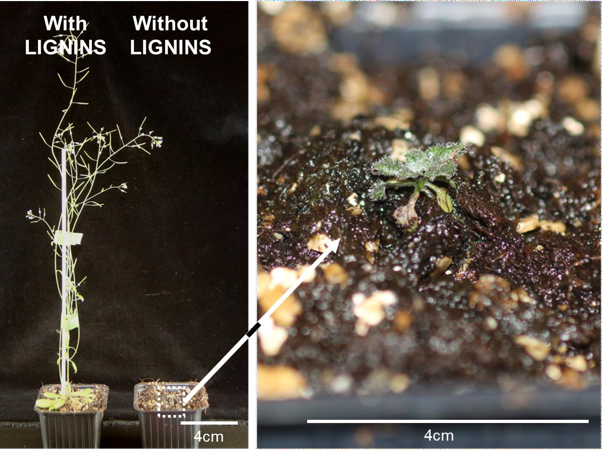
Figure 1. What happen when plants are unable to produce enough lignin? Below is a comparison of two Arabidopsis thaliana plants with normal lignin levels versus drastically reduced lignins. Reduction of 95% in overall lignin levels leads to small, sterile plants that produce far less biomass. Photo: Emiko Murozuka
“Our work combines detailed structural analyses of lignins with insights into their structure-specific physiological functions,” says Prof. Katharina Pawlowski.
Without lignins, there would be no trees, ferns, or flowering plants—only mosses. Lignins strengthen plant cell walls, enabling water transport, UV protection, and defense against pathogens. They also store an estimated 25–30% of all biological carbon on Earth.
The study, conducted in collaboration with researchers from the University of São Paulo (Brazil) and the Tokyo University of Agriculture and Technology (Japan), synthesizes decades of research to clarify how lignins form and function. It shows that the specific spatial distribution and chemical composition of lignins in each cell type determine how effectively plants grow and adapt to their environment.

Figure 2: International collaborative team that has assembled the study to unravel the physiological roles of lignins in plants.
The comprehensive review also includes a glossary of lignin terms, a proposed revised nomenclature for lignin chemistry, and an in-depth look at lignins from their molecular structure to their genetic regulation and physiological roles. "The diversity of lignin structures reflects the many adaptive processes plants have made over their long evolutionary history,” adds co-author Prof. Shinya Kajita from Tokyo University of Agriculture and Technology.
Access the publication
Physiological roles of lignins – tuning cell wall hygroscopy and biomechanics New Phytologist (2025)
Read more about lignin research at Stockholm University
Lignin paves the way for a fossil-free society
Research Groups at Stockholm University
Post for DEEPs Bluesky, shared by the Bolin Centre Bluesky:
New study in @newphyt.bsky.social reveals how lignin diversity helps plants thrive on land – without them, they become small, sterile plants that produce far less biomass.
Visit biolush.eu and join us in shaping the future of the biobased industry.
For technical inquiries, reach out to: For general information and press inquiries:
Aji Mathew Milica Velimirović
Project Coordinator Bio-LUSH Communications Manager
[email protected] [email protected]