
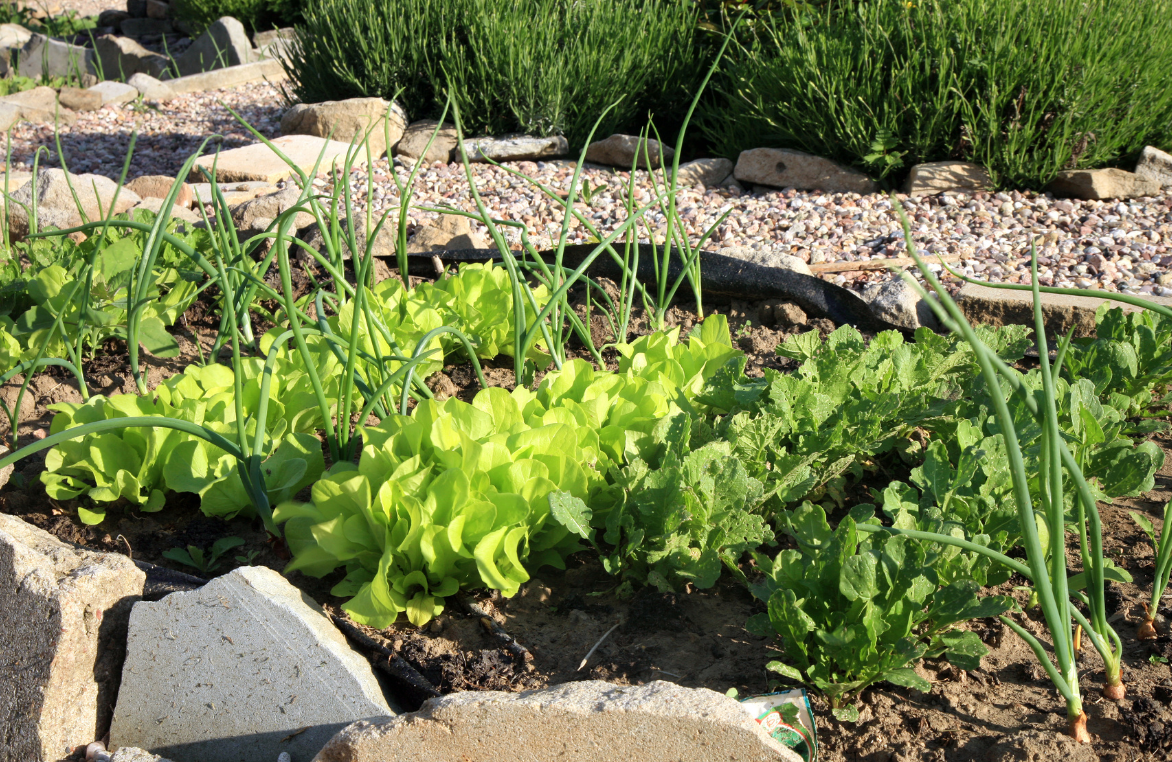
Most farmers think intercropping is all about saving space, but in reality it is more about timing and pest control. Intercropping is an agricultural practice that involves planting two or more crops on the same land at the same time. It maximizes land use and improves productivity, but the interaction of these intercropped plants must be monitored both above and below ground.
Onion (Allium cepa) and lettuce (Lactuca sativa) are vegetable crops that can be successfully grown together. Despite their compatibility, many farmers and gardeners are unaware of the potential benefits of combining them in an intercropping system.
Why onions and lettuce work well together
Most people wonder if onions can grow with lettuce. The simple answer is yes. Onion is one of the best companion plants for lettuce and vice versa.
One of the key reasons this combination is effective is its ability to function as a natural pest control system. Onions act as a pest-repelling crop because of their strong smell. Onions emit sulfur-containing volatile compounds that repel insects or mask the chemical signals pests use to locate host plants. A field study in Mozambique found that lettuce plots intercropped with onions had significantly more intact plants than monoculture plots, with the "surround" pattern of onion rows showing the strongest protective effect against the black cutworm (Agrotis ipsilon). This means farmers can reduce or, in some cases, completely avoid insecticide use.
The two crops also grow well together because they use soil resources differently. An important principle in intercropping is to avoid combining crops that compete at the same root level, especially when land is limited. Lettuce has shallow roots, while onions grow slightly deeper and more vertically. This difference in root depth reduces competition for water and nutrients, allowing both crops to develop side by side efficiently.
An important advantage is the difference in their growth speed. Lettuce provides quick income due to its short growth cycle, while onions, although slower to mature, often carry higher market value. This allows farmers to earn in stages, first from the lettuce and later from onions, making the system both productive and economically beneficial.
How to set up onion and lettuce intercropping
The success of this system lies in how both crops complement each other in growth, root structure, and pest management. To achieve this balance, farmers need to follow practical steps that ensure both crops grow efficiently without competing.
- Land preparation. The soil should be well-tilled, loose, and rich in organic matter. Since lettuce requires good moisture and onions prefer well-drained conditions, the land should be prepared in a way that allows water retention without waterlogging. Adding compost before planting supports both crops.
- Spacing. Farmers can adopt different planting patterns, such as alternating rows (onion, lettuce, onion) or planting lettuce between onion rows. Each crop needs enough space to access sunlight, water, and nutrients. The specific spacing depends on the varieties chosen, but the key principle is to avoid overcrowding while keeping the onion rows close enough to provide pest deterrence.
- Planting timing. Lettuce, which grows faster, can be planted slightly earlier or at the same time as onions. This allows it to establish quickly without being overshadowed as the onions continue to develop.
- Watering. Both crops require consistent moisture during early growth. However, onions are sensitive to excess water. Maintaining balanced soil moisture helps both crops grow without stress.
- Harvesting. Lettuce matures quickly and can be harvested early, creating more space and reducing competition for the onions. The onions continue growing after the lettuce has been removed and are harvested later when bulbs are fully developed.
Common mistakes farmers make with this system
Despite its benefits, onion-lettuce intercropping can fail if not properly managed.
- Choosing incompatible varieties. Not all onion and lettuce varieties are suited for intercropping. Some lettuce varieties grow too large or take too long to mature, leading to shading and increased competition. Certain onion varieties require more space or a longer growing period. Choosing compact, quick-maturing lettuce alongside standard bulb onions tends to give the best results.
- Poor water management. Farmers often assume both crops need the same amount of water at every stage. Lettuce needs consistent moisture to develop properly, while onions are sensitive to excess water. Overwatering can lead to onion rot, and insufficient moisture affects lettuce quality.
- Unbalanced fertilization. Applying fertilizer without considering the needs of both crops creates problems. Too much nitrogen may push rapid lettuce growth but produce weak onion bulbs. Insufficient nutrients limit both crops. A balanced approach, ideally based on a soil test, supports healthy development across the system.
- Wrong planting time. This is about more than the calendar date. Lettuce performs best in cooler conditions and struggles in high heat, while onions tolerate a wider temperature range. Planting lettuce into hot conditions reduces its growth and the overall productivity of the system.
- Overestimating pest control benefits. While onions reduce pest activity through their volatile compounds, they do not eliminate pests entirely. Farmers still need to monitor their crops and take additional measures when necessary. Relying solely on the onion's repellent effect can lead to unexpected crop damage. A 2025 review of intercropping for pest management confirmed that while intercropping consistently reduces pest pressure compared to monoculture, the effect varies depending on crop combination, planting pattern, and local pest populations. Integrated approaches that combine intercropping with other IPM practices produce the most reliable results.
Final thoughts
Intercropping onions and lettuce is a practical system that improves productivity, reduces costs, and makes better use of available resources. By combining crops with different root depths, growth patterns, and pest interactions, farmers can create a more balanced and efficient farming system.
When carefully planned and well-managed, this combination allows farmers to grow more, spend less, and get better results from the same land.
References
- Marassiro, F., Ferrão, J., & Seni, J. (2016). Intercropping of lettuce and onion controls caterpillar thread, Agrotis ipsilon, major insect pest of lettuce. Chemical and Biological Technologies in Agriculture, 3, 28.
- Mota, J. H., et al. Agronomic and economic performance of intercropping onion and lettuce at varying plant densities. Referenced in Elouattassi, M., et al. (2024). Enhancing onion growth and yield through agroecological practices. Journal of the Saudi Society of Agricultural Sciences, 23(2).
- Frontiers in Sustainable Food Systems. (2025). Multifunctional roles of intercropping in the management of insect pests affecting pulse crops. Vol. 9.