A plant is wilting in the field, and the first question a grower asks is whether it is bacterial wilt or Fusarium wilt. The two diseases look alike because both block the plant's ability to move water, but they are caused by different organisms, they develop differently, and they are managed differently. Telling them apart is the first step toward controlling either one, because the wrong diagnosis leads to the wrong response and continued losses.
Wilt diseases disrupt the movement of water and nutrients through the plant's vascular system, mainly the xylem. As that transport is choked off, the plant loses turgor and the leaves and stems droop, wilt, and eventually die if the cause is not addressed. This is why wilting is such a misleading symptom: a plant can wilt in soil that holds plenty of moisture, because the problem is not a lack of water in the ground but a blockage inside the plant. Among the vascular diseases that cause this, bacterial wilt and Fusarium wilt are two of the most destructive, and they affect a wide range of economically important crops.
What bacterial wilt is
Bacterial wilt is caused mainly by the soil-borne bacterium Ralstonia solanacearum species complex. It attacks the xylem, the tissue that carries water and dissolved nutrients from the roots upward. Once inside, the bacterium multiplies rapidly in these water-conducting vessels and restricts water movement, so the plant wilts even when the soil is moist. Left unmanaged, it can cause severe yield losses or complete crop failure.
What makes bacterial wilt so difficult is that it develops inside the plant. Unlike foliar diseases that sit on the leaf surface, the pathogen is already established internally by the time symptoms show, and in susceptible crops it spreads fast under warm, moist conditions.
Ralstonia solanacearum is a gram-negative bacterium that survives in soil, water, weeds, and infected plant debris, which is part of why it is so persistent. It usually enters through natural openings or wounds in the roots, caused by cultivation, transplanting, insects, or nematodes, then moves up the xylem, multiplying and producing sticky substances that clog the vessels. That blockage is the direct reason infected plants wilt despite adequate soil moisture.
The bacterium has an exceptionally wide host range across hundreds of plant species, but it does the most economic damage in vegetable and tropical crops. Tomato, pepper, eggplant, and potato are among the most susceptible, and the disease is also a major constraint in ginger, especially in the warm, humid conditions where the pathogen thrives. For tomato specifically, where resistant varieties are the main line of defence, the detail is covered in the guide to bacterial wilt in tomato and resistant varieties.
What Fusarium wilt is
Fusarium wilt is caused mainly by the soil-borne fungus Fusarium oxysporum. It infects many important crops worldwide and causes significant losses on commercial farms and in home gardens alike. The fungus enters through the roots, spreads into the xylem, and as it grows inside the vessels it restricts water movement, so the plant wilts, yellows, and eventually dies if the infection becomes severe. Like bacterial wilt, it is systemic and hidden, so symptoms often appear only after considerable internal damage has been done.
Not every strain of Fusarium oxysporum is harmful. Many live in soil harmlessly and help break down organic matter, but pathogenic strains have evolved to infect specific hosts and invade their vascular tissue. One reason the disease is so hard to eliminate is that the fungus produces thick-walled survival structures called chlamydospores, which stay dormant in the soil for many years until a suitable host and favourable conditions return.
A distinctive feature of Fusarium oxysporum is that it is divided into host-specialised groups called formae speciales, meaning "special forms." Each one is adapted to a particular crop or closely related group, and a strain that attacks one crop generally will not infect an unrelated one. For example, F. oxysporum f. sp. lycopersici causes Fusarium wilt of tomato, f. sp. cubense causes Panama disease of banana, f. sp. vasinfectum infects cotton, and f. sp. ciceris causes Fusarium wilt of chickpea. This host specificity is why rotating to an unrelated crop can lower disease pressure in some systems.
How to recognise each disease in the field
Bacterial wilt usually strikes suddenly. A healthy-looking plant may begin to wilt during the hottest part of the day, and the whole plant can collapse in a short time. A telling feature is that the leaves usually stay green in the early stages even as they go limp, so yellowing is not the first sign. As it progresses the plant wilts permanently and dies, and a cut stem often shows light-to-dark brown discolouration in the vascular tissue where the bacterium has invaded.
The simplest field confirmation is the bacterial streaming test. Cut a section of the lower stem and stand it in a clear container of clean water. If the plant has bacterial wilt, thin, milky-white threads of bacteria stream out from the cut surface within a few minutes. It is not a substitute for laboratory diagnosis, but it is a reliable field indicator.
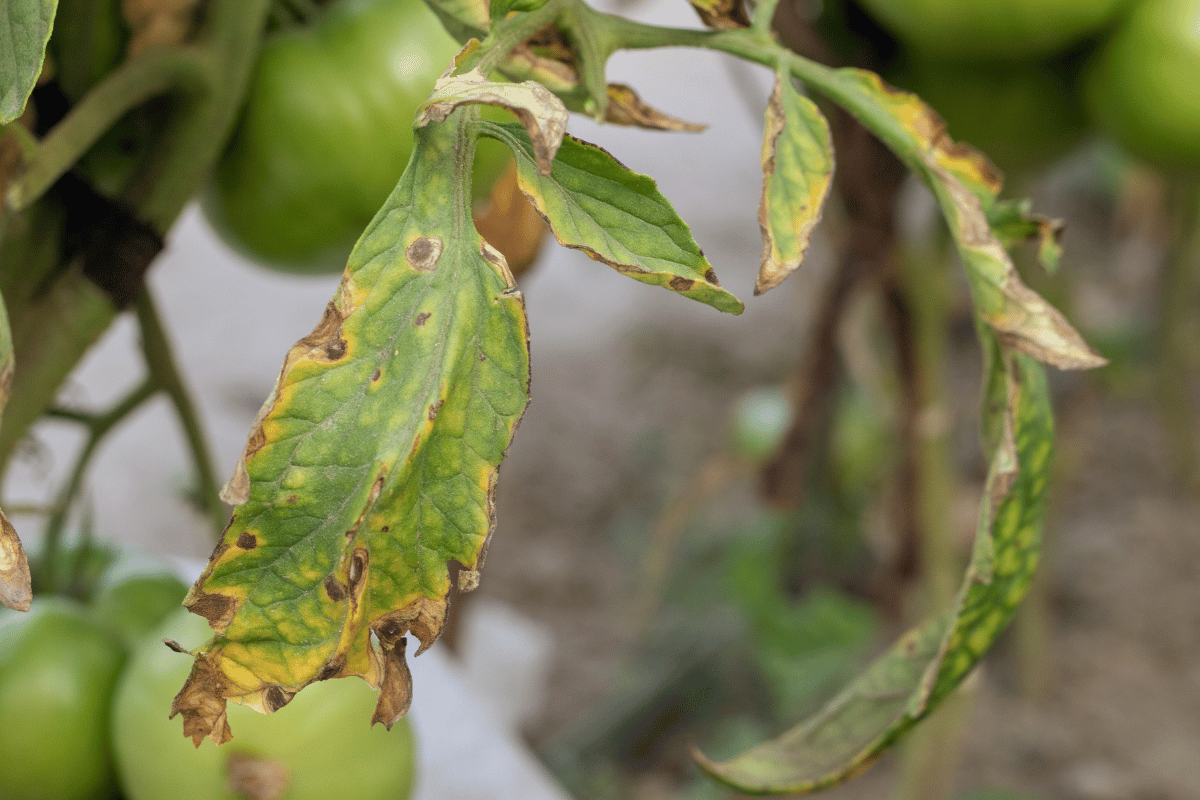
Fusarium wilt develops more gradually. The first sign is often yellowing of the older, lower leaves while the upper leaves still look healthy, and yellowing or wilting frequently begins on just one side of the plant or one side of a leaf, which is one of its characteristic signs. As the fungus spreads, growth slows, the plant gradually wilts, and severely infected plants become stunted with older leaves drying and dropping. A stem cut lengthwise usually shows brown discolouration in the vascular tissue, especially near the base. Crucially, a Fusarium-infected stem does not produce bacterial streaming in water, and that single difference is often enough to separate the two in the field.
| Feature | Bacterial wilt | Fusarium wilt |
| Cause | Bacterium | Fungus |
| Organism | Ralstonia solanacearum species complex | Fusarium oxysporum |
| Speed of collapse | Rapid, often within days | Gradually, over weeks |
| Leaf yellowing | Usually, leaves stay green later | Usually early, often one-sided |
| Bacterial streaming test | Present | Absent |
| Vascular browning | Yes | Yes |
| Soil survival | In soil, water, weeds, and plant debris | Many years, as chlamydospores |
| Cure once infected | None, prevention only | None, prevention only |
Managing bacterial wilt
Once a plant has bacterial wilt there is no chemical treatment that cures it, so management is about preventing infection and limiting spread. Plant resistant or tolerant varieties wherever they are available. Rotate with non-host crops for several seasons to reduce the bacterium in the soil, bearing in mind that rotation will not fully eliminate it because the pathogen survives on weeds and alternative hosts.
Field sanitation matters just as much. Remove and destroy infected plants as soon as they appear, use clean irrigation water, disinfect tools and equipment, and avoid moving contaminated soil between fields. Good weed control removes the alternative hosts that can harbour the bacterium between crops.
Managing Fusarium wilt
Fusarium wilt is also best managed by prevention rather than cure. Resistant cultivars are one of the most reliable and cost-effective ways to reduce losses. Crop rotation with non-host crops can lower pathogen populations, though the fungus persists in soil for years. In hot climates, soil solarization, covering moist soil with clear plastic for several weeks, reduces fungal spores near the surface before planting.
Use healthy, disease-free seedlings from reputable sources so the pathogen is not introduced on planting material, and improve soil drainage, since waterlogged, poorly drained soils stress plants and raise their susceptibility. Where available, beneficial microorganisms such as Trichoderma species can help suppress the fungus as part of an integrated management programme.
Practices that reduce both diseases
Preventing wilt disease is cheaper and more effective than fighting it after infection. Start with certified, disease-free seed or seedlings from reliable suppliers. Clean and disinfect tools, machinery, and footwear before moving between fields, and never move soil from an infected field to a healthy one, since both pathogens survive in soil. Keep drainage good, inspect crops regularly for early wilting, yellowing, or stunting, and remove and destroy diseased plants quickly. Rotate with non-host crops where possible and keep fields free of weeds that act as alternative hosts. Combining these habits with resistant varieties is the strongest long-term defence against both diseases.
| Field action checklist |
|
Bacterial wilt and Fusarium wilt are among the most destructive vascular diseases in agriculture. They both cause wilting and can look similar in the field, but they come from different pathogens and differ in how they infect, spread, and are controlled, which is exactly why correct identification matters so much. Regular monitoring, early diagnosis, good sanitation, clean planting material, and resistant varieties are the most effective ways to limit their impact and protect both yield and income.
Sources
Volesky, N., Murray, M., and Nischwitz, C. (2022). Fusarium and Verticillium wilts of vegetables. Utah State University Extension.
Genin, S., and Denny, T. P. (2012). Pathogenomics of the Ralstonia solanacearum species complex. Annual Review of Phytopathology, 50, 67-89.
Mansfield, J., et al. (2012). Top 10 plant pathogenic bacteria in molecular plant pathology. Molecular Plant Pathology, 13, 614-629.
Edel-Hermann, V., and Lecomte, C. (2019). Current status of Fusarium oxysporum formae speciales and races. Phytopathology, 109, 512-530.