
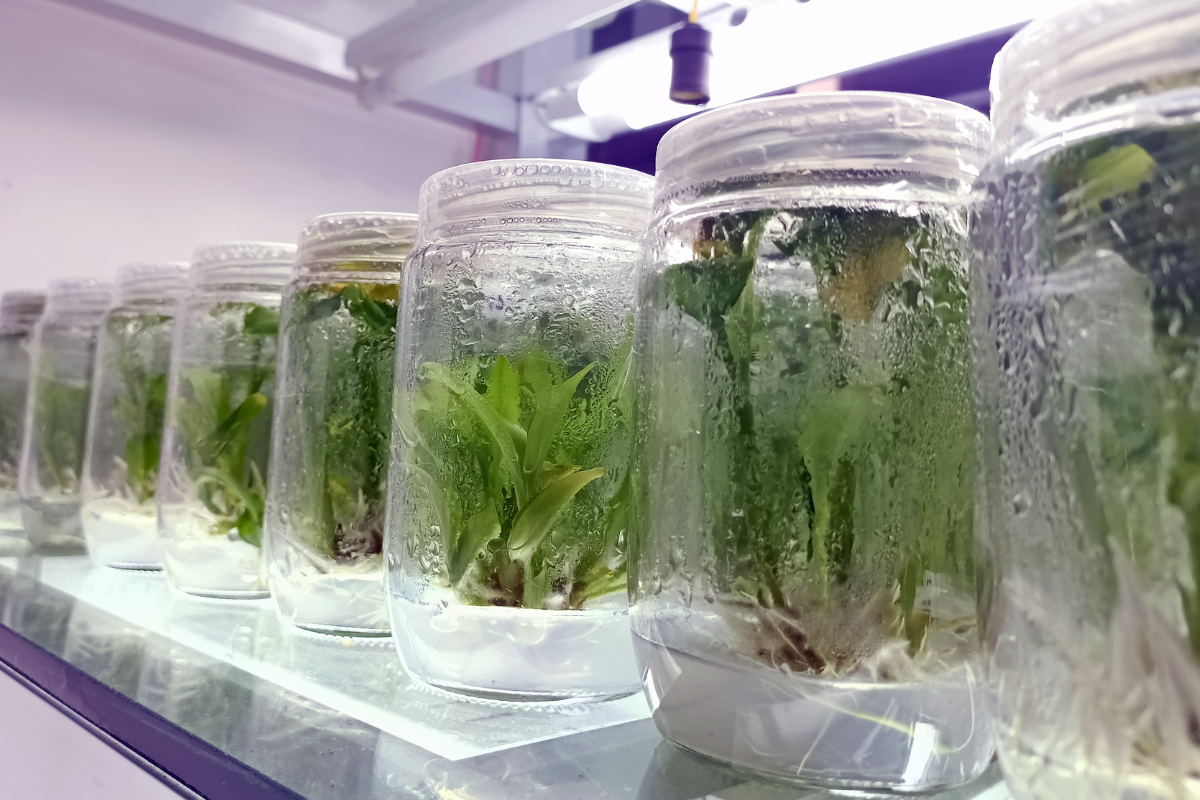
Plant tissue culture overview
Plant tissue culture has evolved from a pioneering laboratory technique to a modern plant biotechnology cornerstone. Rooted in the principle of cellular totipotency, it enables regeneration, propagation, and genetic improvement across a wide spectrum of plant species. Innovative tissue culture approaches are redefining agricultural practices in the context of global challenges such as food insecurity, biodiversity loss, and climate change. This review critically examines recent advances including bioreactor-based systems, synthetic seed technology, cryopreservation, nanotechnology, and genome editing as well as their integration into agricultural production systems. Applications in disease-free propagation, crop improvement, conservation, and secondary metabolite production are detailed, alongside challenges such as somaclonal variation, contamination, scalability, and regulatory barriers. The synthesis underscores the importance of tissue culture as a bridge between biotechnology and sustainable agricultural production, offering solutions for global food security and resilience in the face of environmental change.
What is plant tissue culture?
Plant tissue culture, first conceptualised in the early 20th century and later operationalised through the development of nutrient media such as Murashige & Skoog, has become indispensable in plant research and commercial agriculture. The technology exploits the inherent totipotency of plant cells, enabling regeneration of entire plants from small explants under controlled in vitro conditions. Traditional applications such as micropropagation, somatic embryogenesis, and callus induction have facilitated the production of uniform, disease-free planting material across diverse crops (Valdiani et al., 2019; Verdú-Navarro et al., 2023). In the current era of agricultural intensification and sustainability concerns, however, classical approaches are being augmented with novel methodologies that expand their utility and efficiency. This review explores these emerging innovations and situates plant tissue culture at the nexus of biotechnology and sustainable agriculture.
Classical plant tissue culture techniques
Micropropagation
Micropropagation encompasses initiation, multiplication, rooting, and acclimatisation stages, allowing clonal propagation of elite germplasm with high genetic fidelity (Thorpe, 2007; Rout & Mohapatra, 2021).
Callus culture and organogenesis
Using high auxin or balanced auxin/cytokinin ratios, callus induction is followed by organogenesis to regenerate shoots or roots (Rout & Mohapatra, 2021).
Somatic embryogenesis
Somatic embryogenesis produces bipolar embryo-like structures from somatic cells and underlies synthetic seed technologies and large-scale propagation (Thorpe, 2007; Rout & Mohapatra, 2021).
Haploid and doubled haploid production
Anther and microspore culture methods yield haploid plants, which can be doubled to generate homozygous lines more rapidly than via conventional breeding (Rout & Mohapatra, 2021).
Innovative techniques and approaches
Bioreactor systems
Bioreactor-based propagation systems, especially Temporary Immersion Bioreactors (TIBs), have been shown to improve nutrient delivery, gas exchange, and biomass accumulation while reducing hyperhydricity and labour costs (Mishra, Rajan & Damodaran, 2024; Verdú-Navarro et al., 2023). For example, the Hy-TIB system enabled propagation of cacao and yam plantlets using elevated CO₂, eliminating the need for sugar in some media formulations (PCTOC, 2022) (Author(s), 2022).
Synthetic seed technology
Synthetic seeds, created by encapsulating somatic embryos, shoot tips or nodal segments in gel matrices, offer storage, transport, and direct planting capabilities (Abbas, Mahood & Alhasan, 2022). Applications include short-term conservation of Juglans regia via synthetic seed technology (Sota et al., 2023), and synthetic seed propagation of therapeutic Leptospermum species (Darby et al., 2022).
Cryopreservation and germplasm storage
Cryopreservation allows long-term preservation of genetic resources without risk of somaclonal drift. Embryogenic tissues and somatic embryos of woody species are increasingly being stored successfully (Ballesteros et al., 2024; Titova, Popova & Nosov, 2024).
Nanotechnology applications
Nanoparticles (NPs) are used to improve sterilisation, enhance callus induction and organogenesis, and increase secondary metabolite production. However, issues of NP toxicity require careful study (Balamurugan et al., 2024; “Transforming plant tissue culture with nanoparticles”, 2024; Iqbal et al., 2024).
Genome Editing and Molecular Approaches
Integration of CRISPR/Cas genome editing with tissue culture is accelerating trait improvement by enabling precise mutagenesis and transgene insertion. Tissue culture remains essential in regenerating edited plants for downstream evaluation (Jaganathan et al., 2018; Rout & Mohapatra, 2021).
Omics and Artificial Intelligence (AI) integration
Genomic, transcriptomic and metabolomic profiling are increasingly used to understand molecular dynamics during tissue culture, to improve media formulations, and to reduce empirical optimisation. Machine learning tools are being adopted to predict regeneration outcomes, improve nutrient and PGR formulations (authors, ongoing studies).
Applications in modern agriculture
- Disease-Free Propagation: Tissue culture methods are widely used to produce virus- and pathogen-free material for vegetatively propagated crops such as banana, potato and citrus (Rout & Mohapatra, 2021; Valdiani et al., 2019).
- Clonal Multiplication of Elite Varieties: Bioreactor-accelerated propagation (e.g. using TIBs) allows mass proliferation of elite horticultural and plantation crops (Mishra et al., 2024).
- Crop Improvement: Doubled haploids, mutation induction, and CRISPR editing reduce breeding cycles (Rout & Mohapatra, 2021; Jaganathan et al., 2018).
- Secondary Metabolite Production: Cell culture and hairy root systems in bioreactors yield bioactive compounds at higher concentrations, as demonstrated for Thapsia garganica in TIBs (Corral et al., 2018).
- Conservation of Plant Biodiversity: Cryopreservation and synthetic seeds secure rare and endangered species and landraces for future use (Ballesteros et al., 2024; Sota et al., 2023).
- Climate Resilience: Rapid propagation of stress-tolerant genotypes and development of engineered plants through gene editing aim toward varieties resilient to drought, heat, and salinity (recent gene editing and molecular studies).
Challenges and Limitations
Somaclonal Variation
Prolonged culture and repeated subculturing often lead to genetic/epigenetic instability, which may reduce true-to-type propagation. Molecular markers are increasingly used to detect variation early (Rout & Mohapatra, 2021).
Contamination risks
Microbial contamination remains a major constraint. Nanoparticles offer promise in explant sterilisation, but their effects (both beneficial and toxic) are dosage-, species-, and particle-type dependent (Balamurugan et al., 2024).
Cost and scalability
Even with bioreactors, scaling up remains expensive. Operations require infrastructure, skilled labour, and optimal control of environmental parameters; design improvements (e.g. in headspace, illumination, root handling) are needed (Mishra et al., 2024).
Regulatory and certification barriers
Germplasm exchange, large-scale propagation, and genome-edited plants are subject to phytosanitary laws, biosafety regulations, certification schemes, and intellectual property constraints (Rout & Mohapatra, 2021; Jaganathan et al., 2018).
Regulatory and ethical considerations
Plant tissue culture intersects with phytosanitary law, intellectual property rights, and biosafety regulation. International movement of tissue-cultured plants requires phytosanitary certification and compliance with National Plant Protection Organisations (NPPOs). For genome edited plants, biosafety committee approvals and regulatory clearances are obligatory. Ethical considerations include germplasm sovereignty, benefit sharing, and equitable access.
Future Perspectives
- Scalable Bioreactor Systems: From lab-scale vessels to industrial bioreactors (single-use systems, modular designs), with improved illumination, gas exchange, and ergonomic design (Verdú-Navarro et al., 2023; Titova et al., 2024).
- AI-Driven Optimization: Predictive modelling of media composition, PGR doses, culture environment to accelerate protocol development (emerging research).
- Integration with Controlled Environment Agriculture: Linking tissue culture with vertical farming, hydroponics/aeroponics, for precise propagation and transplanting workflows.
- Plant-Based Biofactories: Using tissue culture systems for production of recombinant proteins, vaccines, and specialized metabolites at industrial scales (Corral et al., 2018; Verdú-Navarro et al., 2023).
Conclusion
Plant tissue culture has matured into a multifaceted technology with far-reaching applications in agriculture, conservation, and biotechnology. Novel innovations—including synthetic seeds, cryopreservation, nanotechnology, and genome editing—extend its relevance beyond propagation, positioning it as a keystone of sustainable agricultural development. By bridging classical methods with advanced technologies, tissue culture holds transformative potential to address pressing global challenges in food security, biodiversity preservation, and climate resilience.
References
- Abbas, M. K., Mahood, H. E. & Alhasan, A. S. (2022) Production of synthetic seeds in vegetable crops: A review, IOP Conf. Ser.: Earth Environ. Sci., 1060(1), 012099.
- Ballesteros, D. et al. (2024) ‘Current status of the cryopreservation of embryogenic material of woody species’, Frontiers in Plant Science, 14, 1337152.
- Balamurugan, V., Abdi, G., Karthiksaran, C., Thillaigovindhan, N. & Arulbalachandran, D. (2024) ‘A review: improvement of plant tissue culture applications by using nanoparticles’, Journal of Nanoparticle Research, 26, 188.
- Corral, P., Lorrain-Lorrette, B., Martinez-Swatson, K., Michoux, F. & Simonsen, H. T. (2018) ‘Use of a temporary immersion bioreactor system for the sustainable production of thapsigargin in shoot cultures of Thapsia garganica’, Plant Methods, 14, 79.
- Darby, I. D., Wiegand, A., Bai, S. H., Wallace, H. M. & Trueman, S. J. (2022) ‘Synthetic seed propagation of the therapeutic-honey plants Leptospermum polygalifolium and L. scoparium (Myrtaceae)’, Australian Journal of Botany, 70(6), 447-454.
- Iqbal, M. et al. (2024) ‘Nano-Integrated Plant Tissue Culture to Increase the Rate of Callus Induction, Growth, and Curcuminoid Production in Curcuma longa’, Plants, 13(13), 1819.
- Mishra, M., Rajan, S. & Damodaran, T. (2024) ‘New paradigm shifts in micropropagation of fruit crops through bioreactors - a review’, Indian Journal of Horticulture, 81(1).
- Rout, G. R. & Mohapatra, A. (2021) ‘Tissue culture and its applications in crop improvement: A critical review’, Plant Cell, Tissue & Organ Culture, 146, 507-527.
- Sota, V., Benelli, C., Myrselaj, M., Kongjika, E. & Gruda, N. S. (2023) ‘Short-term conservation of Juglans regia L. via synthetic seed technology’, Horticulturae, 9(5), 559.
- Titova, M., Popova, E. & Nosov, A. (2024) ‘Bioreactor Systems for Plant Cell Cultivation at the Institute of Plant Physiology of the Russian Academy of Sciences: 50 Years of Technology Evolution from Laboratory to Industrial Implications’, Plants, 13(3), 430.
- Transforming plant tissue culture with nanoparticles: a review of current applications (2024) Plant Nano Biology, 10, 100102.
- Verdú-Navarro, F., Moreno-Cid, J. A., Weiss, J. & Egea-Cortines, M. (2023) ‘The advent of plant cells in bioreactors’, Frontiers in Plant Science, 14, 1310405.