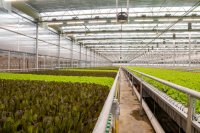
A growing number of cattle ranchers are looking beyond traditional grain-based finishing strategies, and hydroponic barley fodder has emerged as one of the more promising alternatives. Between June and October 2023, a comparative feeding trial at Sandstone Ranch in Colorado put this approach to the test, tracking four beef steers across two distinct diets over 145 days. Two steers received hydroponic barley fodder with grass hay, while the other two received a conventional grain finisher mix with grass hay. The results offer a practical look at how these strategies compare on cost, growth performance, and revenue potential.
This article summarizes the trial's design, key findings, and financial implications. For a detailed breakdown of feed costs and per-steer revenue calculations, see Feed costs and financial performance: hydroponic fodder vs. grain-fed beef. For operational guidance on setting up a hydroponic fodder system, see Setting up a hydroponic fodder system for cattle finishing.
How the trial was structured
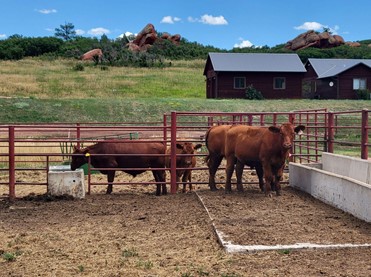
The trial was conducted at Sandstone Ranch, located roughly 16 miles south of the FarmBox Foods campus in Sedalia, Colorado, where the hydroponic fodder was produced. Four steers were divided into two groups of two: the fodder-fed group (steers #6 and K6) and the grain-fed group (steers #8 and #14). All four animals had ad libitum access to grass hay round bales, fresh water, and salt and mineral blocks throughout the study. The hay consumption rate was consistent across both groups, averaging approximately 38 lbs per steer per day over the 145-day period.
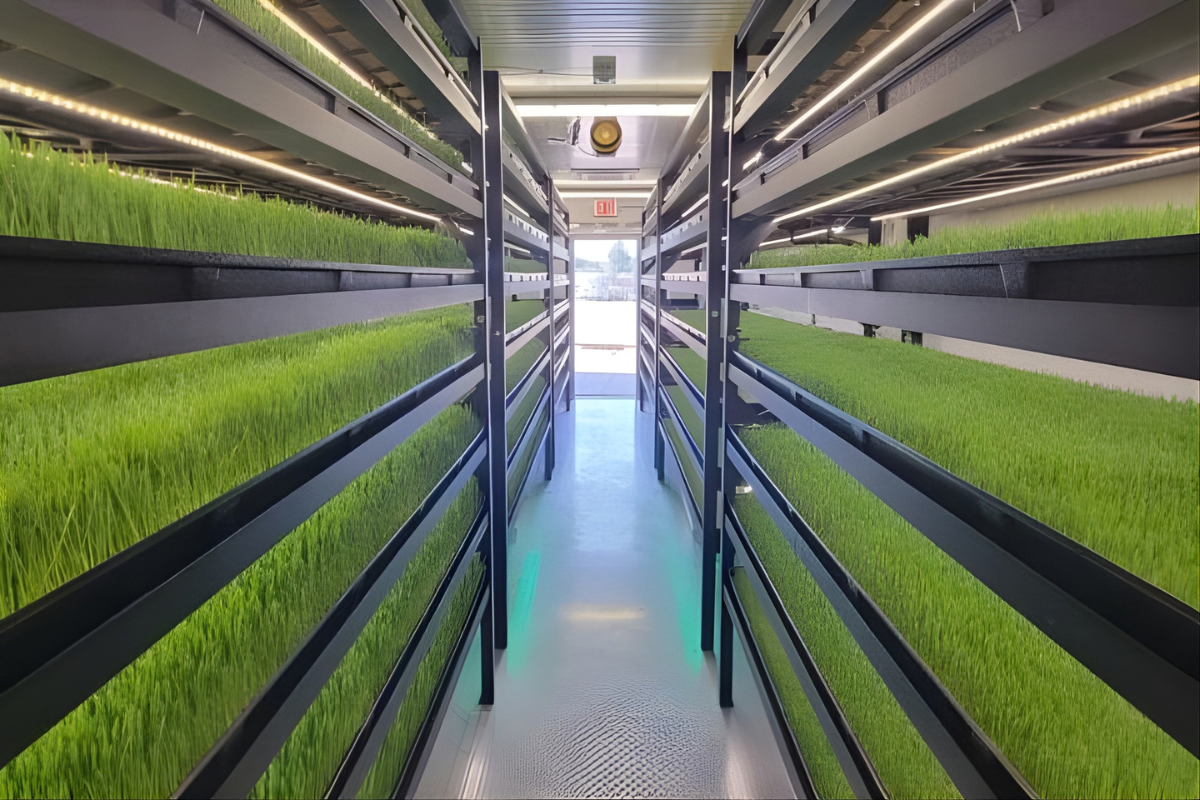
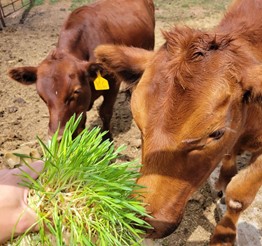
The hydroponic fodder was produced from barley grain using a container-based system on the FarmBox Foods campus. Each day, 130 lbs of barley seed entered a 7-day growth cycle and yielded approximately 850 lbs of fresh fodder at harvest. The fodder was picked up and delivered to the ranch three times per week, with rations averaging 33 to 35 lbs per steer per feeding. This exceeded the typical 3% of body weight inclusion rate; the intention was to test whether steers could be finished on hydroponic fodder without traditional concentrates, a departure from standard finishing protocols.
The grain-fed group received a custom finisher mix produced by Forty Mile Feed in Kiowa, Colorado. The mix included cracked corn, oats, legumes, and concentrated pellets, fed at approximately 3% of body weight.
Steers were weighed on the 5th, 15th, and 25th of each month to track growth curves and calculate Daily Weight Gain (DWG). One weighing anomaly occurred on June 25th when a water tank malfunction led to two separate measurements (dry and rehydrated), and the September 25th weigh-in was skipped for operational reasons. Neither event compromised the overall integrity of the data.
It is worth noting several limitations. The sample size of four steers is not statistically representative, and the off-site fodder production introduced logistical variability in feed delivery. The fodder-fed K6 steer was a Red Angus, a smaller breed than the Limousin steers in the grain-fed group, which influenced final weights. Despite these constraints, the trial provides a realistic case study of what ranchers can expect when integrating hydroponic fodder into a finishing program.
Growth performance
The grain-fed steers outperformed the fodder-fed steers in weight gain across the board. Steer #8 posted the highest DWG at 3.61 lbs per day, followed by #14 at 2.89 lbs per day. In the fodder-fed group, steer #6 averaged 2.08 lbs per day while K6 (Red Angus) came in at 1.94 lbs per day.
On average, the grain-fed steers gained 3.25 lbs per day compared to 2.01 lbs per day for the fodder-fed steers, a difference of roughly 62% in favor of grain. Final weights reflected this gap: the grain-fed steers finished at 1,330 and 1,245 lbs, while the fodder-fed steers finished at 1,180 and 1,085 lbs.
For context, the ranch also maintained 12 steers on open-range pasture during the same period. Those grazing steers averaged a DWG of 2.13 lbs, which places the fodder-fed performance roughly on par with traditional grass-fed finishing. This comparison matters for ranchers evaluating the economic case for fodder-based systems, since it positions hydroponic fodder as a functional equivalent to pasture in terms of growth rate, but with far less land required.
 plotting all four steers.jpg)
Weight trajectories for all four trial steers (June to October 2023). Grain-fed steers #8 (yellow) and #14 (green) diverge sharply from fodder-fed steers #6 (blue) and K6 (red) by mid-trial. The grazing baseline (grey) tracks close to the fodder-fed group.
Feed cost comparison
The cost difference between the two strategies was substantial. Hydroponic fodder cost $0.05 per lb to produce (covering barley seed, water, electricity, and operating expenses, but excluding labor). The grain finisher mix cost $0.26 per lb when purchased in bulk. Grass hay, at $0.125 per lb, was a constant across both groups.
The average daily diet cost for the fodder-fed group was $8.74 per steer, compared to $13.24 per steer for the grain-fed group. Over the full 145-day trial, each fodder-fed steer cost $1,267 to feed, while each grain-fed steer cost $1,920. That represents a 34% reduction in feed expenses for the hydroponic approach.
When processing costs (averaging $650 per steer) are factored in, total costs came to $1,917 per fodder-fed steer and $2,570 per grain-fed steer.
Revenue and the grass-fed premium
The financial picture shifts further when market value enters the equation. Based on USDA Choice grade pricing and Midwest retail averages for 2023, the study calculated revenues from both primal and sub-primal cuts using standard carcass yield assumptions: 63% of live weight retained after slaughter, with boneless yield at 60% of the carcass.
Without any grass-fed premium applied, the average per-steer revenue was $1,388 for fodder-fed steers and $1,187 for grain-fed steers. In other words, even before accounting for the grass-fed label, the fodder strategy generated 14.4% more revenue per steer because the lower feed costs more than offset the lighter carcass weights.
The more significant financial advantage comes from the grass-fed designation. Beef finished on hydroponic fodder, grass hay, and minerals qualifies as grass-fed, which commands a retail premium. The study applied a conservative $3 per lb addition on primal cuts (retailers frequently charge $3 to $4 more), producing an average grass-fed revenue of $2,152 per fodder-fed steer. That is roughly 45% more than the $1,187 per steer generated by grain finishing, assuming the producer holds grass-fed certifications.
Both groups were unofficially graded as USDA Choice. Official grading confirmation from the processing facility was still pending at the time the study was published.
What this means for ranchers
The trade-off at the center of this trial is straightforward: grain finishing produces heavier, faster-growing steers, but hydroponic fodder finishing costs significantly less and opens access to the grass-fed market premium. The financial modeling shows that the cost savings alone tip the balance in favor of fodder, and the grass-fed revenue opportunity widens the gap considerably.
Beyond cost, hydroponic fodder offers advantages in resource efficiency. The FarmBox Foods system used an average of 550 gallons of water per day and produced 155 tonnes of fodder annually, equivalent to the output of roughly 30 acres of traditional forage. The company describes this as a 99% reduction in both water and land use compared to conventional forage production, though those figures apply specifically to its container-based system and should be evaluated against each ranch's local conditions.
The study's authors emphasize that the trial focused specifically on diet composition and cost. Broader conclusions about animal health, environmental impact, or consumer preference require further research. Future trials with larger sample sizes, on-site fodder production (eliminating the logistical challenges of off-site delivery), and formal carcass grading would strengthen the evidence base for ranchers considering this approach.
For producers weighing their finishing strategy, the core takeaway is that hydroponic barley fodder is a financially viable alternative to grain. It does not match grain on growth rate, but the combination of lower feed costs, comparable meat quality, and access to grass-fed pricing creates a compelling economic case, particularly for operations where land and water are limited or where grass-fed certification is already in place.
References
- Gonzalez, J. (2023). Feeding the Future: A Comparative Analysis of Traditional Grain-Fed and Hydroponic Fodder-Fed Strategies for Finishing Beef Steers. FarmBox Foods.
- Campbell, J. A. (2022). Understanding Beef Carcass Yields and Losses During Processing. Penn State Extension.
- U.S. Bureau of Labor Statistics. (2023). Average Retail Food and Energy Prices, U.S. and Midwest Region.
- USDA Agricultural Marketing Service. (2023). National Monthly Grass Fed Beef Report.
- USDA. (2023). What is "grass fed" meat?. Ask USDA.