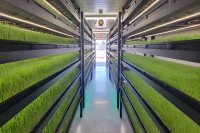
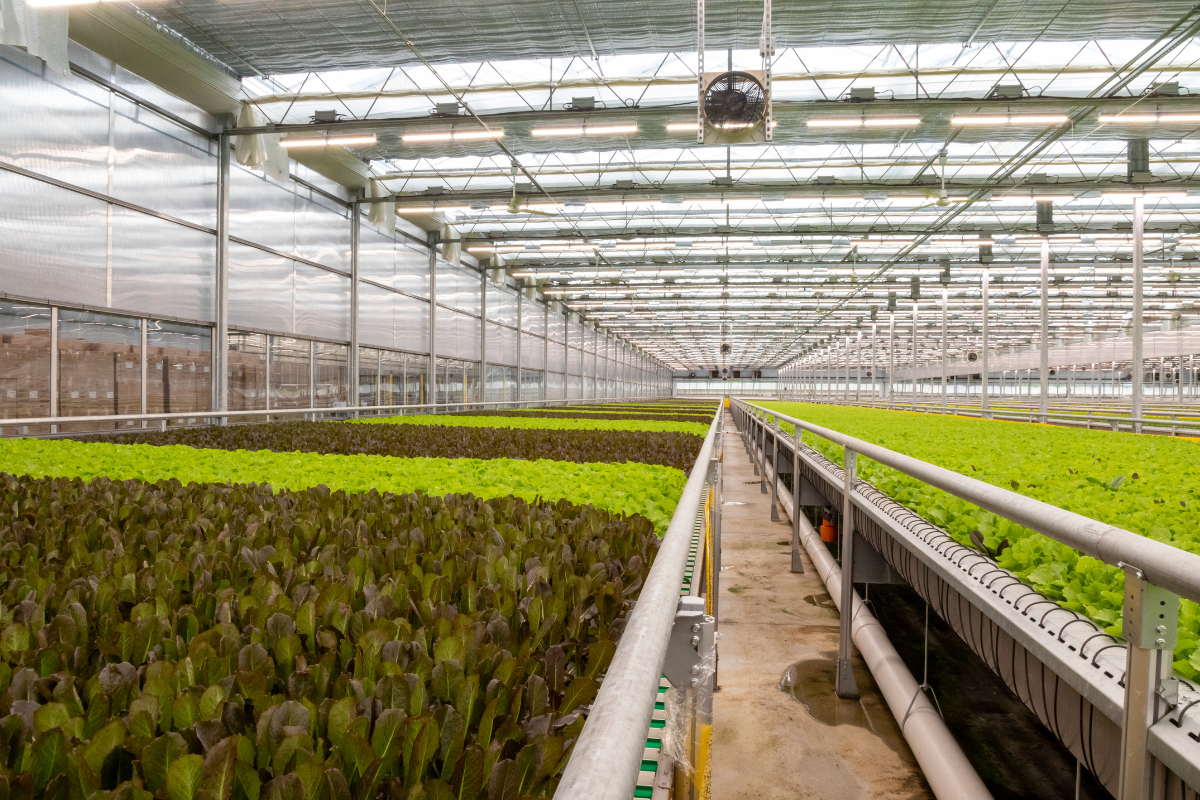
Feed typically represents the single largest operating expense in any cattle finishing operation. In a 145-day trial at Sandstone Ranch in Colorado (June to October 2023), two feeding strategies were compared side by side: hydroponic barley fodder with grass hay, and a conventional grain finisher mix with grass hay. The trial tracked four beef steers, two per group, and generated detailed cost and revenue data for each animal. This article breaks down those numbers.
Feed inputs and their costs
Three feeds were used across the trial: hydroponic barley fodder, a grain finisher mix, and grass hay. Their per-pound costs set the foundation for everything that follows.
The hydroponic fodder was produced at the FarmBox Foods campus in Sedalia, Colorado. The $0.05 per lb cost covers barley seed, electricity (27 kWh per day), water (550 gallons per day), and other operating expenses. It does not include labor, which required approximately 3 hours daily for harvesting, seeding, and pre-germination. The grain finisher mix, sourced from Forty Mile Feed in Kiowa, Colorado, was a custom blend of cracked corn, oats, legumes, and concentrated pellets. Its retail price was $0.34 per lb, reduced to $0.26 per lb when purchased in bulk. The bulk price was used for all calculations in this study. Grass hay round bales, averaging 1,100 lbs each, cost $250 per ton, or $0.125 per lb.
.jpg)
The Forty Mile Feed finisher mix: cracked corn, oats, legumes, and concentrated pellets. At $0.26/lb in bulk, this was more than five times the per-pound cost of hydroponic fodder.
|
Feed |
Cost per lb |
|
Hydroponic barley fodder |
$0.05 |
|
Grain finisher mix (bulk) |
$0.26 |
|
Grass hay |
$0.125 |
Both groups consumed hay at the same rate throughout the trial, so hay cost functions as a constant. Over 145 days, the four steers went through approximately 20 round bales, which translates to roughly 38 lbs of hay per steer per day.
Daily diet costs over time
Because rations were calculated at approximately 3% of body weight and adjusted as the steers grew, daily feed costs increased over the course of the trial for both groups.
For the fodder-fed group, the total daily cost per steer (fodder plus hay) started at $7.59 on June 1st and rose to $10.23 by October 25th. The average across the full trial was $8.74 per steer per day. On the fodder side specifically, the theoretical 3% inclusion rate would have meant roughly 29 lbs of fodder per steer per day, but the actual ration was higher at approximately 78 lbs per steer per day. This was intentional: the study aimed to test whether steers could be finished on fodder alone, without concentrates.
For the grain-fed group, the total daily cost per steer (grain plus hay, using the bulk grain price) started at $10.44 on June 1st and rose to $16.47 by October 25th. The average was $13.24 per steer per day. Grain inclusion averaged 31 lbs per steer per day, with hay consumption averaging 41 lbs per steer per day.
The gap between the two strategies widened as the steers gained weight, since the grain mix costs more than five times as much per pound as the fodder. By the final month, the grain-fed group's daily diet cost was 61% higher than the fodder-fed group's.
.png)
Daily diet cost per steer, June through October 2023. The fodder-fed line (blue) stays relatively flat while the grain-fed line (red) climbs steadily as body weight increases.
Total feeding costs
Over the full 145-day period, total feeding costs per steer were:
|
Metric |
#6 (Fodder) |
K6 (Fodder) |
#8 (Grain) |
#14 (Grain) |
|
Total gain (lb) |
302.00 |
281.00 |
524.00 |
419.00 |
|
Time period (days) |
145 |
145 |
145 |
145 |
|
DWG |
2.08 |
1.94 |
3.61 |
2.89 |
|
Feed cost per day (avg) |
$8.74 |
$8.74 |
$13.24 |
$13.24 |
|
Cost per lb gained |
$4.20 |
$4.51 |
$3.66 |
$4.58 |
|
Total feeding cost |
$1,267.30 |
$1,267.30 |
$1,919.80 |
$1,919.80 |
|
Processing cost (avg) |
$650.00 |
$650.00 |
$650.00 |
$650.00 |
|
Total cost with processing |
$1,917.30 |
$1,917.30 |
$2,569.80 |
$2,569.80 |
|
Finished weight (lb) |
1,180.00 |
1,085.00 |
1,330.00 |
1,245.00 |
|
Process cut (63%) |
743.4 |
683.6 |
837.9 |
784.4 |
|
Yield carcass (bone-in 72%) |
535.2 |
492.2 |
603.3 |
564.7 |
|
Yield carcass (boneless 60%) |
446.0 |
410.1 |
502.7 |
470.6 |
|
Retail sales primal cuts (76%) |
$2,952.34 |
$2,714.65 |
$3,327.64 |
$3,114.97 |
|
Retail sales sub-primal cuts (24%) |
$490.90 |
$451.38 |
$553.30 |
$517.94 |
|
Income extra (primal cuts, grass-fed) |
$765.00 |
$765.00 |
$0.00 |
$0.00 |
|
Revenue per steer |
$1,526.06 |
$1,248.85 |
$1,311.14 |
$1,063.11 |
|
Revenue per steer (grass-fed) |
$2,290.94 |
$2,013.73 |
– |
– |
The fodder-fed strategy was 34% cheaper on feed alone. Including processing, total costs were $652.50 less per fodder-fed steer. For a producer finishing 50 head, that difference would represent over $32,000 in savings on the feeding side alone.
It is also worth examining the cost per pound of weight gained, which accounts for the different growth rates. Steer #6 (fodder) cost $4.20 per lb gained, K6 (fodder, Red Angus) cost $4.51, steer #8 (grain) cost $3.66, and #14 (grain) cost $4.58. Grain-fed steer #8 was the most feed-efficient animal in the trial, but the group averages were closer than the daily cost figures might suggest: $4.36 per lb gained for fodder versus $4.12 for grain. The grain-fed advantage in feed conversion did not fully offset its higher absolute cost.
Carcass yields and cut values
Converting live weight into retail revenue requires several processing steps, each with its own yield percentage. The study used industry-standard assumptions drawn from Penn State Extension research on beef carcass composition.
After slaughter, approximately 63% of live weight is retained as carcass. From the carcass, bone-in cuts yield about 72%, while boneless cuts yield approximately 60%. The study used the boneless yield for its revenue calculations. Primal cuts (chuck, round, loin, and rib) account for roughly 76% of the carcass value, with sub-primal cuts making up the remaining 24%.

Standard beef carcass breakdown. Primal cuts (chuck, rib, loin, round) command the highest retail prices and account for most of the revenue in the financial model. Image: Penn State Extension.
Using 2023 Midwest retail prices for USDA Choice grade beef, the weighted average price for primal cuts was $8.71 per lb. For grass-fed beef, that average rises to $11.71 per lb.
|
Steer |
Finished weight |
Boneless yield |
Primal cut revenue |
Sub-primal cut revenue |
|
#6 (fodder) |
1,180 lbs |
446.0 lbs |
$2,952.34 |
$490.90 |
|
K6 (fodder) |
1,085 lbs |
410.1 lbs |
$2,714.65 |
$451.38 |
|
#8 (grain) |
1,330 lbs |
502.7 lbs |
$3,327.64 |
$553.30 |
|
#14 (grain) |
1,245 lbs |
470.6 lbs |
$3,114.97 |
$517.94 |
On raw retail sales alone, the grain-fed steers generated more revenue per head because of their heavier carcass weights. But revenue is only one side of the equation.
Net revenue per steer
When total costs are subtracted from total sales, the picture changes. The following table shows net revenue per steer under two scenarios: standard pricing and grass-fed pricing.
|
#6 (Fodder) |
K6 (Fodder) |
#8 (Grain) |
#14 (Grain) |
|
|
Net revenue per steer (standard) |
$1,526.06 |
$1,248.85 |
$1,311.14 |
$1,063.11 |
|
Net revenue per steer (grass-fed) |
$2,290.94 |
$2,013.73 |
n/a |
n/a |
At standard pricing, the average fodder-fed steer returned $1,387 versus $1,187 for grain-fed, a 14.4% advantage. The lower feed costs more than compensated for the lighter carcasses.
The grass-fed scenario amplifies this further. Applying a conservative $3 per lb premium on primal cuts (excluding ground beef, using only the higher-value portions of the carcass), the average fodder-fed steer returned $2,152. That represents a 45% increase over the grain-fed average of $1,187, assuming the producer holds grass-fed certifications. Retailers often charge $3 to $4 above conventional pricing for grass-fed cuts, so the $3 figure used here sits at the lower end of the range.
What the numbers do and do not tell us
The financial case for hydroponic fodder finishing is strong on the metrics measured in this trial. Feed costs are substantially lower, and access to the grass-fed market premium creates an additional revenue stream that grain finishing cannot match.
Several factors should be weighed alongside these results. The fodder cost of $0.05 per lb excludes labor, which at 3 hours per day represents a real operational expense that will vary by location and wage rates. The grain price of $0.26 per lb reflects bulk purchasing; smaller operations paying retail ($0.34 per lb) would see an even wider cost gap favoring fodder. The trial's sample of four steers is small, and the breed difference (Red Angus vs. Limousin) in the fodder group affected individual results. Both groups were unofficially graded USDA Choice, but formal grading was pending at the time of the study's publication.
The study did not evaluate long-term cattle nutrition outcomes, animal health markers, or consumer taste preferences between the two approaches. These remain open questions for future research. For producers running their own cost-benefit analysis, the per-pound feed costs and daily diet figures presented here provide a concrete starting point, adjusted to local input prices and herd size.
Appendix: daily diet cost tables
Hydroponic barley fodder diet
|
Date |
Avg weight (lbs) |
3% inclusion (theoretical) |
Cost (theoretical)/day |
Real inclusion (lbs) |
Hay (lbs/day) |
Total cost/day |
|
Jun 1 |
841 |
25.23 |
$1.26 |
67.78 |
33.64 |
$7.59 |
|
Jun 5 |
871 |
26.13 |
$1.31 |
70.20 |
34.84 |
$7.86 |
|
Jun 15 |
886 |
26.58 |
$1.33 |
71.40 |
35.44 |
$8.00 |
|
Jun 25 |
855 |
25.65 |
$1.28 |
68.91 |
34.20 |
$7.72 |
|
Jul 5 |
914 |
27.42 |
$1.37 |
73.66 |
36.56 |
$8.25 |
|
Jul 15 |
922 |
27.66 |
$1.38 |
74.31 |
36.88 |
$8.33 |
|
Jul 25 |
938 |
28.14 |
$1.41 |
75.60 |
37.52 |
$8.47 |
|
Aug 5 |
942 |
28.26 |
$1.41 |
75.92 |
37.68 |
$8.51 |
|
Aug 15 |
959 |
28.77 |
$1.44 |
77.29 |
38.36 |
$8.66 |
|
Aug 25 |
992 |
29.76 |
$1.49 |
79.95 |
39.68 |
$8.96 |
|
Sep 5 |
1,030 |
30.90 |
$1.55 |
83.01 |
41.20 |
$9.30 |
|
Sep 15 |
1,062.5 |
31.88 |
$1.59 |
85.63 |
42.50 |
$9.59 |
|
Oct 5 |
1,062.5 |
31.88 |
$1.59 |
85.63 |
42.50 |
$9.59 |
|
Oct 15 |
1,110 |
33.30 |
$1.67 |
89.46 |
44.40 |
$10.02 |
|
Oct 25 |
1,132.5 |
33.98 |
$1.70 |
91.27 |
45.30 |
$10.23 |
|
Avg (DWG 2.01) |
29.04 |
$1.45 |
78.00 |
38.71 |
$8.74 |
Grain finisher mix diet
|
Date |
Avg weight (lbs) |
3% inclusion (lbs) |
Cost/day (retail) |
Cost/day (bulk) |
Hay (lbs/day) |
Total cost/day (bulk) |
|
Jun 1 |
816 |
24.48 |
$8.32 |
$6.36 |
32.64 |
$10.44 |
|
Jun 5 |
846 |
25.38 |
$8.62 |
$6.59 |
33.84 |
$10.82 |
|
Jun 15 |
940 |
28.20 |
$9.58 |
$7.33 |
37.60 |
$12.03 |
|
Jun 25 |
896 |
26.88 |
$9.13 |
$6.98 |
35.84 |
$11.46 |
|
Jul 5 |
934 |
28.02 |
$9.52 |
$7.28 |
37.36 |
$11.95 |
|
Jul 15 |
943 |
28.29 |
$9.61 |
$7.35 |
37.72 |
$12.06 |
|
Jul 25 |
989 |
29.67 |
$10.08 |
$7.71 |
39.56 |
$12.65 |
|
Aug 5 |
975 |
29.25 |
$9.94 |
$7.60 |
39.00 |
$12.47 |
|
Aug 15 |
1,040 |
31.20 |
$10.60 |
$8.11 |
41.60 |
$13.31 |
|
Aug 25 |
1,095 |
32.85 |
$11.16 |
$8.53 |
43.80 |
$14.01 |
|
Sep 5 |
1,095 |
32.85 |
$11.16 |
$8.53 |
43.80 |
$14.01 |
|
Sep 15 |
1,152.5 |
34.58 |
$11.75 |
$8.98 |
46.10 |
$14.75 |
|
Oct 5 |
1,237.5 |
37.13 |
$12.62 |
$9.65 |
49.50 |
$15.83 |
|
Oct 15 |
1,280 |
38.40 |
$13.05 |
$9.98 |
51.20 |
$16.38 |
|
Oct 25 |
1,287.5 |
38.63 |
$13.12 |
$10.03 |
51.50 |
$16.47 |
|
Avg (DWG 3.25) |
31.05 |
$10.55 |
$8.07 |
41.40 |
$13.24 |
Retail grain at $0.34/lb; bulk grain at $0.26/lb. Total cost/day uses bulk pricing. Hay at $0.125/lb.
References
- Gonzalez, J. (2023). Feeding the Future: A Comparative Analysis of Traditional Grain-Fed and Hydroponic Fodder-Fed Strategies for Finishing Beef Steers. FarmBox Foods.
- Campbell, J. A. (2022). Understanding Beef Carcass Yields and Losses During Processing. Penn State Extension.
- U.S. Bureau of Labor Statistics. (2023). Average Retail Food and Energy Prices, U.S. and Midwest Region.
- USDA Agricultural Marketing Service. (2023). National Monthly Grass Fed Beef Report.