
At the end of 2025 Greece had 6.44 million sheep, against 7.77 million a year earlier, 17.2% fewer, according to the November-December livestock survey published by Eurostat. Across the EU the fall was 2.2%. Goat numbers fell 9.2%, against 2.5% in the EU, and cattle 12.8%, against 0.4%. By Wikifarmer's calculation, Greece lost more sheep in a single year than the net fall for the EU as a whole, while culls for sheep and goat pox explain about a quarter of the fall in sheep and goats.
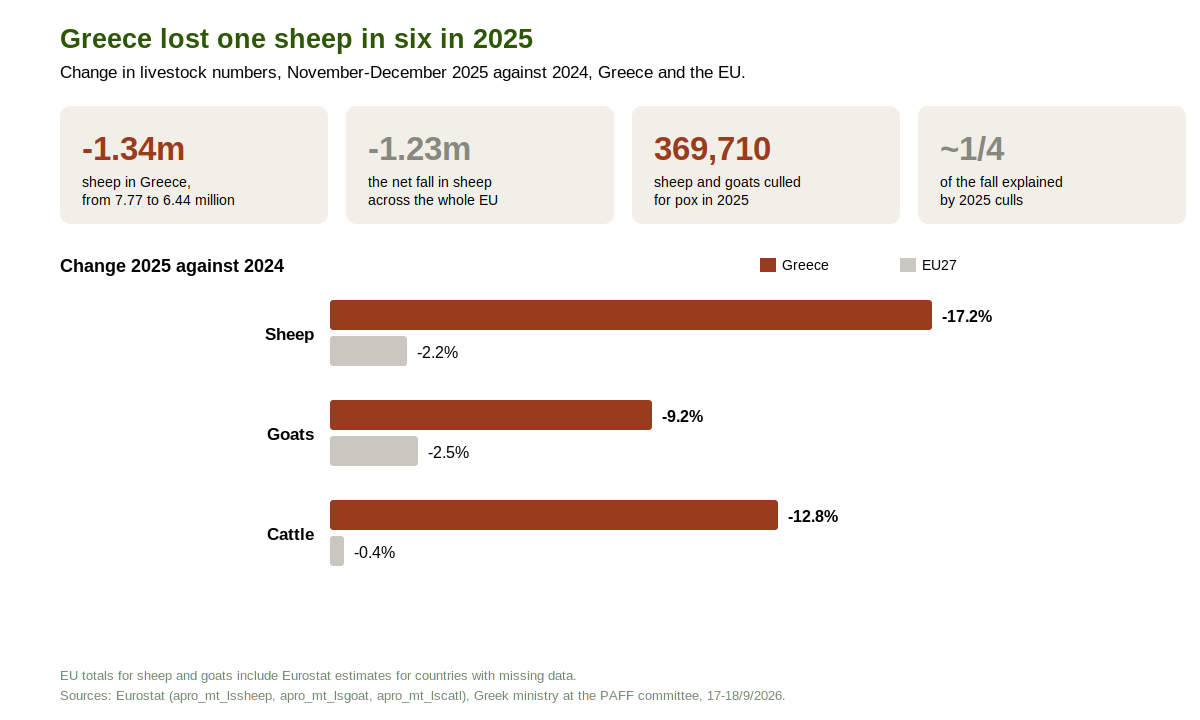
Change in livestock numbers in Greece and the EU between the November-December surveys of 2024 and 2025. Sources: Eurostat, Greek ministry at the PAFF committee.
| Animals | Greece 2024, thousand | Greece 2025, thousand | Change, Greece | Change, EU |
| Sheep | 7,774.2 | 6,439.2 | -17.2% | -2.2% |
| Goats | 2,576.8 | 2,340.6 | -9.2% | -2.5% |
| Cattle | 595.2 | 519.2 | -12.8% | -0.4% |
Source: Eurostat, tables apro_mt_lssheep, apro_mt_lsgoat and apro_mt_lscatl, November-December survey. EU changes from Eurostat's news release of 30 June 2026.
Greece lost more sheep than the whole EU
The net fall in sheep across the EU was about 1.23 million, from 56.52 million to 55.29 million, while Greece alone lost 1.34 million. That means the other EU countries, taken together, had slightly more sheep in 2025 than in 2024, about 108,000, and that the EU decline is essentially Greek. The EU total for sheep includes Eurostat estimates for countries with missing data, so the comparison has a margin, but the gap between Greece's -17.2% and the EU's -2.2% is far too wide to be explained by that.
The fall adds to a long decline across Europe. According to Eurostat's news release of 30 June 2026, the EU had 12.2% fewer sheep and 17.5% fewer goats in 2025 than in 2015.
Pox culls explain about a quarter of the fall
Greece's veterinary services told the EU Standing Committee on Plants, Animals, Food and Feed (PAFF) on 17 and 18 September that between August 2024 and 9 September 2026 there were 2,271 outbreaks of sheep and goat pox and 495,918 animals were culled.
| Period | Outbreaks | Animals culled |
| 2024 (from August) | 318 | 91,232 |
| 2025 | 1,703 | 369,710 |
| 2026, to 9 September | 250 | 34,976 |
| Total | 2,271 | 495,918 |
Source: Greek Ministry of Rural Development and Food, Directorate General of Veterinary Services, presentation to the PAFF committee, 17-18 September 2026.
Sheep and goats together fell by about 1.57 million in 2025, while 369,710 animals were culled during 2025, about 23.5% of the fall. The two periods do not match exactly, since the survey compares animals on a given day in November or December, but the order of magnitude is clear. Culls are part of the explanation, while most of the fall comes from other factors the data do not separate, such as slaughter, less restocking and holdings that closed. Cattle, which are not affected by pox, also fell by 12.8%.
Pox slowed in 2026 but has not stopped
New outbreaks fell sharply in 2026, to 250 by 9 September against 1,703 in the whole of 2025, but the disease is still appearing. Between 1 July and 9 September, 74 outbreaks were confirmed in 14 regional units, with Preveza and Aetolia-Acarnania accounting for 29 of them, while Kastoria, Arta and Argolida recorded their first outbreak. In the cases investigated, the veterinary services are looking at feed suppliers and milk collectors that had also visited other infected holdings as a possible route of transmission.
With help from an EU veterinary team, Greece has prepared a serological surveillance programme covering 1,377 holdings across the nine mainland regions, 153 in each, to be completed by 31 December 2026. The EU mission noted that new outbreaks are still being detected in distant areas despite the control measures, which may point to long-distance transmission or undetected circulation of the virus. According to the same ministry presentation, 166 farmers were not compensated, 80 of them for lack of biosecurity measures.
Greece's share of EU flocks is shrinking
In 2024 Greece had 13.8% of the EU's sheep, third after Spain and Romania, and 24.6% of its goats, the largest share in the EU, according to Eurostat. On the 2025 figures, Greece's share of EU sheep falls to 11.6%, by our calculation. For the country that makes feta and a large part of the EU's sheep and goat meat, a smaller flock bears directly on milk and meat supply in the years ahead, on top of the damage sheep pox and goat pox have done to Greek livestock farming.
Sources
- Eurostat. (2026). EU livestock numbers continued to shrink in 2025. 30 June 2026.
- Eurostat. (2026). Sheep population, apro_mt_lssheep. November-December survey.
- Eurostat. (2026). Goat population, apro_mt_lsgoat. November-December survey.
- Eurostat. (2026). Bovine population, apro_mt_lscatl. November-December survey.
- Eurostat. (2025). Agricultural production, livestock and meat, Statistics Explained. 2024 data.
- Greek Ministry of Rural Development and Food, Directorate General of Veterinary Services. (2026). Sheep and Goat Pox in Greece, presentation to the PAFF committee. 17-18 September 2026.
- European Commission. (2026). EU VET mission, sheep pox and goat pox in Greece. PAFF committee, 17-18 September 2026.