



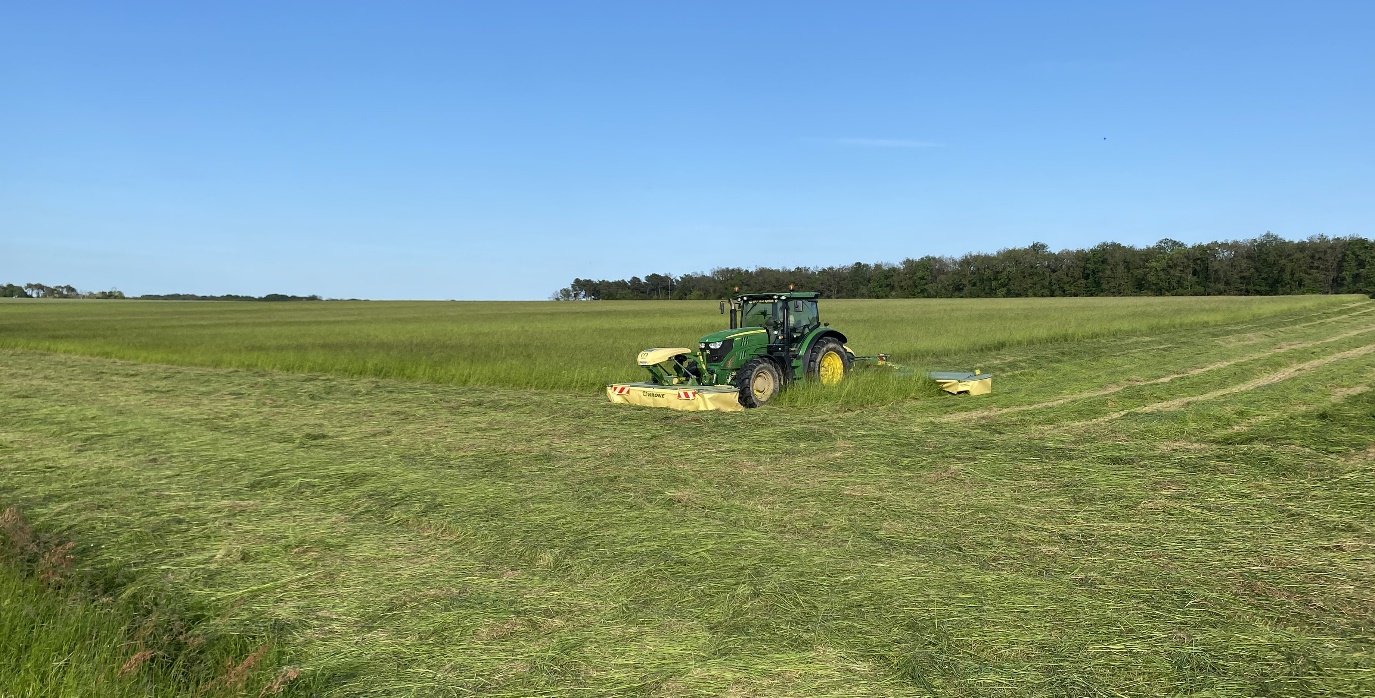
We have all known the moment. You check the forecast on Friday evening, six days of sun are promised, and you decide to cut on Saturday morning. For a few years now, though, something has changed. It is not the number of available windows that is the problem, but their reliability. Rain episodes arrive faster and harder, often at the wrong moment, and when things go wrong, part of the harvest is at risk.
At EARL du Parc, we produce hay on 300 ha of meadows in the Loire Valley. Our hay goes exclusively to professional equestrian operations, sport-horse studs, competition stables, and training centres, clients for whom forage quality is not negotiable. We produce premium grass hay as well as natural-meadow hay. Over the past few years, climate variability has become the single most decisive factor in our season.
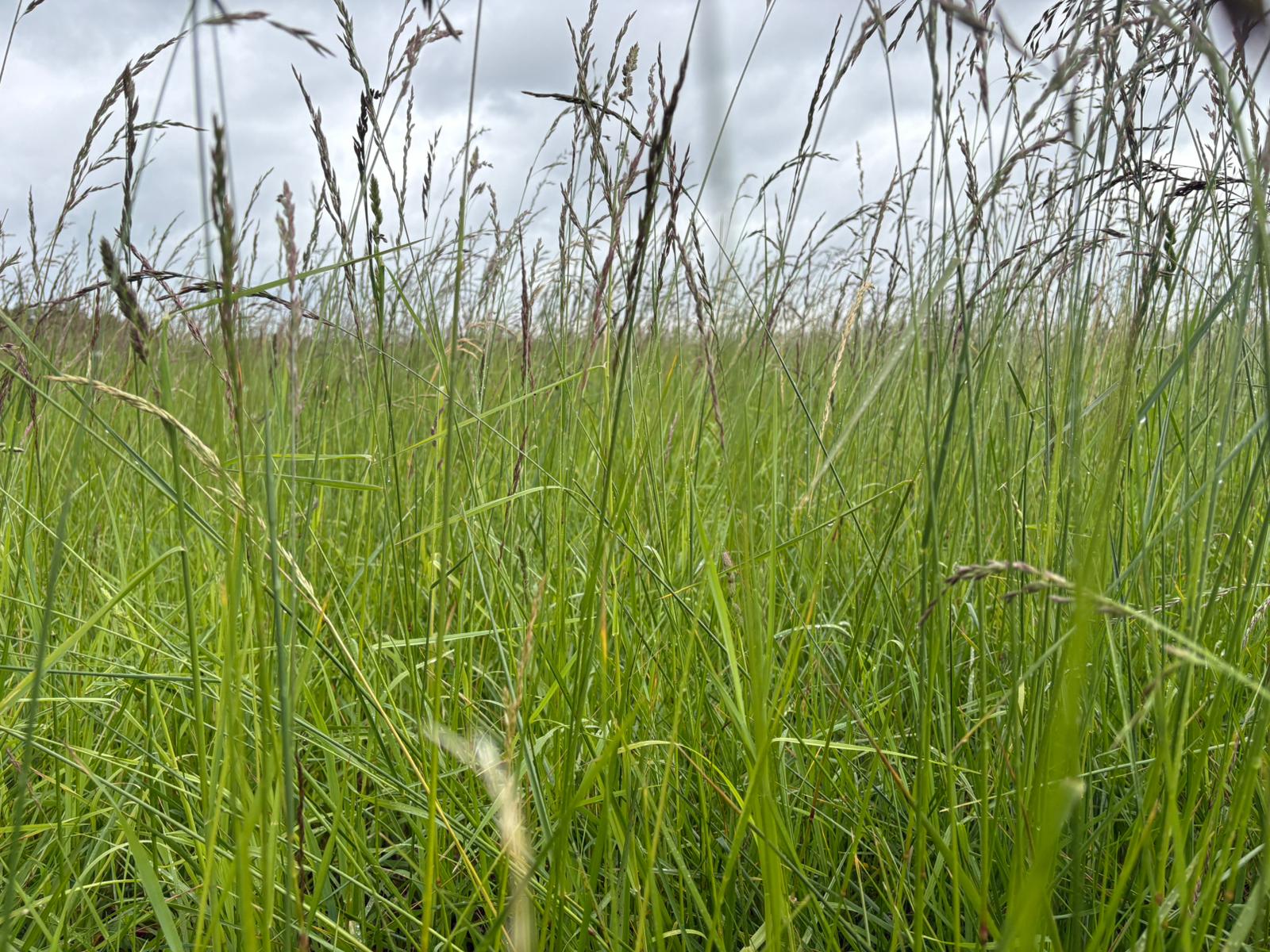
Hay meadows at EARL du Parc in the Loire Valley
Weather that is harder to read
The scientific data do not necessarily show that the six-to-eight-day high-pressure spells are disappearing in France. What has changed is the reliability of those windows and the intensity of the episodes that interrupt them. There is more alternation between long dry runs and violent storm episodes. Heavy rain can arrive in mid-drying, on hay that was coming along well, and ruin everything in a few hours. The feeling that you never get a quiet week any more is especially common among producers in central France. It is not a myth, even if it does not exactly match what the raw weather data say.
On top of this comes a phenomenon that is less often discussed. Early heat does not ripen all species at the same rate. In a mixed sward, cocksfoot is already well into heading when timothy is not yet ready, with fescue and ryegrass somewhere in between. This gap has always existed, but higher spring temperatures amplify it, and the window in which the whole sward is at an acceptable stage narrows sharply. In the final bale it can show as brown stems of over-ripe cocksfoot next to still-green timothy.
Here in Touraine, we have seen for several years an alternation between early warm spells in February and March, which trigger growth, and cold returns in late March or early April, which stress the plants at the wrong moment. The result is grass that shoots up quickly but with less volume than expected, and pressure to cut early, before some grasses pass the heading stage and before a favourable weather window closes again.
Seasons that are never alike
The most striking thing is the disparity from one year to the next. Looking at the last three seasons, the difference is obvious.
2023 was almost perfect. Long, stable windows, rain well placed before cutting that had built up the volumes without causing moisture problems at baling. Solid yields and consistent quality. Probably an exception.
2024 was the most difficult season we have known. Never more than five consecutive days of decent weather, and those short windows came with high ambient humidity that stopped the hay from drying properly. You could bale at 15% moisture in late afternoon and find bales at 18 or 20% the next morning, the insufficiently dry hay taking the moisture back out of the air overnight. Above 15%, we cannot deliver to our premium clients. In June and July, major floods submerged several plots, which simply could not be cut, having become too dirty and dusty. Between the short windows, the humidity, and the flooding, 2024 was a season where, even doing everything right, we struggled to hold our optimal quality level.
2025 offered better general conditions, but its own surprises. Uncertain weather in May pushed us to take calculated risks on cutting dates. On several lots, we baled in conditions that looked viable by all our indicators, and we ended up with bales that rose in temperature after storage, a sign that residual moisture had triggered biological activity inside the bale. We had to bring them back out to air them, unplanned work, costly in time and handling, on bales we had considered finished.
2026 started very early in May, earlier than ever, because the high temperatures had accelerated heading, and because we now know that stable windows can close without warning. With very strong heat during the cutting period, drying was fast, but managing that speed without yellowing the grass was another challenge.
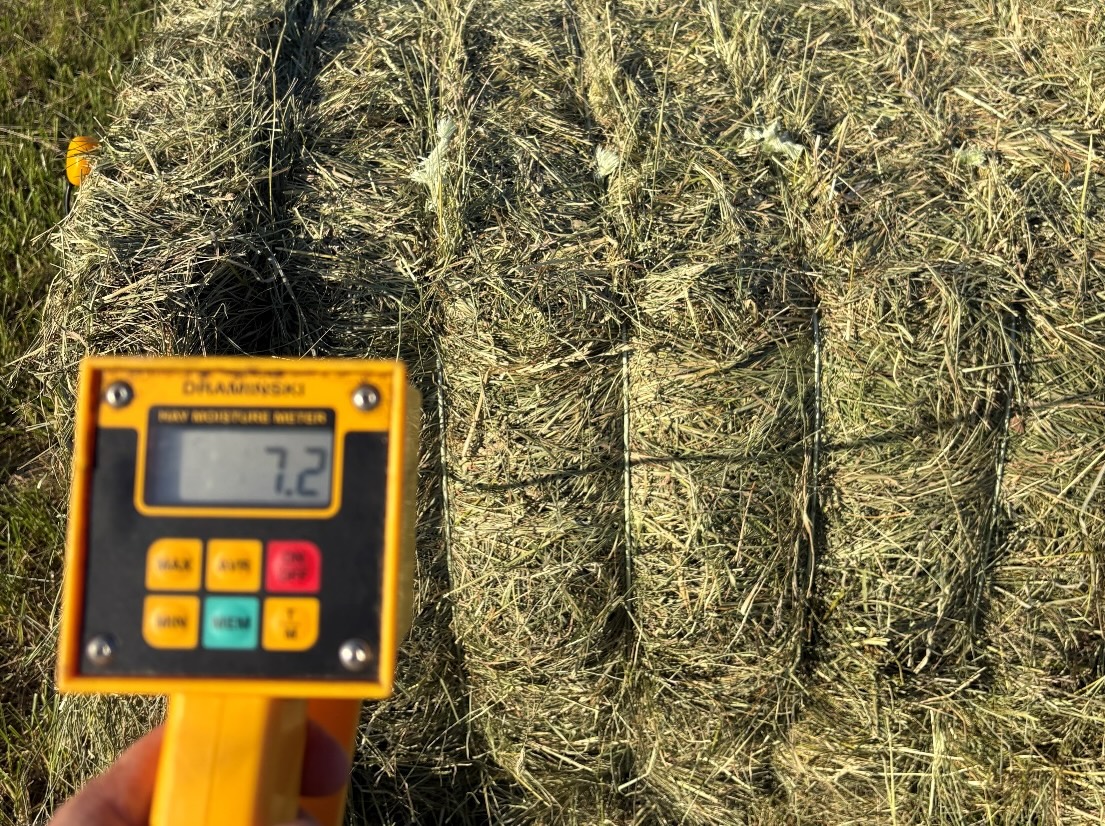
Checking hay moisture with the handheld Draminski tester
What happens inside a bale that is too wet
Hay baled with too much residual moisture is not only a question of nutritional quality, it is potentially dangerous. Moisture triggers microbial activity that produces heat inside the bale. Below 55 to 60°C, this phase is concerning but manageable, these are the bales that "breathe out their fire" in the 48 hours after baling. Above 60°C, you enter a zone of serious risk to quality, with mycotoxin production and rapid nutrient degradation. Above 70°C, the risk of spontaneous combustion is no longer theoretical, and a barn can literally burn.
For a sport horse, and well short of that point, heat-damaged hay carries direct risks. Fungal spores, dust, and mycotoxins are incompatible with the sanitary quality our clients demand. So we invested in a temperature-monitoring system using fixed probes, Haytech by Quanturi. Each lot is monitored in real time and sends mobile alerts, which makes it possible to act in time.
This field data is complemented by an annual forage analysis carried out by the Irish Equine Centre, in Kildare, a laboratory specialising in forage for sport horses. Last season's results, a digestible energy of 8.3 MJ/kg, a dry matter of 85.9%, and an iron content of 32 mg/kg, are of direct interest to sport-horse owners, who are particularly sensitive to excess iron. These analyses are our transparency tool. They allow a factual conversation with each client about what they are buying, and they guarantee a high, documented quality, season after season.
Colour or moisture
A premium hay buyer looks at colour. A good green bale signals hay gathered quickly, not over-exposed to the sun after cutting and well preserved. A pale or yellowish bale suggests excessive tedding or too long a stay in the field. Both are legitimate quality indicators, but they pull in opposite directions when you manage drying.
Less tedding gives more green colour and less certainty about moisture. More tedding gives less moisture risk and less colour. Our job is to reconcile the two, without sacrificing one for the other. In practice, that means fewer teddings but better placed, more patience, and sometimes more risk-taking on the weather window, cutting a little earlier when conditions are good rather than waiting for the perfect day that never comes.
Our approach is one tedding immediately after cutting, then ideally one or two more at most, only if conditions genuinely allow. It needs night-time humidity below 60%, days of full sun at 26 to 28°C, and if possible wind. Wind is greatly underestimated in discussions of hay drying. A steady wind at 20 km/h does a lot of drying work.
On the other hand, if a few drops fall on hay that is drying, that lot is immediately downgraded. It will not go to horses. The risk of dust and fungal spores developing is not compatible with our equine clients. It is not a question of degree, it is a red line.
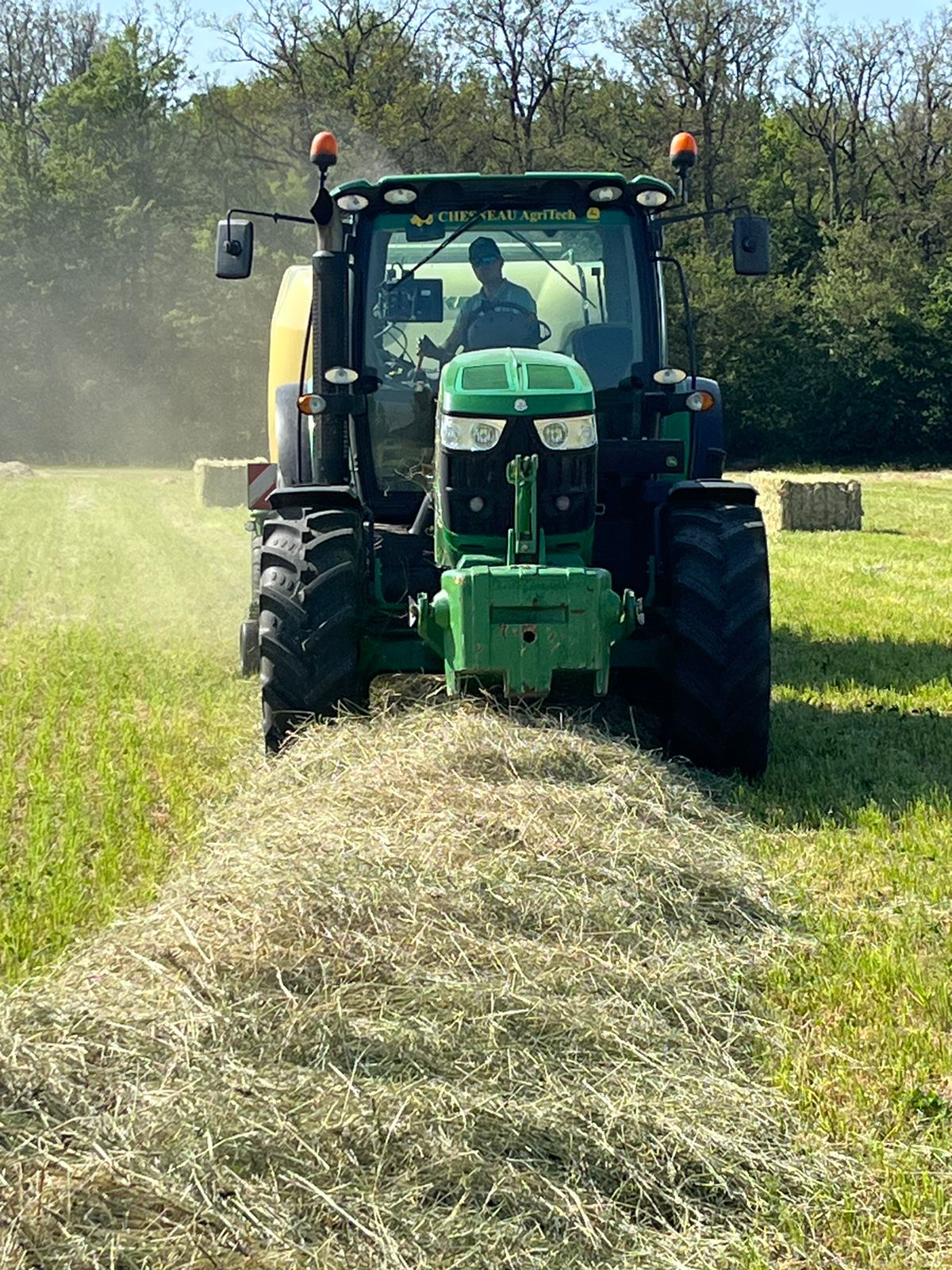
Tractor and telehandler collecting hay bales in the field
Working wider to win on the window
Faced with more unpredictable windows, speed of execution has become a prerequisite. We have gradually adapted our equipment accordingly. The Krone mower-conditioners can cover large areas in a single day. Multiple rakes do the same for tedding and windrowing. The aim is simple, when the window opens, we have to be able to work as many plots as possible.
We also work with a CUMA, a farm-machinery cooperative, for the annual mulching in late autumn. Each November or December, a six-metre-wide mulcher passes over all our plots to shred the regrowth built up since the June cut. This material breaks down over winter and returns nitrogen to the soil. But the benefit we value most is the consistency at drying. The following season, each plot starts from a uniform base, with no old July grass mixed in with young April growth. Drying rates are even and quality is more consistent from one bale to the next.
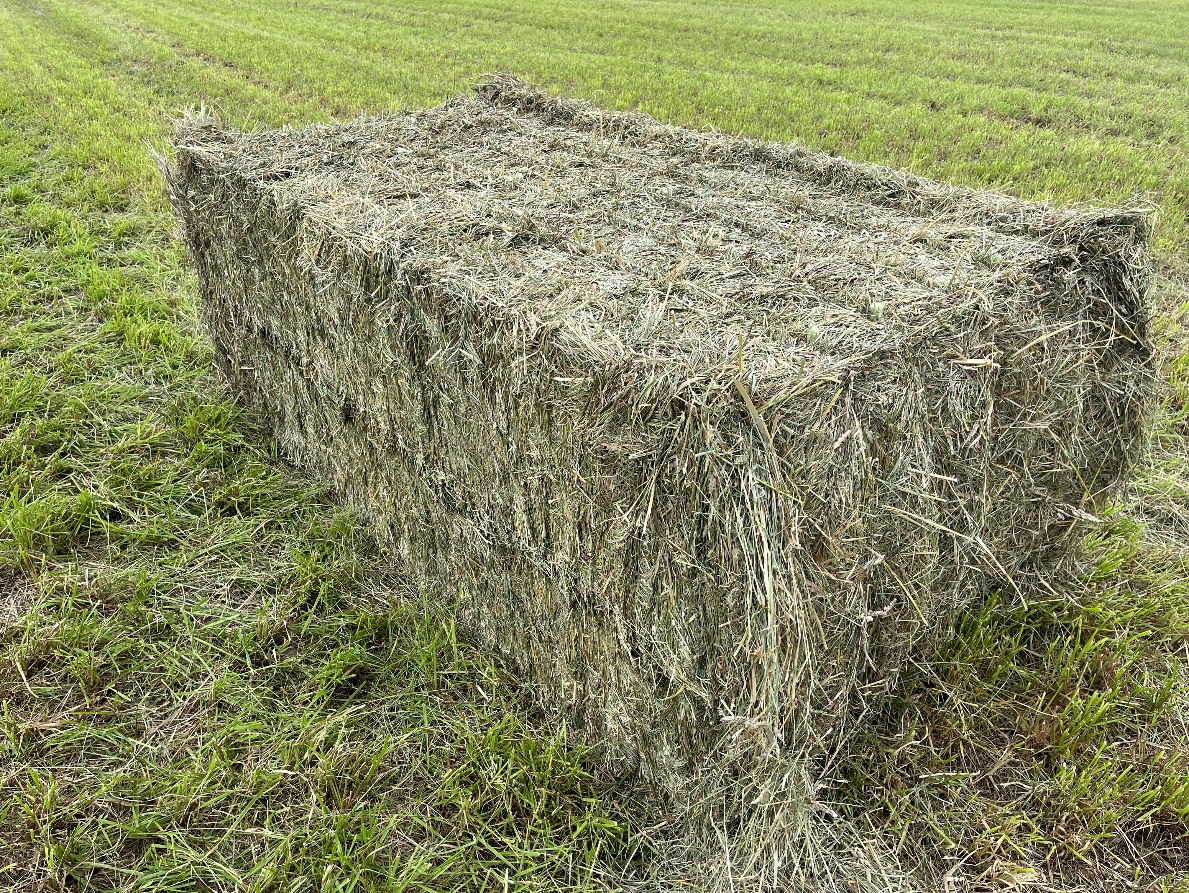
Hay ball Foin du Parc
Knowing when the hay is ready
The baler's moisture sensor and the handheld Draminski tester are both indispensable. But haymaking at a high level involves a reading that no instrument truly replaces.
To decide when to windrow, you look at the colour, you listen to the crack when you twist a handful of stems, and you smell it. Hay that has dried well is crisp without breaking. Hay that holds moisture at its core shows it at the nodes. This is learned over the years.
We move the windrows a few hours before baling to let the underside, the part that has stayed in contact with soil moisture, dry in the sun before the baler passes. We aim to bale from 1 or 2 pm so the surface moisture has had time to leave. If the first bales exceed 12%, we wait. We never bail late in the evening or at night, and we monitor regularly as moisture rises from the soil at the end of the day.
After baling, the 48 hours that count
Baling is not the end of the story. A freshly baled bale continues to balance its moisture internally; the heat rises while biological processes work on the plant material. In good seasons, we leave the bales grouped in the field for 48 hours after baling so they "breathe out their fire" before going into the barn. Bales brought in too fast can trap that heat inside and rise in moisture.
In 2025, some plots did not allow us that delay. We brought them straight in, and we paid for it with temperature rises. We had to bring the bales back out. That is the kind of consequence that comes from working in compressed windows, with no margin for error.
What a good window looks like today
Based on everything we have learned, the minimum window to produce good hay below 15% moisture without sacrificing colour looks like this, seven to ten consecutive days of sun with temperatures above 26°C, night-time humidity that drops, and ideally wind.
Day 1, cutting, with tedding straight after. Days 2 to 4, drying, one or two teddings depending on conditions. Day 5 or 6, windrowing, depending on whether the hay seems ready. Baling from day 6, starting in early afternoon.
This window is increasingly rare. When it does not come, the work is to compress the steps without compromising on the basic rules, and to be transparent with clients when the product reflects a difficult season.
This is our reality as a premium hay producer in the Loire Valley. These meadows remain among the best in France for sport-horse forage. But getting the most from them takes major investment in equipment, an ability to adapt very fast, and a level of weather vigilance this trade did not always demand twenty years ago. And then, you always need a little luck.
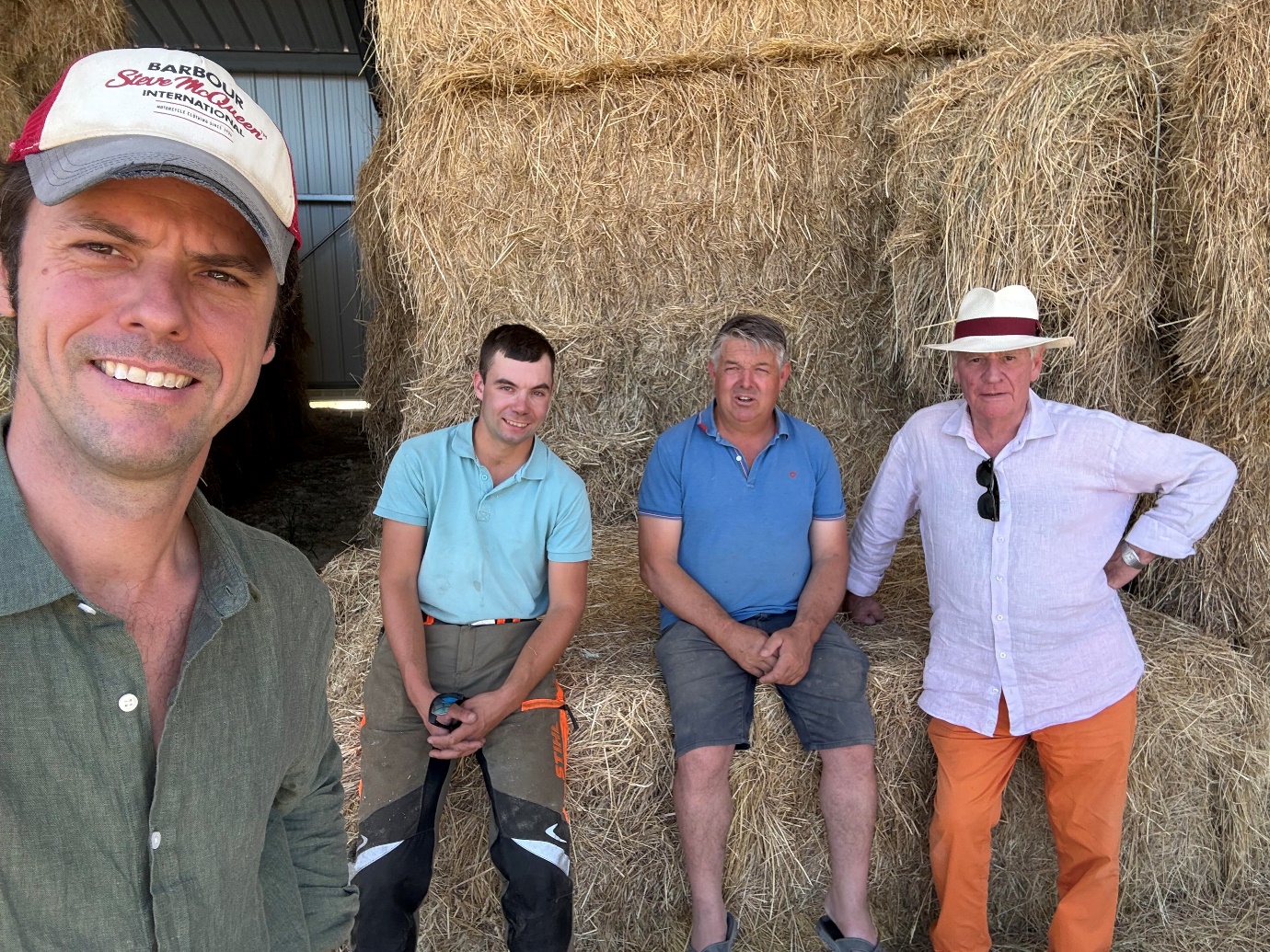
Quentin de Louvencourt runs EARL du Parc de Montpoupon, at Céré-la-Ronde (Indre-et-Loire), and produces more than 1,000 tonnes of premium hay a year for professional studs and equestrian centres in France and Europe.