



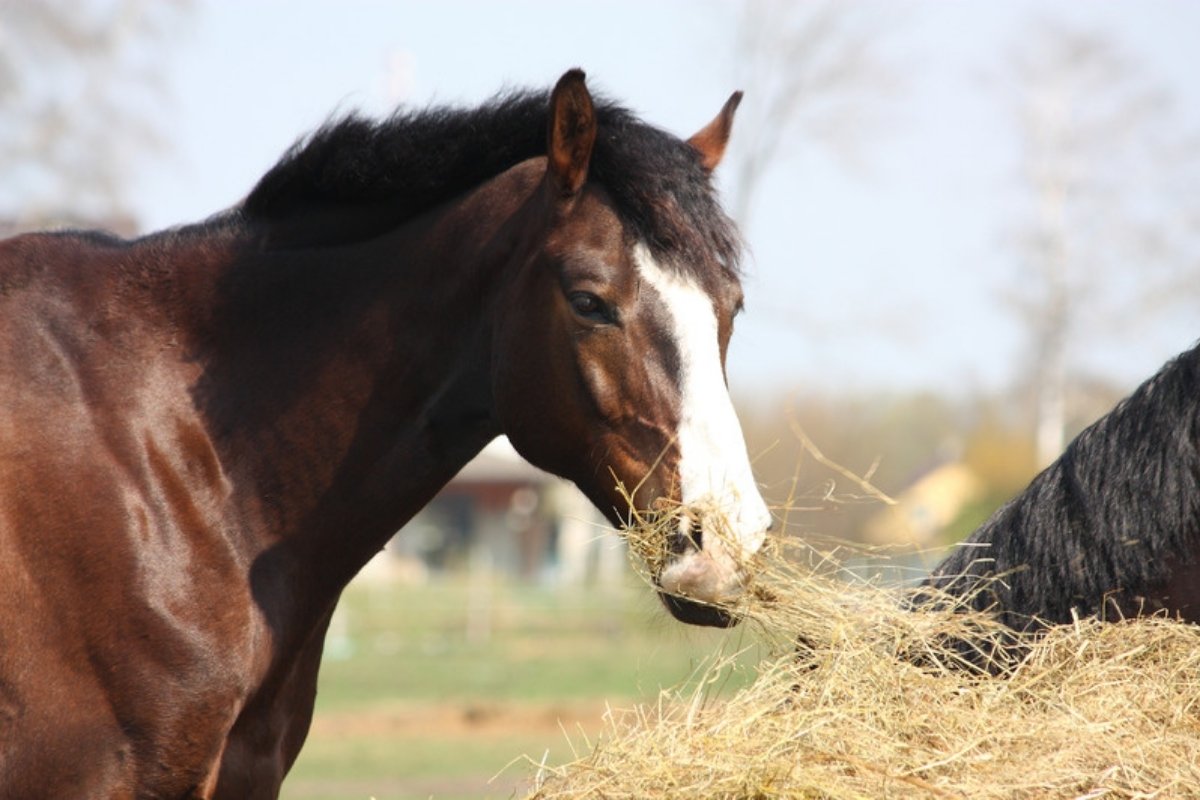
The manager of a stud farm once told me: "Every truckload I get is a different hay, I never know what I'm going to find." Another complained of hay that was "always pale and unappetising", which his horses ate only when they were very hungry. A third regularly received dusty bales, and a fourth often found brambles or dirt in his loads.
None of this is unusual. As far as I know, these are the most common problems that buyers of hay for sport horses run into, and most of them could have been avoided with a few simple checks. Here is how to look at hay beyond its surface.
What makes good hay for a sport horse?
Before inspecting, you need to know what you are looking for. Quality grass hay for sport horses has several characteristics you can see, smell and feel.
Smell: good hay smells of clean, dry grass, and the nose is rarely wrong. A mouldy, damp-earth or ammonia smell is an immediate warning sign.
Colour: well-made, well-dried hay keeps a green tint, a sign that the plant was cut at the right stage, dried in good conditions and kept out of the rain. Hay that is too pale or yellow has either been bleached by the sun through excessive turning, or caught rain while drying. Either way, part of its nutrients has been lost.
Stems and leaves: look for long, fine stems with plenty of leaf. The leaf holds most of the protein and digestible sugars, and hay that has lost its leaves, because it was baled too dry or handled roughly, loses part of its feed value.
Cutting stage: hay cut at heading, before full flowering, is more digestible and richer in energy than hay cut late. Seed heads that have already opened, or very hard, woody stems, point to a late cut.
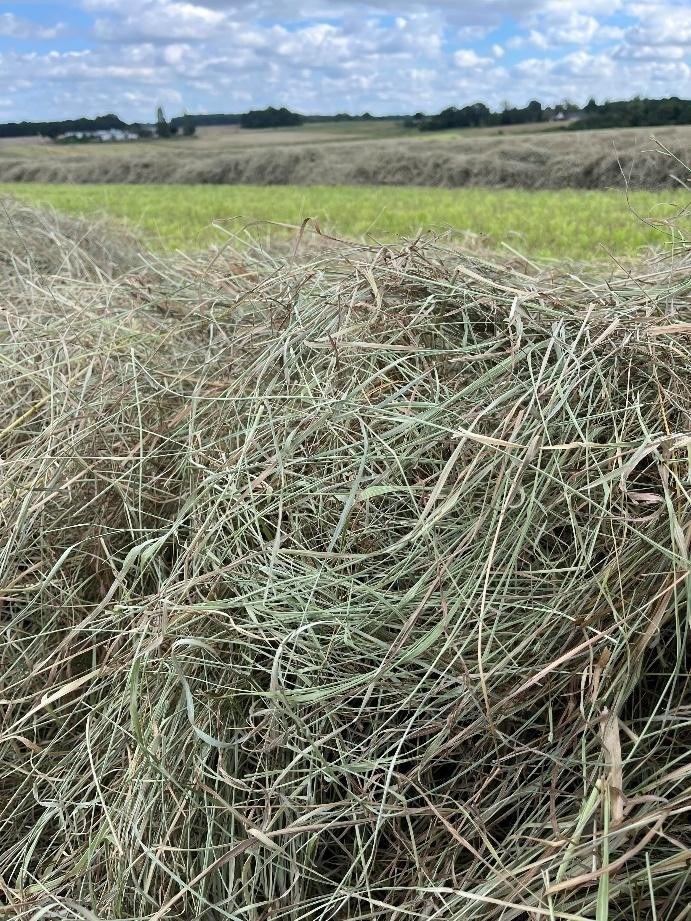
Well-dried hay keeps its green colour and its leaves. Photo: EARL du Parc de Montpoupon
How can you spot dusty hay?
Dust in hay is a major problem for the respiratory health of sport horses. Dusty hay carries fungal spores that irritate the airways, and this is often where chronic coughs begin.
The main cause is the moisture content at baling. Hay baled too damp develops moulds that are invisible to the eye but very much present. On our farm we aim to bale at 8 to 12% moisture. We test the first bales with a probe moisture meter as they leave the baler, and we stop if a reading goes above 12%. The goal is to stay below 15% once the hay has stabilised, since hay can take back a few points of moisture after baling.
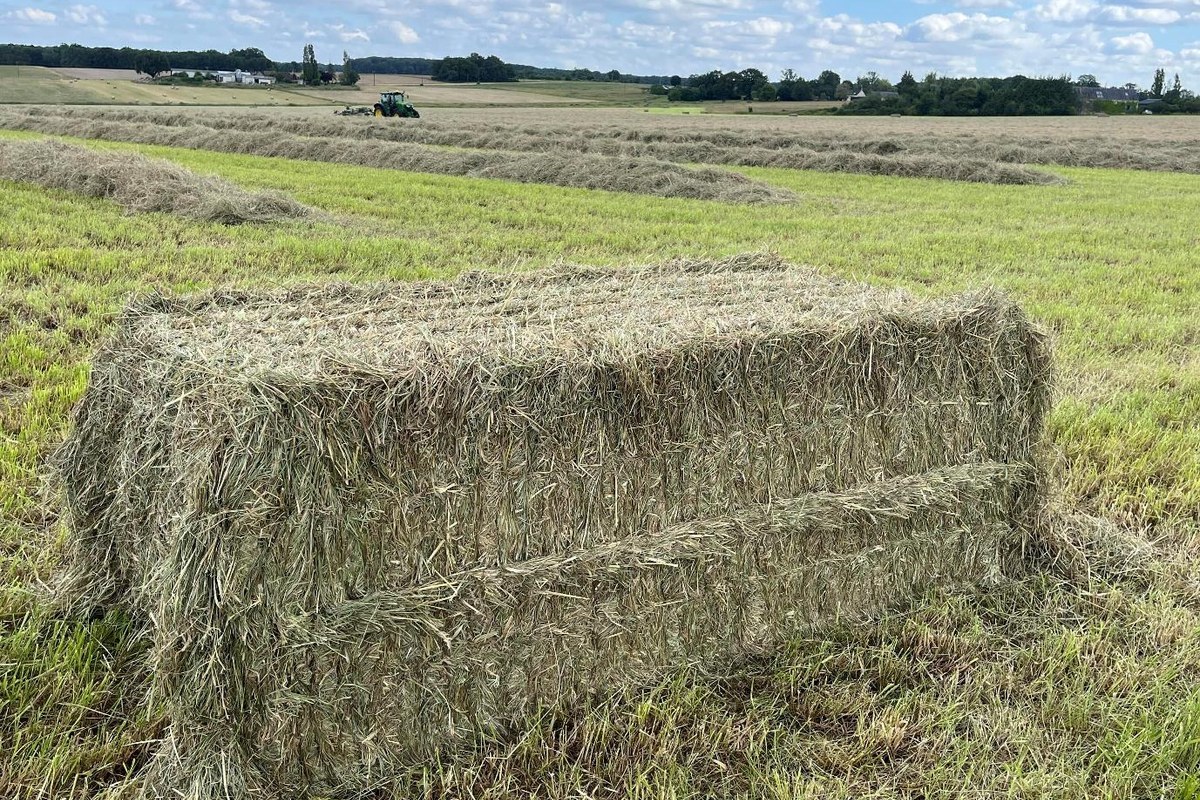
Moisture at baling largely decides the quality of the hay. Photo: EARL du Parc de Montpoupon
Opening a bale already tells you a lot. Open a section and give it a sharp shake. If a cloud of dust rises, that is a bad sign. Rub a handful of hay between your hands. Clean hay leaves nothing grey on your palms.
Mould shows in the smell and the look of the hay, with discoloured patches and hay that is sticky or greyish inside the bale. A bale that heated after baling can have such patches in one spot only, and they are not always visible from the outside.
Storage matters almost as much as the harvest. Hay baled at a good 10% that has spent six months in an open shed, exposed to damp air, can reach you in poor condition. Ask where and how the bales are stored.
On our farm we check moisture when the hay goes into the shed, and again at loading. A flake of hay, meaning a slab inside the bale, can occasionally keep a pocket of moisture and deteriorate slightly, but we do everything we can to prevent it. We never bale before 2 pm, so the morning moisture has time to lift, or after 7 or 8 pm, depending on how damp the ground gets in the evening. Since we started using fixed temperature probes in the bales, we also track temperature rises in real time during difficult harvests. That monitoring let us act quickly on a few lots in 2025, a year when the weather window never went beyond four days of fine weather, which is not enough to make quality hay.
How do you read a forage analysis?
A forage analysis is the only way to look past appearances. Here are the key indicators, in the order they deserve your attention.
| Indicator | What it measures | Reference range for sport horses | Watch out if |
| Dry matter (DM) | Share that is not water | 85 to 92% | below 80%, risk of fermentation |
| Digestible energy (DE) | Actual energy value | 7.9 to 8.8 MJ/kg DM | below 7 MJ, poorly suited to sport |
| Crude protein | Nitrogen × 6.25 | 80 to 160 g/kg DM | below 70 g/kg, hay too mature |
| NDF (total fibre) | Digestibility and satiety | 42 to 70% DM | above 70%, poorly digestible hay |
| ADF (least digestible fibre) | Energy digestibility | 22 to 40% DM | above 45%, low energy |
| WSC (water-soluble carbohydrates) | Soluble sugars | below 10 to 12% DM for sensitive horses | above 15%, risk for horses with a metabolic profile |
| Iron (Fe) | Antagonistic trace element | 50 to 400 mg/kg DM | above 300 mg/kg, chronic excess to watch |
| Pathogenic fungi | Hygienic quality | None isolated | any presence, reject for a sport horse |
Sources: Eurofins Equi Feed, Kentucky Equine Research and Platinum Performance.
Two points matter here. Always read the results on a dry matter basis when you compare two hays. And an analysis is only worth something if the sample is representative, meaning it is made up of several samples taken from different bales of the same lot, and not only from the best-looking one.
Our 2026 analyses of two hay lots
As an example, here are the analyses of two lots from our farm. Every year we have our hay analysed by the Irish Equine Centre in Kildare, Ireland, a laboratory specialising in forage for sport horses. This season we analysed our mixed meadow grasses and our timothy separately.
Mixed grasses: dry matter of 86.4% and digestible energy of 9.1 MJ/kg, a good level for a horse in hard work and above the usual range for grass hay. NDF of 50.4% DM, for fair digestibility, ADF of 31.1% DM, within target, and high water-soluble carbohydrates (WSC) at 18.7% DM, which has to be taken into account for horses prone to metabolic syndrome. Iron at 83.2 mg/kg, very low, and no pathogenic fungi isolated.
Timothy: dry matter of 86.6% and digestible energy of 8.0 MJ/kg, a gentler profile suited to horses that do not need a high energy intake. NDF of 59.5% DM, with more fibre and a slower passage through the gut, ADF of 38.9% DM, at the upper end of the acceptable range, and much lower water-soluble carbohydrates at 10.0% DM. Iron at 63.9 mg/kg, very low, and no pathogenic fungi isolated.
Both hays are clean, with no pathogenic fungi, good dry matter and very low iron. Ordinary hay usually contains between 200 and 400 mg/kg of iron, and our permanent meadows in Touraine, on clay-limestone soils that have never been ploughed, naturally produce low-iron hay. This matters for horses that are sensitive to excess minerals or whose total ration is already rich in them.
The difference between the two lots is telling. The mixed grasses carry more energy and more sugar, while the timothy is more fibrous and gentler. They are not the same hay, and they do not suit the same horses. A sport horse in intensive work will do well on the mixed grasses, whereas a calmer horse, a pony or an animal at metabolic risk will be better off on timothy.
What should you ask your supplier?
Before you confirm an order, it is fair to ask for:
- The cutting date and cut number: a first spring cut (May to June in the northern hemisphere) or a second summer cut, as this changes the nutritional profile.
- Moisture at baling: how it was measured, and the target value.
- Storage conditions: hay kept under cover, ventilated and protected from damp.
- A forage analysis: with its date and the identification of the lot analysed.
- Consistency from one lot to the next: an assurance that the next truck will look like the first.
This last point is often the hardest. A serious producer answers these questions without hesitating, while a middleman does not always know the moisture at baling, which is exactly why it is worth asking.
Which mistakes should you avoid?
Judging a bale only by its outside: a bale can turn yellow on the surface after a few weeks in the light or in damp air without the inside being bad. The reverse is also true, and a bale can look good outside and hide a problem inside.
Not looking inside: scratching the surface or opening a bale is the only way to see what it really contains.
Probing in one spot only: a pocket of moisture can be very localised. We have seen bales with a damp patch of about twenty centimetres, where the hay was discoloured and degraded, while the rest was perfect. One reading is not enough.
Not walking around the bale: inspecting every side shows up dirty patches, traces of soil or foreign matter such as brambles, thistles or docks, which you cannot see from one side.
Buying from a photo: the ideal is always to visit the producer and see and smell the hay yourself. A nice photo of hay is not hard to take.
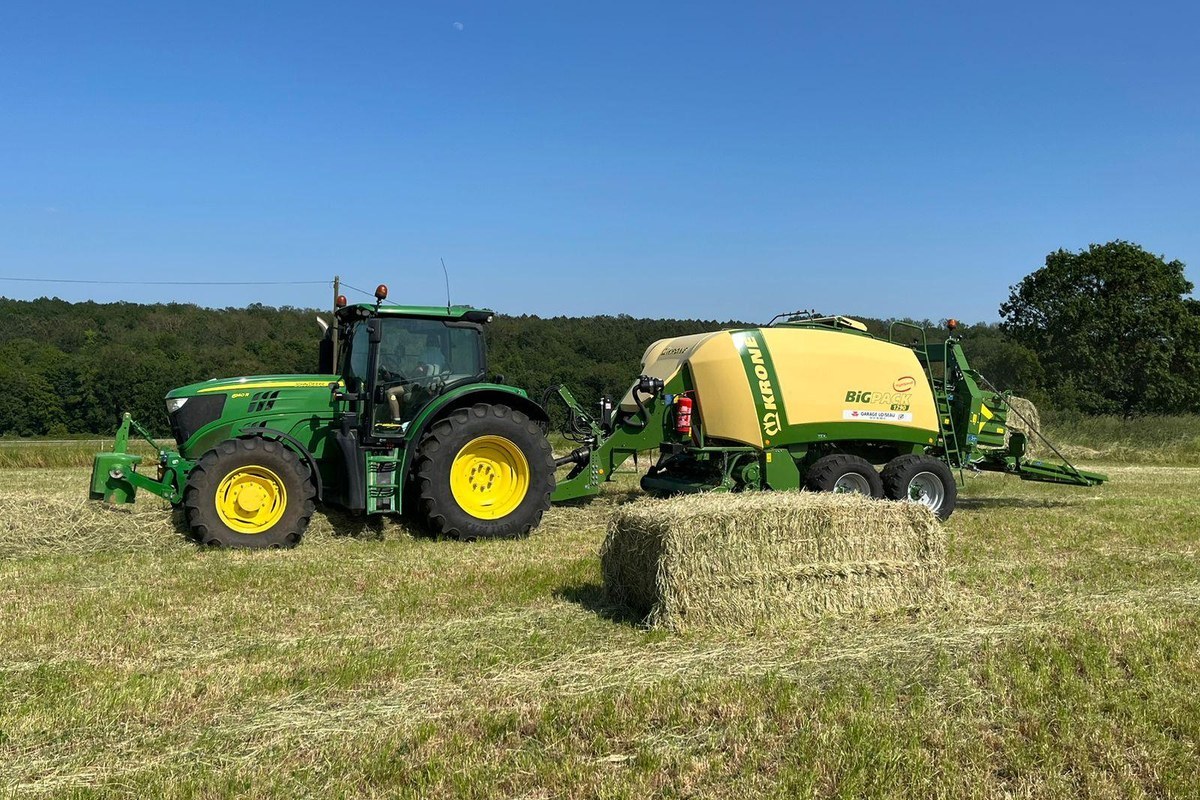
Visiting the producer is still the best way to judge hay. Photo: EARL du Parc de Montpoupon
Frequently asked questions
Is dusty hay dangerous for horses? Yes. The fungal spores in dusty or poorly stored hay are a common cause of airway inflammation. In a sport horse, whose performance depends on its breathing capacity, even mild irritation can have a measurable effect.
How can you check hay quality without an analysis? Smell, colour, texture and dust when the bale is opened are the four quick indicators. They do not replace an analysis, but they rule out bad hay before you even measure its moisture.
Hay or haylage for a top-level sport horse? Both can work. Haylage is easier to make in wet weather and keeps some nutrients. Well-made dry hay carries less fungal risk and is simpler to store and to feed. For horses with a history of respiratory problems or a tightly controlled ration, haylage is often preferred, while for hardy horses in intensive work, good, well-baled dry hay remains the reference.
Should you ask for a sample before ordering? It helps, but it is rarely done. Over time, what matters more is the supplier's consistency, and for that nothing beats an analysis for every lot and a history of orders over several seasons.
Key points
Quality hay for sport horses is something you look at, smell and measure. Checks by eye and by nose quickly rule out bad lots. A full forage analysis, covering dry matter, energy, fibre, sugars, minerals including iron, and the hygiene check, gives a precise picture of what the horse really receives. And the questions you put to the supplier often tell you as much as the bales themselves.
For a stud or a competition yard, consistency matters as much as quality on a single delivery. Hay that is exceptional one season and mediocre the next damages trust in the supplier, and of course the horse. What you are looking for is a supplier who can deliver the same hay from one truck to the next. In the end, the best guarantee is still to go and see, on site, the farm that produces your hay.
Sources
Kentucky Equine Research. Basic components of a horse hay analysis.
Platinum Performance. Understanding a hay analysis.
