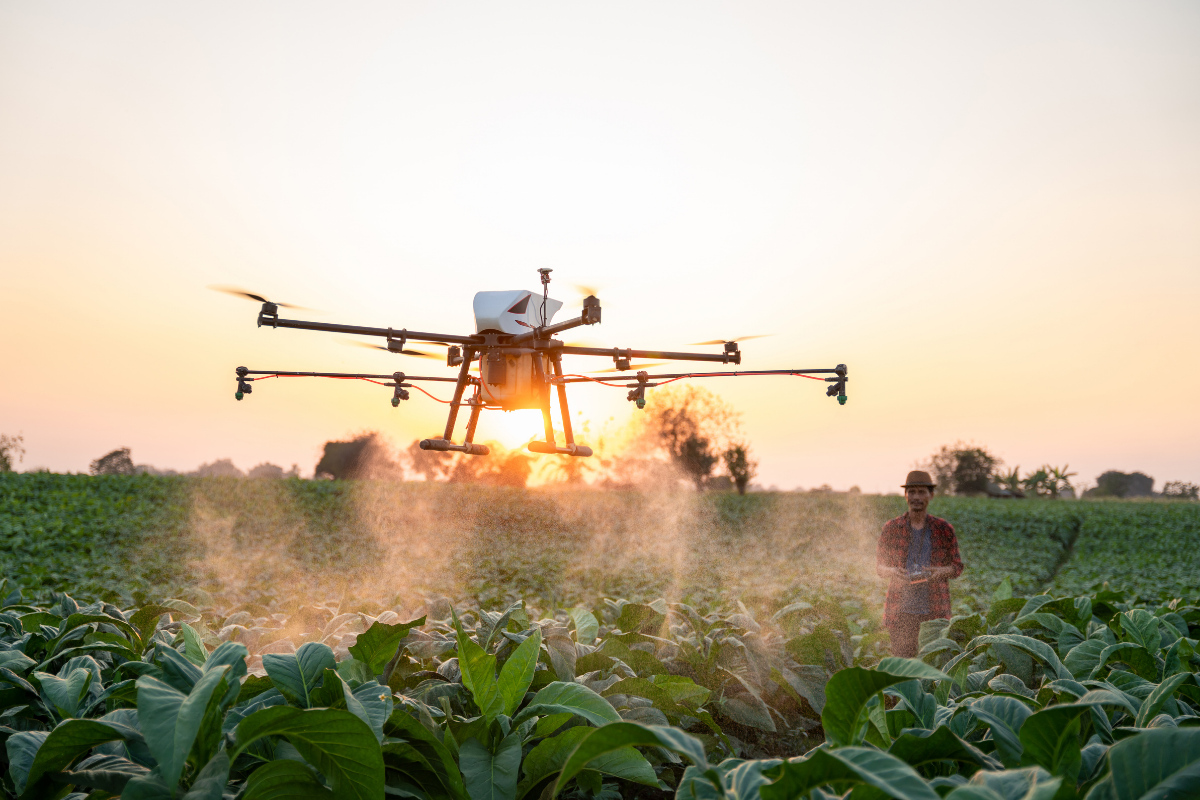
Drones, or uncrewed aerial vehicles, are among the most significant technologies to enter agriculture in recent decades. In precision agriculture, they replace slow, labour-intensive field observation with rapid, high-resolution aerial data, supporting crop monitoring, mapping, spraying, field assessment and decision-making. Used well, they help farmers work more efficiently, cut operating costs and improve profitability. Used badly, they are an expensive way to take photographs. The difference lies in how they are introduced, and that is what this article is about.
Choosing the right drone
Agricultural drones differ by design and by purpose. The main platform types are these.
Fixed-wing drones: suited to covering large areas efficiently, particularly for mapping and imaging.
Multirotor drones: highly manoeuvrable, suitable for detailed imaging, monitoring and spraying.
Single-rotor drones: capable of longer flight times and heavier payloads.
Hybrid VTOL drones: combine the range of a fixed-wing aircraft with the vertical take-off and landing of a multirotor.
By function, they divide broadly into imaging and mapping drones on one side and spraying or application drones on the other. Imaging drones carry RGB, multispectral, thermal, and other sensors to reveal crop conditions, field variability, and plant stress. Spraying drones apply pesticides, fertilisers and other inputs with greater precision, and newer applications include seeding and targeted interventions.
The decision to introduce drones, though, should begin with the need rather than the technology. The questions are simple. What problem are we solving? Can it reduce labour and operating costs? Can it improve productivity? Can it provide information that leads to better management decisions? A drone is valuable only when the information or service it provides translates into operational value.
My first flights
My first experience with agricultural drones came in 2018, when the technology was still unfamiliar in our workplace and drone adoption across farms in Nigeria was limited. It was viewed with some suspicion because its benefits were not yet understood.
I was selected as the first trainee to operate a fixed-wing eBee drone, a platform built for aerial mapping and imaging. For me, the opportunity was more than professional training. From childhood, I had wanted to fly, and not merely kites or toy aircraft but something I could actually control in the air. Being trusted with this technology felt like a dream becoming real.
Training was intensive and practical. We flew roughly three days a week, reviewed both captured and processed images, identified errors, and applied the lessons to subsequent flights. I learned that a successful drone operation begins long before take-off. The pre-flight checks that matter are weather conditions, drone maintenance, battery and controller status, wind direction, notification of any other aerial operations, and an accurately defined area of interest.
One lesson stood above the rest. Enthusiasm must never replace procedure.
Mistakes that became lessons
During one early flight, I completed the mapping mission but forgot to programme the drone to land once it had covered the area of interest. It simply carried on, flying in circles. A safety feature saved the day, initiating a landing when the battery fell below its programmed threshold. Without that safeguard, the mistake would have been an expensive one.
On another occasion, a propeller was not properly checked before flight. The drone crashed into mature rice and was lost for several days, until the manufacturer used its last known coordinates to help us find it. The experience fixed a principle in place. Technology does not remove operational risk. It makes disciplined procedure more important, not less.
Winning the people over
Introducing the technology was not only a technical challenge. It was a people-management challenge, and that side of it is discussed far less often.
Some farm supervisors initially believed the drone was there to spy on them and report their activities to senior management. Building trust took continuous engagement and explanation, and the breakthrough came when Area Managers began to see the value of the information the imagery produced.
We ran sessions explaining the processed imagery, and in particular the Normalised Difference Vegetation Index, NDVI, a vegetation index used to assess differences in plant vigour and identify variability within a field. For more than two and a half years, we shared weekly NDVI reports with the Area Managers, walking through what the images meant and how they could inform field operations. Gradually, the drone stopped being an unfamiliar monitoring tool and became a source of operational intelligence they asked for.
The drone is the least important part.
The greatest lesson of my experience is that the value of a drone is not in the aircraft. It is in the quality of the data, the interpretation of that data, and the decisions that follow.
The research literature increasingly supports the same conclusion, with systematic reviews of drone applications in agriculture documenting their use in crop-health monitoring, disease and pest detection, irrigation management, yield estimation and precision spraying, while also recording the same constraints practitioners meet on the ground: battery life, data-processing demands, skills, cost, and regulation.
Drones should not be introduced because they are innovative. They should be adopted where they solve real operational problems and generate measurable value.
For me, every flight was more than technology. It was an adventure, a learning experience, and a childhood dream fulfilled. More importantly, it showed how the right technology, supported by training, disciplined process and stakeholder buy-in, can change the way a farm is managed. The future of agriculture will depend on combining agronomic knowledge with technology and actionable data. Drones are part of that future, and when deployed for the right reasons, they make farming more efficient, more productive, and more profitable.
Sources
Guebsi, R., Mami, S., and Chokmani, K. (2024). Drones in precision agriculture, a comprehensive review of applications, technologies, and challenges. Drones, 8(11), 686.
García-Munguía, A., Guerra-Ávila, P. L., Islas-Ojeda, E., Flores-Sánchez, J. L., Vázquez-Martínez, O., García-Munguía, A. M., and García-Munguía, O. (2024). A review of drone technology and operation processes in agricultural crop spraying. Drones, 8(11), 674.