


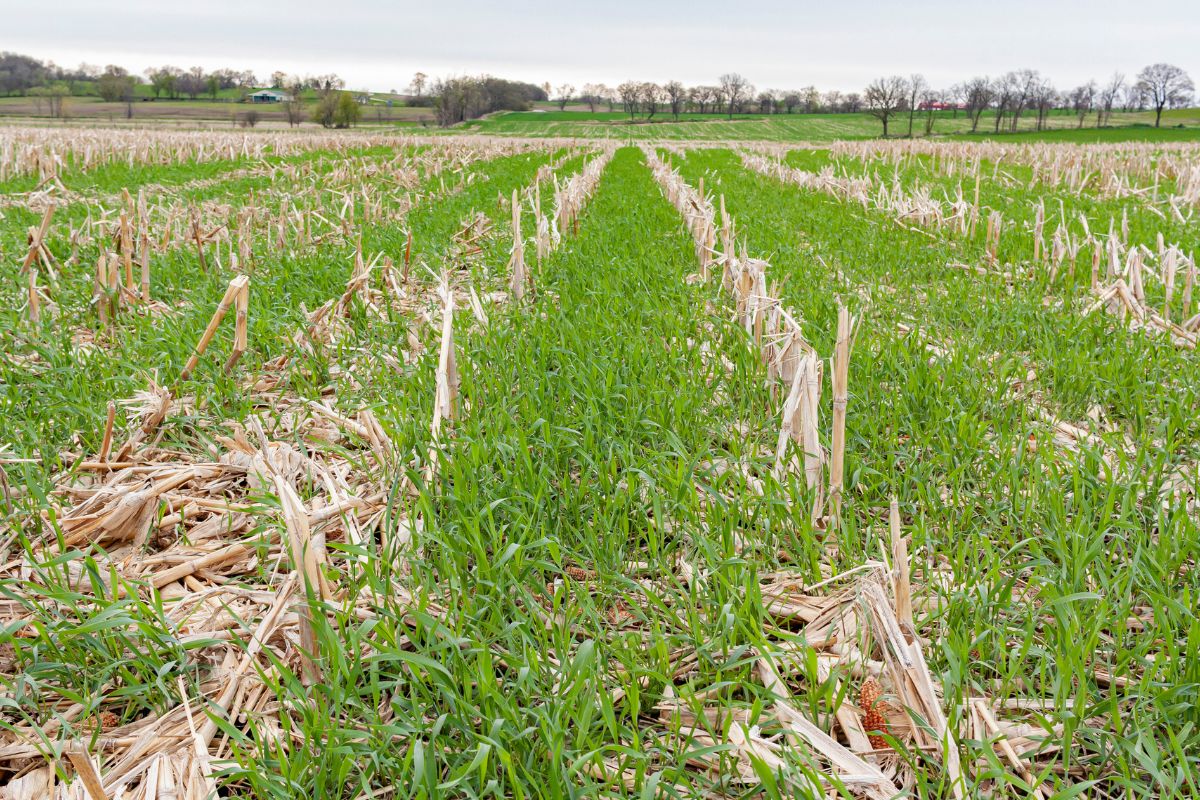
Farmers around the world are hearing about regenerative agriculture, and for good reason. Soil degradation, rising input costs, and unpredictable weather are squeezing margins from every direction, and regenerative practices promise to reverse much of that pressure. The term itself can feel overwhelming, however, suggesting a whole-system overhaul, a leap of faith, a risk most farmers cannot afford to take all at once.
Here is what fewer people say. You do not have to change everything at once. Cover cropping, growing plants in your fields between cash crop seasons, is widely regarded as the single most accessible entry point into regenerative farming. It asks for the least upheaval, costs less than most farmers expect, and starts improving your soil from the first season.
Research and farmer experience alike show that most people who try it quit before it starts working. This article explains what cover cropping actually does, what gets in the way, and how to make it work, drawing on examples from India.
What cover crops actually do beyond the basics
When you leave a field bare after harvest, the soil does three things. It erodes, it loses moisture, and it loses the biological activity that makes nutrients available to your next crop. A bare field is a quiet field, and not in a good way.
Cover crops fix this by keeping the soil covered and the roots alive well beyond your cash crop season. Those living roots feed billions of soil microbes, bacteria, fungi, and other organisms that in turn cycle nutrients, build soil structure, and make your land more resilient to drought and heavy rain alike.
Research documents five key benefits.
- Better soil structure. Cover crops with fibrous root systems, such as cereal rye and oats, reduce compaction and improve water absorption.
- Free nitrogen. Legume cover crops such as hairy vetch, cowpea, and sunhemp fix atmospheric nitrogen, in some cases supplying the equivalent of 60 to 120 kg of nitrogen per hectare, which reduces what you need to buy.
- Higher soil organic matter. As the cover crop biomass decomposes it raises soil organic matter, which improves water retention, nutrient availability, and yield stability over time.
- Weed suppression. A thick cover crop canopy shades out weeds and reduces herbicide needs. Some species, such as cereal rye, also release natural biochemicals that inhibit weed germination.
- Climate resilience. Cover-cropped fields consistently perform better in both drought and flood years because the soil holds water more effectively.
A 2023 review published in International Soil and Water Conservation Research (Koudahe et al., 2023) confirms that grass species are especially effective at building soil carbon through deep root systems, while legume mixes add biological nitrogen and promote microbial life. A mixed-species cover crop delivers more than either alone.
How Indian farmers already use cover crops
Indian farmers have centuries of experience with practices that align closely with regenerative cover cropping, often under different names. Two of the most powerful and most underused are dhaincha (Sesbania bispinosa) and sunhemp (Crotalaria juncea), nitrogen-fixing legumes that double as green manure cover crops.
How Punjab farmers cut urea costs before the paddy season
In Punjab, India's most intensively farmed state, Punjab Agricultural University (PAU) has recommended sunhemp and dhaincha as green manure cover crops for rice farmers for decades. The practice is straightforward. After the rabi (winter) crop is harvested, farmers sow sunhemp or dhaincha in April or May, then incorporate the crop into the soil 6 to 8 weeks later, just before transplanting paddy.
The documented results from PAU research are striking. Farmers who follow this cycle can save 25 kg of nitrogen fertiliser per acre on their paddy crop, the equivalent of 55 kg of urea. For basmati growers, PAU records show that when basmati follows a green manure crop, no urea fertiliser is required at all, a remarkable saving given that fertiliser costs are among the largest inputs for most Indian paddy farmers.
Dhaincha is particularly valued in saline and waterlogged soils, common in parts of Punjab and Haryana. It fixes 60 to 100 kg of nitrogen per hectare, grows in otherwise unproductive soils, and helps correct iron deficiency in rice, a common problem in alkaline soils that costs farmers in remediation products.
Long-term soil restoration on Karnataka farms
A 2023 peer-reviewed study published in Frontiers in Agronomy by researchers from the Ashoka Trust for Research in Ecology and the Environment (ATREE) in Bangalore examined soil health on farms in Karnataka that had practised regenerative agriculture, including cover cropping, mulching, mixed cropping, and no-till, for five or more years, compared with conventional farms (Singh et al., 2023).
The findings were clear. Farms with more than five years of regenerative practice showed significantly higher soil bacterial diversity, improved soil organic carbon, and better availability of key nutrients like nitrogen and phosphorus than both newer regenerative farms and conventional farms. The study concluded that long-term and regular use of regenerative farm practices in Karnataka has the potential to support sustainability in soil health and agriculture.
This is an important lesson. The benefits accumulate slowly and then become unmistakable. Farmers who quit in year two miss the inflection point that arrives in years four and five.
India's broader cover cropping landscape
According to research published by the Council on Energy, Environment and Water (CEEW), cover cropping is now practised across nearly every Indian state. The common species fall into three groups by function.
- Legumes for nitrogen fixation: cowpea (lobia), berseem, moong (mung bean), sunhemp (Crotalaria juncea), and dhaincha (Sesbania bispinosa).
- Grasses and cereals for biomass and soil cover: sorghum, pearl millet, maize, and barley.
- Brassicas and others for rainfed areas: mustard and lentil, used widely in central and eastern India.
In rainfed areas of Karnataka, Andhra Pradesh, and Maharashtra, mulching with cover crop residues is common practice for conserving soil moisture between rains. In hilly states like Sikkim and Uttarakhand, cover crops are integrated into ginger cultivation to prevent erosion on slopes. The practice already exists across India. It simply needs to be understood as regenerative, valued, and expanded.
Why most farmers quit in year two
If cover cropping delivers so much, why is everyone not doing it? According to research published in Frontiers in Sustainable Food Systems (Myers and Wilson, 2023), the barriers are real. The three top challenges farmers report are getting the cover crop established, the time and labour involved in managing one more crop, and choosing the right species from dozens of options that depend on soil type, climate, and goals.
There is also a deeper issue. The benefits of cover cropping compound over time. In the first year, you may see modest weed suppression or erosion reduction. You will not yet see the soil organic matter gains, the water infiltration improvements, or the full nitrogen cycling benefits. Those take three to five years to build.
A 2024 review in Applied Economic Perspectives and Policy (Schnitkey et al., 2024) found that farmers frequently do not receive enough short-term economic return in their first season to make cover cropping feel worthwhile, especially when seed costs, extra fuel, and additional management are factored in. The farmers who succeed consistently describe one thing. They started small, learned their fields, and expanded from there.
How to start without overcommitting
You do not need to cover-crop your entire farm in year one. The practical approach used by experienced farmers and extension advisors comes down to five steps.
Start with one or two fields: choose fields where you have flexibility, with longer harvest windows, or where compaction or erosion is already visible. Problems are good starting points because improvement is visible sooner.
Choose a simple, proven species for your region: in India, sunhemp or dhaincha before paddy, or cowpea as an intercrop in cotton or maize systems. In temperate climates, cereal rye plus hairy vetch is a reliable starting mix. Your local Krishi Vigyan Kendra (KVK) or agricultural university can advise on the best options for your district.
Incorporate at the right time: terminate or incorporate your cover crop when it is at or just before flowering stage. Incorporating too late can compete with your next cash crop for moisture.
Observe and record: take soil samples before you start and again after two years. Note changes in soil moisture, weed pressure, and any input costs saved. This data will guide your next decisions.
Connect with other farmers: farmers who successfully adopt cover crops almost universally credit conversations with neighbours. In India, ATREE, the Organic Farming Research Foundation, and various state KVKs provide resources, demonstrations, and farmer networks.
Three myths that stop farmers before they start
Cover crops will hurt my yields. Research shows the opposite over time. Yield dips, when they occur, are typically seen in the first season and are linked to management errors, mostly from incorporating the cover crop too late, not from cover cropping itself.
I need special equipment. Most cover crops can be seeded with standard equipment. In India, manual broadcasting or hand drilling with common seed drills is sufficient for most species. For narrow planting windows, some farmers broadcast seed into a standing crop by hand, a zero-cost approach.
It is too expensive. Seed costs are real, but nitrogen savings from legume cover crops can offset a large portion of the cost. In Punjab, the urea savings alone from one season of sunhemp or dhaincha can pay for the seed cost several times over. Nationally, the Government of India's Paramparagat Krishi Vikas Yojana (PKVY) and various state schemes offer support for farmers transitioning to natural and sustainable practices.
The bottom line
Cover cropping will not transform your farm overnight. It is the most practical, least disruptive, and most scientifically supported first step into regenerative agriculture available to farmers at any scale, whether you farm one acre in Karnataka or one hundred in Punjab.
The soil does not rebuild in one season. Microbes, fungi, earthworms, and organic matter accumulate slowly. After a few years, you start to notice that your fields hold water differently after heavy rain, that you are applying a little less fertiliser, that the weeds are not quite as bad. That is regenerative agriculture working.
Start with two fields. Try a simple mix. Stick with it for three years before you judge it. The farmers who do this rarely go back.
References
Koudahe, K., Allen, S. C., and Djaman, K. (2023). Critical review of the impact of cover crops on soil properties. International Soil and Water Conservation Research, 11(1), 224–232.
Myers, R. L., and Wilson, K. R. (2023). Farmer perspectives about cover crops by non-adopters. Frontiers in Sustainable Food Systems, 7, 1011201.
Punjab Agricultural University. (2026). Package of practices for crops of Punjab, Kharif 2026. PAU, Ludhiana.
Schnitkey, G., Sellars, S., and Gentry, L. (2024). Cover crops, farm economics, and policy. Applied Economic Perspectives and Policy.
Singh, I., Hussain, M., Manjunath, G., Chandra, N., and Ravikanth, G. (2023). Regenerative agriculture augments bacterial community structure for a healthier soil and agriculture. Frontiers in Agronomy, 5, 1134514.
Souza, L. F., et al. (2025). Cover crops enhance soil health, crop yield and resilience of tropical agroecosystem. Field Crops Research.
Council on Energy, Environment and Water (CEEW). (2023). Cover crops and mulching in India. CEEW, New Delhi.
Soil Health Institute and American Farmland Trust. (2024). Farmer case studies, economic value of soil health practices. Center for Regenerative Agriculture, California State University, Chico.
SARE (Sustainable Agriculture Research and Education). (2024). Cover crops for sustainable crop rotations. SARE Outreach, USDA NIFA.