Clonal avocado trees are genetically identical copies of a high-performing mother tree, built from a superior, uniform rootstock grafted to a top-tier scion. Compared with seedling trees, they offer markedly higher yields, stronger resistance to diseases such as Phytophthora root rot, and improved tolerance of saline soils. They also give an orchard genetic uniformity, which means more even trees and more consistent fruit quality.
Producing them is a technical process, but it can be broken down into clear nursery steps. The method below follows the Frolich etiolation technique, the micro-cloning system developed for large-scale avocado propagation, which roots a clonal shoot on a temporary nurse seedling before the commercial variety is grafted on top.
Step 1: Plant the nurse seed
Plant an avocado seed in a long, narrow polyethylene bag, using a healthy seed from a disease-free source. Allow the seedling to grow until the stem reaches pencil thickness, around 6 mm. This seedling acts as a temporary nurse root system.
Step 2: Graft the desired rootstock clone
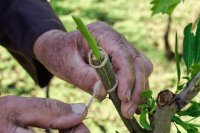
Graft the chosen clonal rootstock variety onto the nurse seedling, placing the graft as close to the seed as possible. Standard grafting techniques work here, usually whip grafting. This multiplies genetically identical rootstocks with the traits you want, such as disease and salinity tolerance. Take care to get every factor of the graft right, since a clean union is the foundation of everything that follows.
Step 3: Etiolation or dark treatment
Once the graft buds begin to grow, move the plant into a dark room that has good ventilation and a temperature no higher than 25°C. In the dark, the shoot grows long, pale, and soft. These etiolated shoots are much easier to root than green ones.
Step 4: Root induction
When the etiolated shoot reaches 20 to 30 cm, take the plant out of the dark room. Make a small wound or incision near the base of the etiolated shoot, in the manner of layering, and apply a rooting hormone such as IBA to the wound to stimulate new roots on the clonal shoot. Bury the wounded section by mounding soil or rooting medium around it, covering 5 to 7 cm of the etiolated stem and enclosing it with a sleeve of the poly bag or a cup, so that roots form from the clonal shoot.
Step 5: Recovery
Place the plant in a greenhouse or shaded area under warm conditions of about 28°C and good humidity of 70 to 80%. During this stage the pale shoots turn green, the leaves harden off, and roots begin to form.
Step 6: Root development
Roots form from the wounded point through aerial layering, around the etiolated stem and above the grafted point on the nurse seed. Over time the new clonal root system develops while the original nurse seedling roots gradually die off. The plant now has a true clonal rootstock root system, which can be separated from the mother plant.
Step 7: Transplant to larger bags
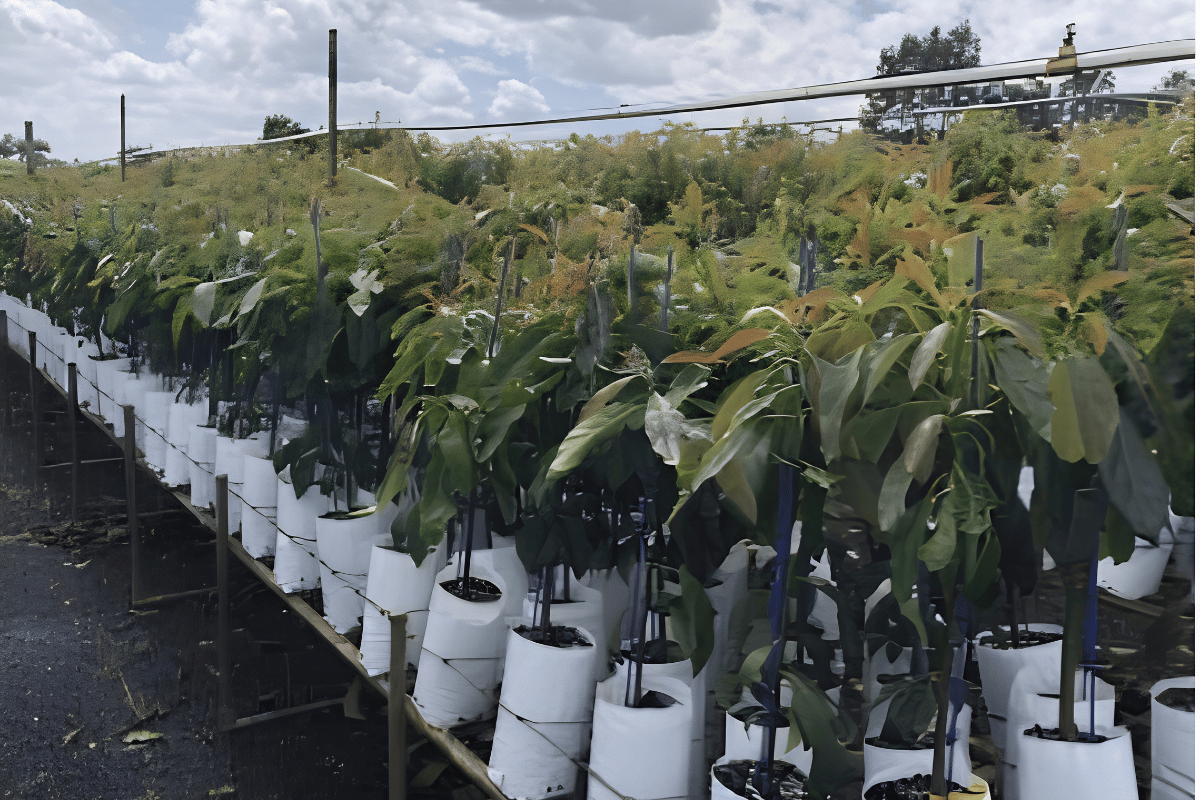
When the plant regains vigour, separate the rooted plant from the mother plant and transfer it to standard avocado nursery bags of around 8 litres. Maintain proper watering and fertilisation.
Step 8: Graft the commercial variety
Once the rootstock is ready, graft the fruit cultivar, such as Hass or Fuerte, onto the clonal rootstock. Common methods include the whip graft, the whip and tongue graft, and the wedge graft. Use clean grafting knives, and if necessary treat the scion and rootstock with a fungicide before grafting. For a successful union, the rootstock and scion should be of similar diameter, the cambium layers should be in good contact, and the graft should be wrapped tightly with grafting tape. Tying the union securely helps it heal and keeps water out, which would otherwise cause rotting. Growing the plants under shade with high humidity of 70 to 80% raises the survival rate.
Step 9: Aftercare of the grafted plant
Keep grafted plants under 70 to 80% shade and avoid overwatering, which helps prevent Phytophthora root rot. Remove any shoots emerging below the graft. Once the graft joint has healed, stake the new shoot growing from the scion.
Step 10: Hardening off
When the scion is growing well, gradually reduce the shade and remove the grafting tape once the union has fully healed. The plants are then ready for field planting.
Why clonal propagation matters for avocado farmers
Clonal avocado propagation is a relatively new technology that farmers can adopt to solve several of the biggest challenges in avocado production, including Phytophthora root rot, salinity, and low or inconsistent yields. Beyond addressing those problems, it gives the farmer genetic uniformity across the orchard, which translates into even trees and consistent fruit quality. For a grower planting an orchard meant to last for decades, that uniformity and disease resistance can make the difference between a productive investment and a struggling one.