


Before spending money on fertiliser, labour or land preparation, a farmer has to decide what seed to plant. Some buy certified seed, while others keep part of the harvest for the next season, a practice often called "grain" or "recycling" in Ghana. Farm-saved seed can cut cash costs and preserve varieties farmers know, but its quality depends on how it was selected, harvested, dried and stored. Certified seed gives added assurance of quality, but it cannot guarantee a high yield on its own, because rainfall, soil fertility, planting date, pests and crop management still matter.
What is the difference?
Certified seed is produced and handled within a regulated seed system, with field inspection, laboratory testing and certification. In Ghana, quality assurance and certification are the job of the Ghana Seed Inspection Division (GSID), part of the Ministry of Food and Agriculture's Plant Protection and Regulatory Services Directorate. Certification aims to keep a variety's identity and genetic purity, and certified seed should carry an official tag or label identifying the crop, variety and seed lot. Buy from a recognised dealer and check the package rather than relying on the seller's word alone.
Farm-saved seed is seed a farmer keeps from their own harvest, or gets from another farmer, to plant in a later season. It is not automatically poor quality. It can be a sensible choice when the variety is suitable and the seed plants were healthy, especially for varieties that can be saved reliably. Without inspection or testing, though, the farmer may not know its germination rate, purity or health. Research in Ghana shows that farmers' decisions about improved seed are shaped by availability, trust, cost and access to preferred varieties.
What certified seed gives the farmer
Confidence in the variety: certified seed gives better assurance that the variety is what the label says. That matters when the farmer needs a particular maturity period, grain colour, plant type or market preference. If varieties are mixed, plants may mature at different times, which makes field management and harvesting harder, and varietal identity matters most of all for farmers supplying buyers with clear quality requirements.
Evidence of quality checks: good seed should germinate well and be physically pure, with little contamination from weed seed, other crops or inert material. None of this can be confirmed by looking at the bag. Ghana's seed inspection system combines field inspection with laboratory analysis, and GSID runs a National Seed Testing Laboratory at Pokuase, near Accra.
A more even stand: when more seeds germinate and seedlings emerge well, the field has fewer gaps, and a uniform stand makes weeding, fertiliser application and harvesting easier. Certification still does not guarantee a better yield. The seed must be genuine, suited to the location and stored correctly, and the crop still needs good management.
Less avoidable uncertainty: poor germination can force a farmer to buy replacement seed, pay for extra planting labour or settle for fewer plants than planned. A reliable certified lot lowers the risk of starting with seed of unknown quality. Certified seed can cost more, however, and its availability can be patchy. A study of seed security among smallholder farmers in semi-arid Ghana found that both access to seed and its storage are affected by climatic and non-climatic factors.
What can go wrong with farm-saved seed
The risk lies in saving seed without checking it carefully, more than in saving it at all. Seed from diseased plants can carry seed-borne pathogens. Seed harvested too early, dried poorly or stored in damp conditions can lose its ability to germinate. Insects, rodents, broken seed and mixing with other varieties all reduce quality as well.
A 2023 study of farm-saved maize seed in Tanzania found that many sampled lots fell short of the country's germination standard and only about half met its physical purity standard. Seed dried on tarpaulins and stored in hermetic bags tended to be of better quality than seed dried on bare ground and kept in ordinary polypropylene bags. The study is from Tanzania, but it shows how much handling and storage affect seed quality. A 2022 maize study in Mexico likewise found that hermetic storage helped maintain seed germination and limited quality losses.
Know what type of variety you are saving, too. Seed saved from hybrids may not give a uniform crop or keep the same performance in the next generation, so ask an extension officer whether a particular variety is suitable for saving. Grain bought as food should not be used as planting seed without question, since its variety, treatment and storage history may be unknown.
How to check seed before planting
These checks apply to both certified and farm-saved seed. They help you spot warning signs, but they do not replace a formal laboratory test. Our article on what to check before buying seed covers the label and packaging in more detail.
Check the source and label: buy from a recognised dealer, and look for an intact package and an official tag showing the crop and variety, the lot or batch, and germination details where they are given. Be wary of torn, altered or unlabelled bags, since GSID inspectors deal with counterfeit seed in the Ghanaian market. Under the 2022 Planting for Food and Jobs campaign, MoFA required certified seed to carry inspection tags with details such as the variety and germination percentage.
Inspect the seed: a good sample should look reasonably uniform for the variety, with few broken, shrivelled, insect-damaged or discoloured seeds, and little sand, chaff, stones, weed seed or seed of other crops. Appearance helps, but it cannot prove that seed will germinate.
Check for moisture, mould and insects: avoid seed that smells musty, looks mouldy, feels damp or contains live insects. Dry seed properly before storing it, and keep it in a cool, dry place, protected from rain, rodents and direct sun. Airtight storage helps limit quality losses.
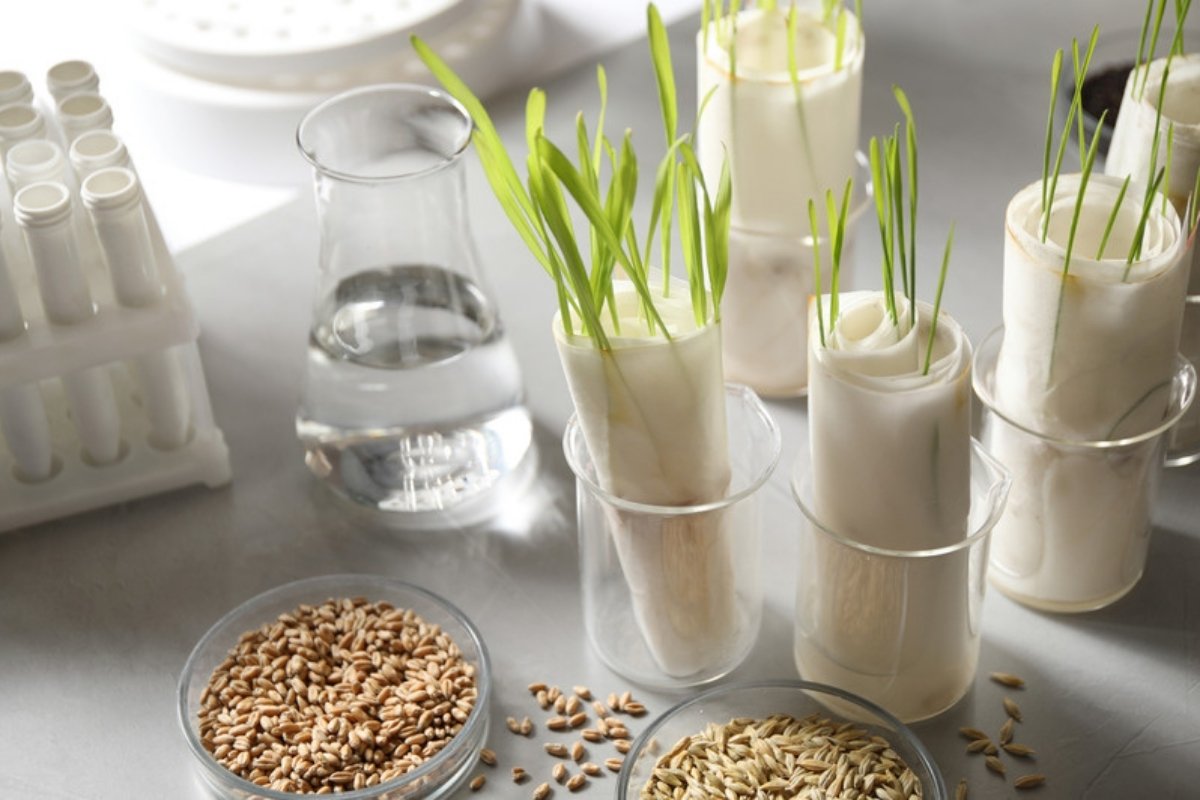
Run a simple germination test: take 100 seeds at random and place them between clean, damp paper or cloth, moist but not waterlogged. Keep them somewhere warm enough for the crop and check them daily. At the crop's usual germination time, count the normal seedlings. If 85 of the 100 produce normal seedlings, the observed germination is 85%. This is a rough farm test, since conditions and counting periods vary by crop, so for large plantings or uncertain results ask an extension officer or a seed laboratory.
Decide before planting the whole field: if germination is low, the seedlings are weak or the results are uneven, consider replacing the seed or get professional advice. Sowing more seed will not fix disease, poor vigour or uneven emergence.
A practical decision for the season
If the crop matters to household income, a buyer requires a specific variety, or replanting would be costly, genuine certified seed from a reliable source is often the safer start. If you use farm-saved seed, select healthy plants of the variety you want before harvest, keep the seed crop apart from mixed or diseased plants, harvest at maturity, dry the seed thoroughly, remove damaged seed and store it safely. Record the variety and harvest year, and test germination before planting.
Farmers in Ghana can ask their local MoFA extension officer or the Ghana Seed Inspection Division for guidance on certified seed and seed testing. Whichever route you choose, the aim is seed that is suitable, healthy and reasonably pure, and likely to establish the crop you need for the season, rather than either the most expensive seed or the cheapest.
Sources
Ahiakpor, F., et al. (2022). Seed security among smallholder farmers in semi-arid Ghana. Environmental Challenges, 6, 100438.
García-Lara, S., et al. (2022). Hermetic storage technologies preserve maize seed quality and minimize grain quality loss in smallholder farming systems in Mexico. Journal of Stored Products Research, 96, 101954.
Ministry of Food and Agriculture, Ghana (2013). National seed policy. Accra.
Ministry of Food and Agriculture, Ghana (2022). PFJ 2022, general implementation modalities for improved seeds.
Mwanishi, G., and Msuya, D. (2023). Assessment of the quality status of farm-saved maize (Zea mays L.) seeds in a lake zone, Tanzania. Journal of Current Opinion in Crop Science, 4(3), 119-131.
Quarshie, P. T., Abdulai, A.-R., and Fraser, E. D. G. (2021). Africa's "seed" revolution and value chain constraints to early generation seeds commercialization and adoption in Ghana. Frontiers in Sustainable Food Systems, 5, 665297.
TASAI (2022). The African Seed Access Index, Ghana country report.