Cashew (Anacardium occidentale L.) is a tropical tree crop of considerable economic importance in Nigeria and the broader West African sub-region. Nigeria currently ranks among the top three cashew-producing nations in Africa, with production exceeding 350,000 metric tonnes annually as of 2023 (Tridge, 2023). The crop provides livelihoods for over 1 million Nigerians and generates substantial foreign-exchange earnings. The Cocoa Research Institute of Nigeria (CRIN), established in Ibadan in 1964, has a broad mandate covering cashew research alongside cocoa, kola, and coffee (CRIN, 2022).
This article opens a three-part review of research on the cashew farming system in Nigeria, with emphasis on integration with livestock production. Part 1 here covers the origin, botany, varieties, and the main farming system configurations practiced by Nigerian cashew growers. Part 2 examines how cashew by-products can be used as livestock feed, and the bioactive compounds that make them valuable, and Part 3 reviews the regional West African picture and the role of cashew farming in climate change adaptation and mitigation.
Origin, distribution, and Nigeria's position
Cashew is indigenous to the restinga, the low vegetation of sandy soils along the Eastern and Northeastern coast of Brazil (Johnson, 1973). The genus Anacardium belongs to the family Anacardiaceae, a moderately large family comprising approximately 74 genera and 600 species. Within Anacardium, which comprises up to 20 species distributed across Central and South America, only A. occidentale has attained global commercial and economic significance. The primary center of diversity is the Amazon basin, with a secondary center in the Brazilian Planalto.
The Portuguese were responsible for the global spread of cashew, introducing it to Mozambique in Africa and later to Goa, India, between 1560 and 1565, from where it dispersed throughout Southeast Asia. The word "cashew" is reportedly derived from the Portuguese "caju", which is itself derived from the Tupi name "acaju". By the late 16th and early 17th centuries, cashew had been introduced to West Africa, where it found ecological suitability across the tropical and sub-tropical belt between latitudes 27°N and 28°S (Nambiar, 1977, as cited in IJDR, 2023).
Nigeria's cashew cultivation dates back over six decades, with commercial plantations first established in the states of Oyo, Ogun, Ondo, Kogi, Kwara, and Benue (Adeigbe et al., 2015). Production was relatively static at approximately 25,000 tonnes over 25 years from 1965, but has since grown dramatically. By 2021, production had reached 240,000 tonnes annually, representing nearly an eightfold increase from the 30,000 tonnes recorded in 1990 (Agricdemy, 2021). Projections indicated that Nigeria's production would surpass 500,000 metric tonnes by 2028 (Tridge, 2023).
Nigeria is currently the third-largest producer of cashew nuts in Africa and the sixth in the world, with a production capacity of approximately 240,000 to 350,000 tonnes annually and yields ranging from 300 to 800 kg per hectare (NEPC, 2023). In West Africa, cashew farming is predominantly carried out by smallholder farmers, with over 2 million smallholders across the region (Development Gateway, 2024). In Nigeria, approximately 60 percent of the total land area under cashew cultivation, estimated at 100,000 hectares by 2000, was owned by smallholder farmers (Onuchi and Aiyelabowo, 2006, as cited in Azeez and Olabanji, 2024).
The CRIN has been at the forefront of cashew research in Nigeria. The Crop Improvement Division of CRIN has developed improved cashew varieties, including CRIN-1, CRIN-2, and CRIN-3, with CRIN-1 demonstrating superior germination and early growth responses in variety trials (Adeigbe et al., 2015). Cashew research and development at CRIN began formally in 1972 and has spanned the introduction of varieties, selection, production management, processing, and marketing over the past five decades. Nigeria's surging cashew exports, particularly to Vietnam and India, underscore the need for coordinated research to optimize the entire cashew farming system, including its livestock integration components.
Botanical description and types
Anacardium occidentale L. is a tropical evergreen tree belonging to the family Anacardiaceae. In its natural habitat, the tree can grow as tall as 14 meters, though dwarf cultivars, which reach up to 6 meters, are preferred for commercial cultivation due to earlier maturity and higher yields. A spreading canopy characterises the species, leathery elliptical-obovate leaves with a distinctive wavy margin, and small star-shaped bisexual and male flowers borne in terminal panicles.
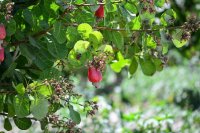
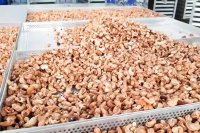
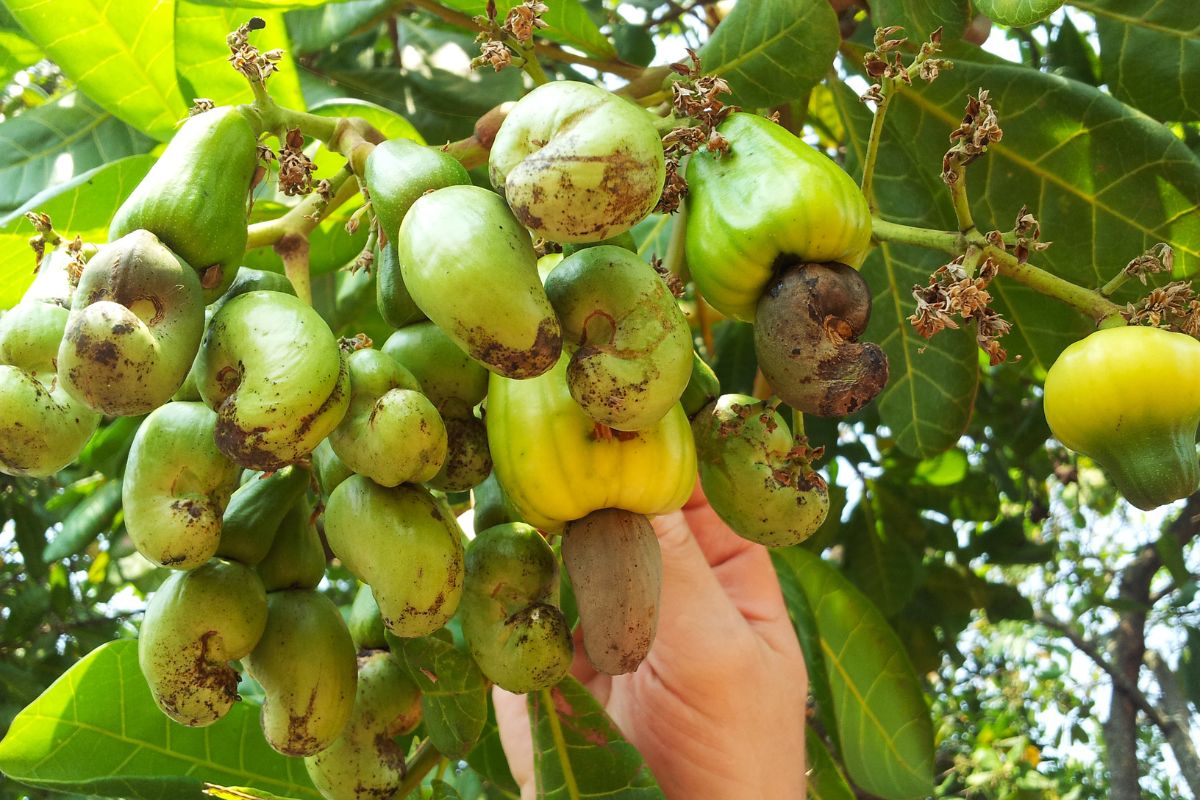
The cashew plant produces two distinct components, the true fruit and the false fruit (cashew apple). The true fruit is a kidney-shaped drupe (the cashew nut), approximately 2 to 3 cm long, with a hard outer shell (pericarp) containing the cashew nut shell liquid (CNSL). The false fruit, commonly called the cashew apple, is the enlarged, fleshy, pear-shaped receptacle (hypocarp) that develops from the expanded flower stalk after fertilisation. It is typically yellow to red in color, juicy, and astringent (IJDR, 2023).
The genus Anacardium is subdivided taxonomically into Kingdom Plantae, Division Magnoliophyta, Class Magnoliopsida, Order Sapindales, Family Anacardiaceae, Genus Anacardium, Species occidentale L. Within the family Anacardiaceae, the tribe Anacardieae consists of eight genera, including Androtium, Buchanania, Bouea, Gluta, Swintonia, Mangifera, Fegimanra, and Anacardium (IJDR, 2023).
Morphologically, the cashew tree possesses a taproot system with extensive lateral roots that improve soil anchoring and facilitate nutrient uptake. Wild cashew trees tend to be stout and twisted, while cultivated forms, particularly those propagated by grafting, are more compact. Flowers are small, fragrant, and predominantly male, with a limited proportion of hermaphrodite flowers that bear fruit. Pollination is largely entomophilous, with bees among the primary pollinators.
In Nigeria, CRIN has classified cashew into open-pollinated (local) varieties and improved hybrid varieties. The open-pollinated types, which have been grown in Nigeria the longest, are not resistant to diseases and pests and produce approximately 0.5 tonnes of cashew nuts per hectare. Improved varieties developed and released by CRIN, including CRIN-1, CRIN-2, and CRIN-3, offer significantly higher yields, improved nut quality, and better adaptability to Nigerian agro-ecological conditions (Adeigbe et al., 2015). Dwarf cashew varieties are particularly sought after for integrated farming systems because their lower canopy allows for more light penetration, supporting understorey crops and livestock grazing.
Types of farming systems in cashew
Cashew is grown under a variety of farming system configurations that reflect the socio-economic circumstances of farmers, land availability, agro-ecological conditions, and policy environments. The principal cashew farming systems observed in Nigeria and comparable cashew-producing countries are sole cropping (monoculture), mixed cropping and intercropping systems, agroforestry systems, and cashew-livestock integrated systems (Azeez and Olabanji, 2024).
Sole cropping system
Monoculture cashew farming involves planting cashew trees as the only crop, typically at commercial scales. The system facilitates the application of uniform agronomic practices and mechanization, but it exposes the farmer to market price volatility, pest and disease risks, and reduced biodiversity. Sole cropping is increasingly promoted by government and private-sector actors in Nigeria to maximize nut production and facilitate traceability for export.
Intercropping system
The large plant spacing used in cashew cultivation, typically 8m × 8m to 10m × 10m, inherently supports intercropping during the early establishment phase. In Nigeria, cashew is commonly intercropped with arable crops such as maize, cassava, yam, cowpea, groundnut, and vegetables during the first three to five years before canopy closure (Wajare et al., 2021; Azeez and Olabanji, 2024). Research in Nigeria and other cashew-producing countries has demonstrated that cashew-maize and cashew-cassava-yam combinations yield high economic returns. At the same time, cashew-rice and cashew-plantain intercropping effectively suppresses weeds without negative effects on cashew growth (Wajare et al., 2021). Tuber crops, particularly cassava and Amorphophallus, are among the most suitable intercrops with cashew in terms of total returns.
Mixed cropping and tree-based systems
In parts of Ekiti, Ondo, and Osun states, cashew is grown in mixed systems alongside perennial crops such as cocoa, oil palm, and kola. This approach mirrors traditional agroforestry practices and provides farmers with multiple income streams (Koralewicz and Vlcek, 2025). Mixed cropping with tree crops provides shade regulation and ecological services such as carbon sequestration and soil fertility improvement.
Smallholder subsistence systems
The dominant cashew farming system in Nigeria remains the smallholder subsistence system, where cashew seeds are planted on existing farmlands previously used for arable crops (Azeez and Olabanji, 2024). Management is often rudimentary, with random planting densities, limited use of improved varieties, and minimal post-harvest infrastructure. Despite its limitations, the system supports the livelihoods of millions of rural households across the cashew belt.
Commercial plantation system
Since the early 2000s, large commercial cashew plantations have emerged, particularly following government incentives and the entry of private investors. By 2023, Nigeria had opened two high-profile cashew processing plants, with five more expected to commence operations shortly thereafter (Tridge, 2023). Commercial plantations typically use improved cashew varieties, recommended planting spacings, and some degree of mechanisation. Integration of livestock into commercial plantations, however, remains largely unexplored in Nigeria.
Key features of the cashew farming system
The cashew farming system exhibits several distinctive features that differentiate it from other tropical tree crop systems and that have important implications for livestock integration and by-product utilisation.
Drought tolerance and adaptability
Cashew is a drought-resistant, fast-growing evergreen that is well-adapted to sandy and coastal environments. It thrives in tropical and subtropical regions with annual rainfall between 600 and 3,500 mm, tolerates poor, lateritic soils, and can survive extended dry seasons. This resilience makes cashew particularly suitable for degraded and marginal lands in Nigeria's derived savanna and Guinea savanna zones, where it serves simultaneously as a productive crop and a land rehabilitation tool.
Dual crop structure
Unlike most tree crops, cashew yields two distinct marketable products, the cashew kernel and the cashew apple, in a ratio of approximately 1:8 by fresh weight. The cashew apple, which constitutes approximately 90 percent of the total fresh weight of the cashew fruit complex, is largely underutilised in Nigeria, where the focus remains predominantly on nut production and export. As Part 2 of this review details, the cashew apple represents a significant feed resource for livestock.
Low-input requirements
Cashew cultivation requires relatively less labour, fertiliser, and agrochemical inputs than many other export tree crops such as cocoa and rubber. The low-input requirement makes cashew accessible to resource-limited smallholder farmers and compatible with organic and low-external-input farming systems. The compatibility of cashew with existing farming knowledge and practice is a key driver of its adoption across West Africa.
Seasonality and phenological characteristics
Cashew production is highly seasonal, with the harvest period typically spanning January to April in the Nigerian context. Seasonality has important implications for the availability of cashew by-products as livestock feed, requiring conservation technologies such as ensiling, drying, and fermentation to extend their utility across the year.
Soil improvement functions
Cashew trees contribute to soil fertility improvement through organic matter addition, nitrogen fixation in the rhizosphere, reduced erosion, improved water retention, and carbon sequestration in both biomass and soil (Mahajan et al., 2021). Research from Benin, West Africa, documented carbon stock in cashew plantations ranging from 63 to 85 tonnes of carbon per hectare, with 78.9 percent stored in the trunk and the remainder in branches and leaves (IJECC, 2025).
Export orientation
A defining feature of the Nigerian cashew farming system is its strong orientation toward raw nut export, with approximately 315,677 tonnes exported in 2022 (USDA-FAS, 2026). This export orientation has constrained value addition within the country, including the exploitation of cashew apple and cashew nut shell by-products, which are largely discarded or burned, causing environmental pollution.
What this means for integrated farming
The Nigerian cashew farming system has expanded enormously over the past three decades, evolved into a diverse set of configurations from monoculture to traditional smallholder mixed cropping, and continues to rely heavily on raw nut export. The dual crop structure (nut plus apple), the wide tree spacing during establishment, the dry-season harvest window, and the orchard's drought tolerance all create conditions that are well-suited to livestock integration. Yet integration with livestock remains the least developed dimension of the Nigerian cashew system, with most existing practice happening informally at the smallholder level and without systematic documentation. Part 2 of this review examines how the by-products of this large and growing cashew sector can be converted into a valuable livestock feed resource, and what the scientific evidence on inclusion levels, bioactive compounds, and production responses tells us about the potential of integrated cashew-livestock systems for Nigerian producers.
References
Adeigbe, O. O., Olasupo, F. O., Adewale, B. D., and Muyiwa, A. A. (2015). A review on cashew research and production in Nigeria in the last four decades. Scientific Research and Essays, 10(5), 196–209.
Development Gateway: An IREX Venture. (2024). Building a sustainable cashew sector in West Africa through data and collaboration. Cashew-IN Project Final Report.
Johnson, D. V. (1973). The botany, origin, and spread of the cashew, Anacardium occidentale L. Journal of Plantation Crops, 1, 1–7.
Koralewicz, A., and Vlcek, J. (2025). Mapping the extent and exploring the drivers of cocoa agroforestry in Nigeria, insights into trends for climate change adaptation. Agroforestry Systems, 99(2), 421–438.
Mahajan, G., Sharma, A., and Patel, D. (2021). Carbon sequestration, soil fertility, and water regulation functions of cashew trees in agroforestry systems. Trees, Forests and People, 5, 100107.
Tridge. (2023). Nigeria's surging cashew production and the potential for the processing industry. Tridge Market Intelligence Report.
Wajare, A. S., Odeyemi, A. K., and Akintola, J. O. (2021). Intercrop practices in cashew production in Nigeria, a review. World Journal of Advanced Research and Reviews, 11(2), 1–10.