
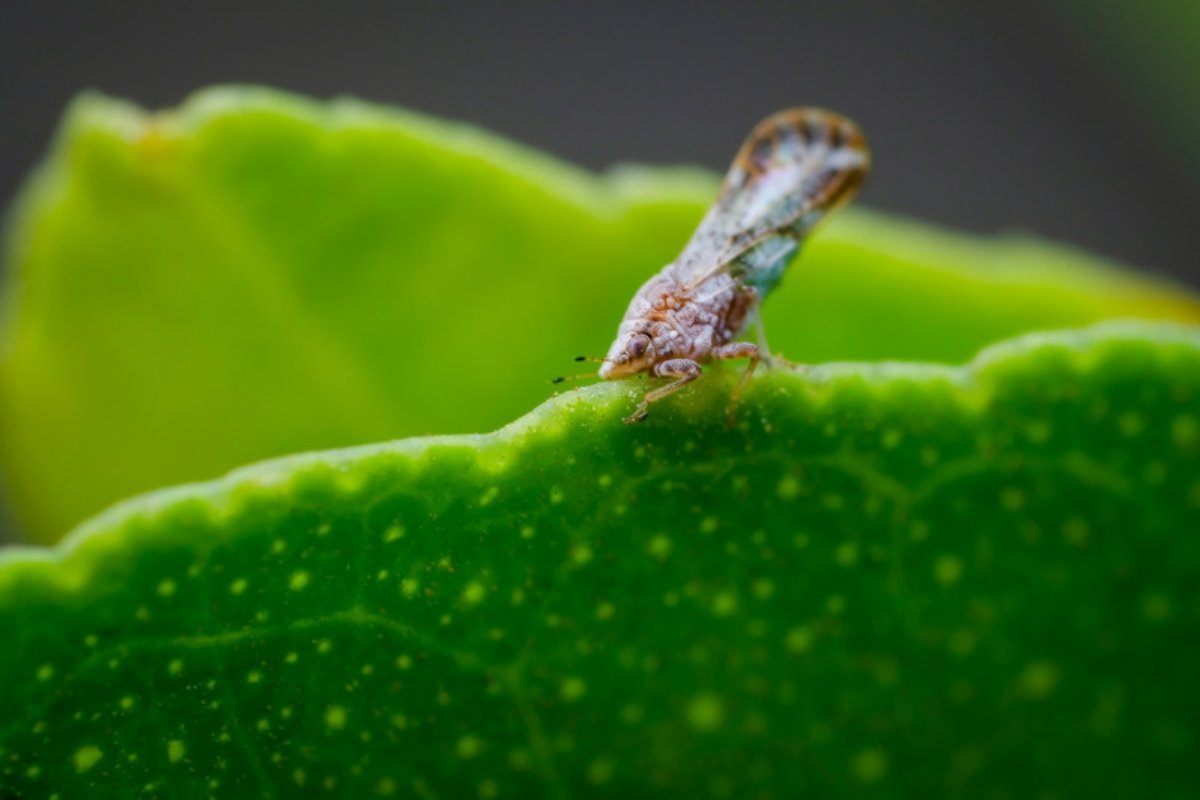
The recent detection of the Asian citrus psyllid, Diaphorina citri, on Rhodes, the first record of the insect in Greece, puts the country's citrus crops at risk.
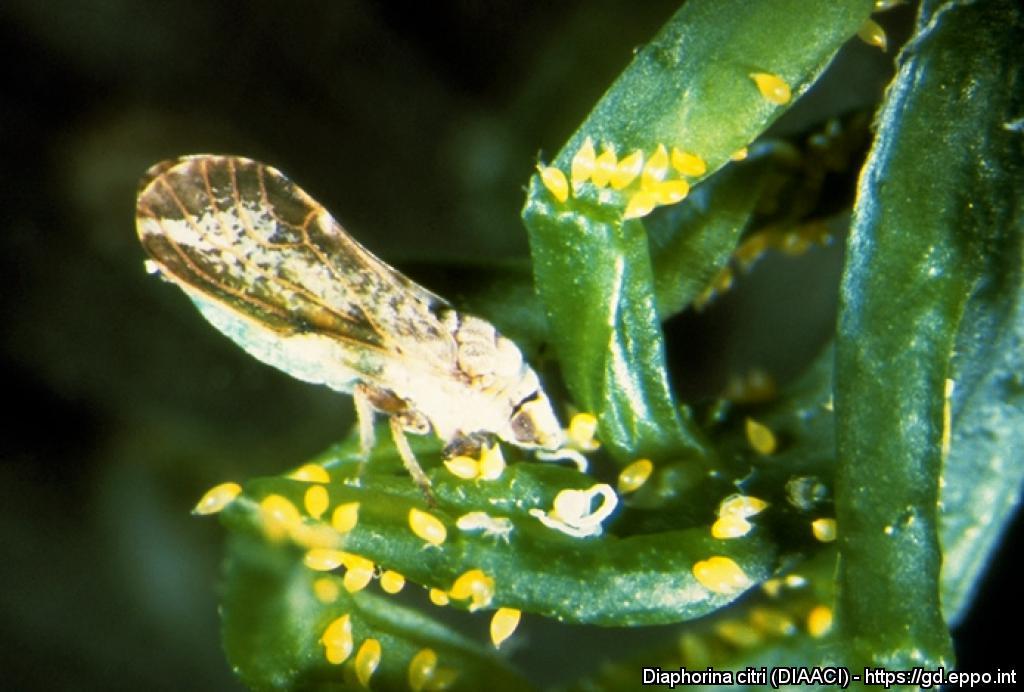
Adult of the Asian citrus psyllid and yellow eggs on a young citrus shoot. Photo: J.M. Bové, INRA Bordeaux, via the EPPO Global Database.
Which crops does the Asian citrus psyllid attack?
The insect belongs to the family Psyllidae and attacks all citrus species. Its main hosts are mandarin, lemon, sour orange, pomelo, grapefruit and lime, as well as the ornamental orange jasmine (Murraya paniculata) and Citrus × aurantiifolia var. macrophylla, which is used as a rootstock for grafting citrus.
Like all psyllids, it feeds by sucking sap from the plant. The main signs of this feeding are distorted, twisted and curled leaves and honeydew, which favours the growth of sooty mould fungi. A witches' broom can also appear, meaning many short, stunted shoots growing together. Severe infestations cause dieback and early leaf drop.
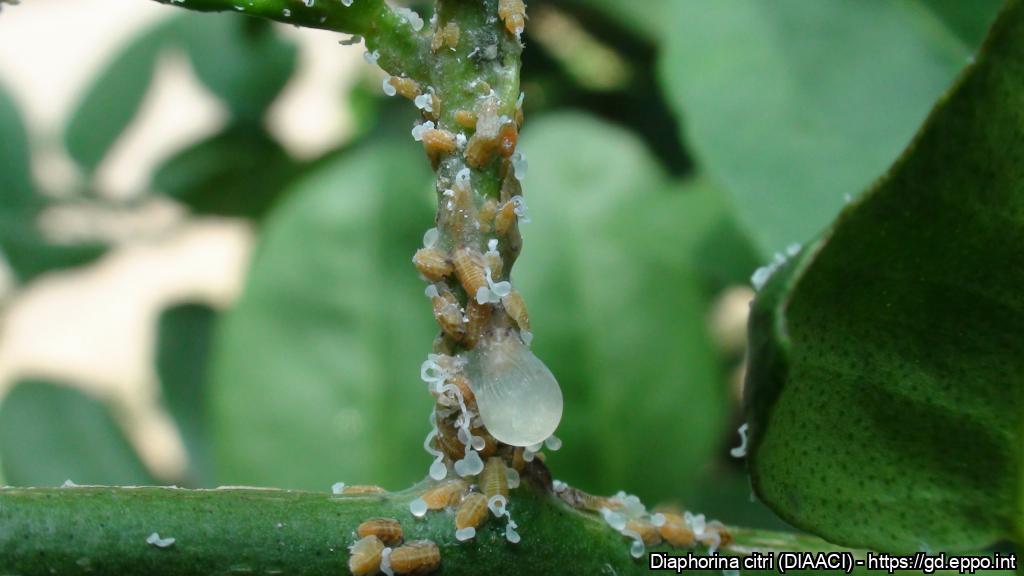
Nymphs of the Asian citrus psyllid with white waxy secretions and a drop of honeydew on a citrus shoot. Photo: Baswaraj Bhede, via the EPPO Global Database.
The psyllid carries the most dangerous citrus disease in the world
Beyond the feeding damage, the presence of the Asian citrus psyllid raises the risk that citrus greening, also known as huanglongbing or yellow dragon disease, will be introduced and spread. The disease is one of the most serious socio-economic threats to commercial citrus production worldwide.
Besides the direct damage it causes by feeding, the Asian citrus psyllid is the main vector of the three bacteria that cause greening, Candidatus (Ca.) Liberibacter asiaticus, Ca. Liberibacter africanus and Ca. Liberibacter americanus. The bacteria survive in the psyllid's body and pass from plant to plant as it feeds. Infection lowers fruit quality, cuts yields very sharply and kills infected trees. Florida is a well-known example, where very large yield losses hit the juice industry, and similar losses have followed in other parts of the world.
Ca. Liberibacter asiaticus, the main bacterium the psyllid transmits, is the most widespread worldwide, in Asia and the Americas. The nearest countries to Greece where citrus greening has been recorded are Saudi Arabia and Iran.
Fortunately, this very serious disease has not been found in Greece.
The Mediterranean is the only major citrus-growing region in the world that is still free of citrus greening. In the Mediterranean, the insect was first found in Israel in 2021 and then in Cyprus in 2023.
Rhodes is the third record of the psyllid in the Mediterranean
In August 2026 the insect was caught in traps in an orange orchard on Rhodes, set as part of the annual national survey programme, and the regional authorities announced the finding on 9 September.
The Benaki Phytopathological Institute confirmed the identification. Because the insect is listed as a quarantine pest in the European Union under Regulation (EU) 2019/2072, Annex II, Part A, its detection means eradication measures and stepped-up surveillance on the island.
How did this quarantine insect reach Rhodes? Over long distances it travels with air currents and with the trade in plant propagation material, such as budwood, grafted trees and rootstock seedlings, which are considered the likely pathways, while spread through the fruit trade is less likely.
Rhodes lies close to other areas with large citrus plantings, namely Crete and the provinces of Muğla and Antalya in Turkey, which makes the confirmed presence of the insect on the island perhaps the most dangerous development so far.
For this reason, surveys for any further spread in Greece and Turkey need to be stepped up, and the movement of plant material has to be checked thoroughly, both within Greece and between countries, especially material coming from Turkey and Greece.
Moving propagation material only with a plant passport is a basic measure against spread. Before they are moved, plants within an infested zone must be kept for at least one month in an insect-proof net house and sprayed every 15 days. Traceability records must also be kept for every batch of plants for planting.
How growers can find the psyllid on new growth
Growers should check new growth regularly, mainly the spring and summer flushes and the water sprouts. Because the damage the psyllid causes on trees looks like that of other citrus pests, such as the citrus leafminer, diagnosis is not easy unless the insect itself is found.
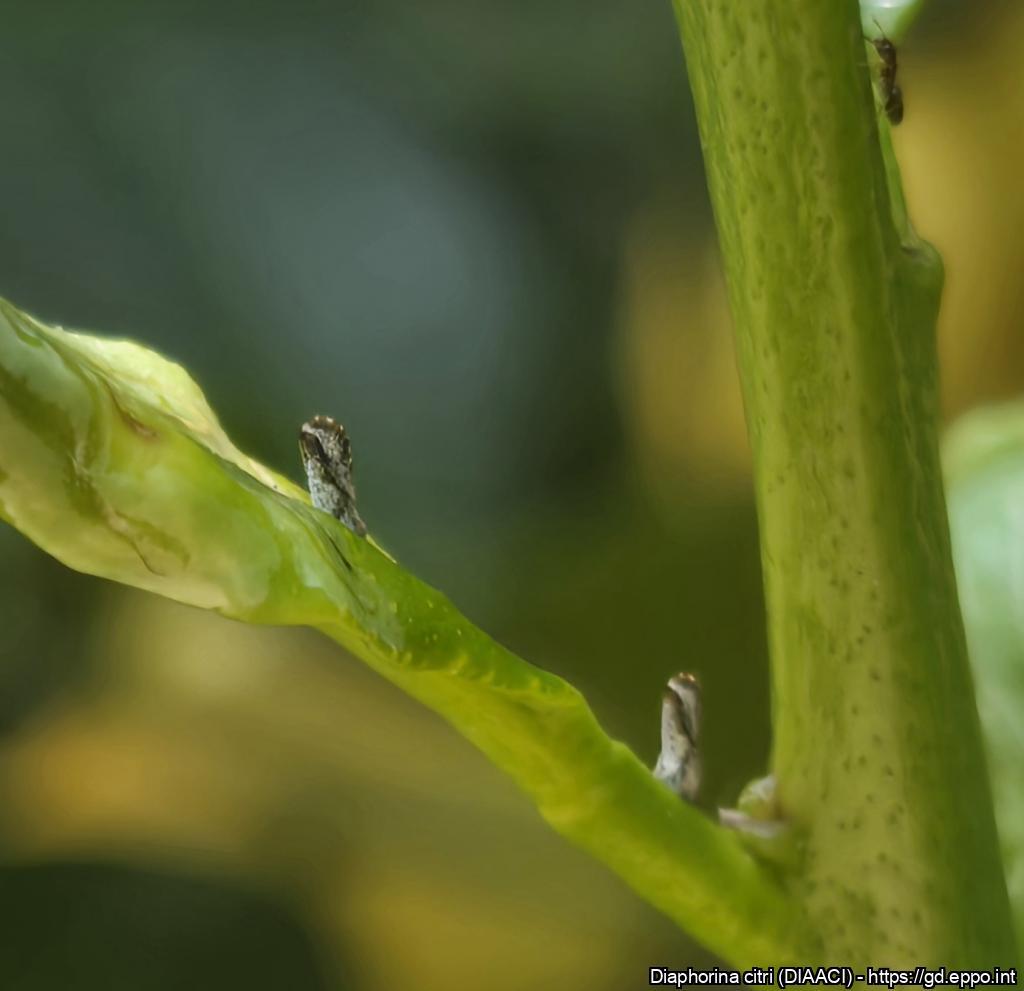
Adults of the Asian citrus psyllid on a young citrus shoot. Photo: Valeri Valentinova Dimitrova, via the EPPO Global Database.
Populations of the Asian citrus psyllid are found mainly on young, tender growth. The adult is about 2 to 4 mm long and brown, with whitish waxy secretions that make it look dusty. The eggs are 0.3 mm long, yellow or orange and elongated, and stand upright inside half-folded leaves, on buds, in leaf axils and in other suitable spots on the young, tender parts of the tree, its shoots and new flushes. The nymphs grow up to 1.7 mm long, are yellow or orange and carry white waxy filaments at the tip of the abdomen. In their last stages of development the nymphs have red eyes.
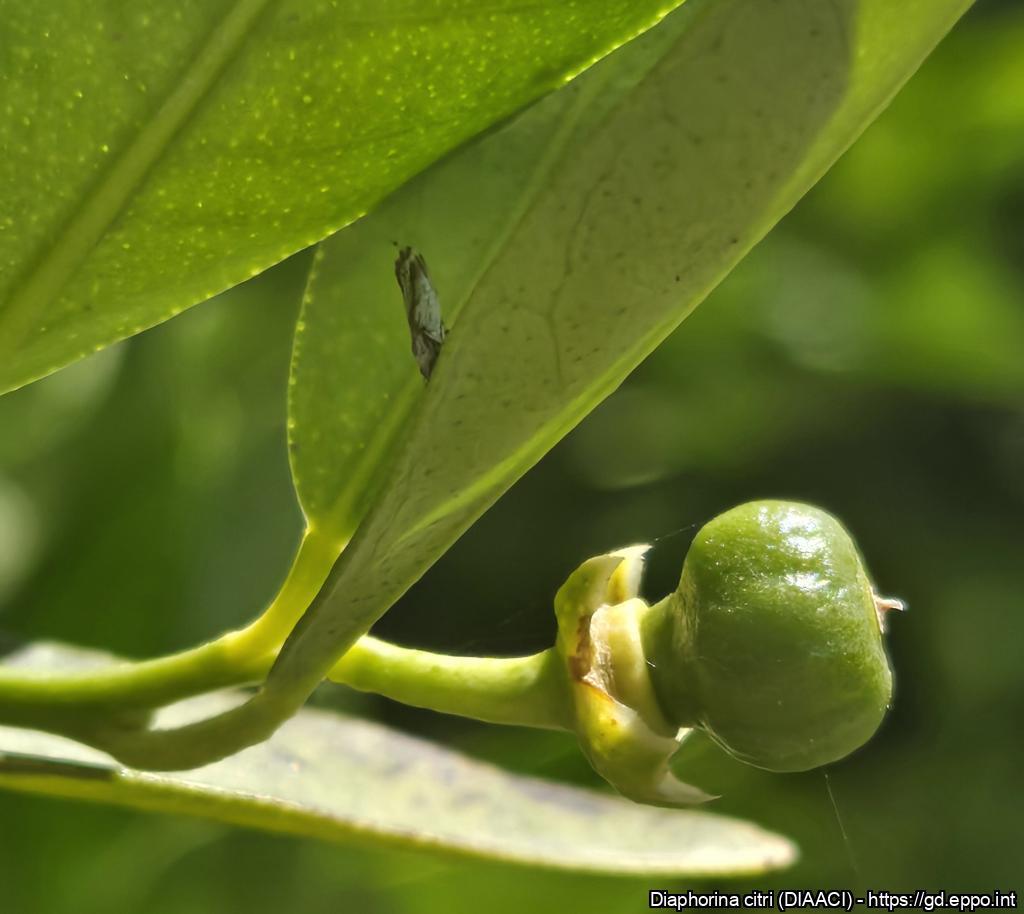
Adult Asian citrus psyllid on a citrus leaf next to a young fruit. Photo: Valeri Valentinova Dimitrova, via the EPPO Global Database.
If the psyllid appears, infested shoots must be destroyed inside the orchard and approved plant protection products applied.
How citrus greening symptoms differ from psyllid damage
Since citrus greening is not present in Greece, the symptoms caused by the insect have to be told apart from those of the greening bacteria it transmits. With greening, leaves show blotchy mottling and interveinal yellowing that looks like zinc deficiency but is asymmetric, appearing on only one side of the leaf. Trees also show small leaves, leaf drop and fruit drop. A typical sign is small, lopsided fruit that stays green on one side and has bitter juice, and cannot be sold.
What to do when the psyllid is suspected
- Suspect plant material must not be moved.
- The regional Directorate of Agricultural Economy and Veterinary Medicine (DAOK) must be informed immediately whenever symptoms or the insects themselves are suspected.
- No one should move citrus plant material with leaves from areas where the Asian citrus psyllid is present to areas where the insect has not been recorded.
Sources
- European Commission. (2019). Commission Implementing Regulation (EU) 2019/2072, Annex II, Part A. Official Journal of the European Union, L 319, 10.12.2019, pp. 1-279.
- EFSA. (2024). Huanglongbing, Trioza erytreae and Diaphorina citri. EFSA story map.
- EPPO. (2026). Diaphorina citri (DIAACI). EPPO Global Database.
- EPPO. (2026). Candidatus Liberibacter asiaticus (LIBEAS). EPPO Global Database.
- EPPO. (2026). First report of Diaphorina citri in Greece. EPPO Reporting Service 2026/205.
- FreshPlaza. (2026). HLB vector detected on the Greek island of Rhodes. 22 September 2026.
- GEOTEE. (2026). First appearance of the Asian citrus psyllid (Diaphorina citri) in Greece. Press release, 9 September 2026, in Greek.