Fermented Nectar for Pest Control? - How Microbial Brews Boost Beneficial Insects
Wine and beers are typical products of fermentation, and humans recognized very early their benefits (1), but what about the benefits of fermentations for… insects?
Small hint: Fermentation is performed by microbes, which use carbohydrates and amino acids from a starter product, such as milk or juice, for their own metabolism.
The process changes the product's chemical profile, enriching it with a new aroma, taste, texture, and nutrients. As a result, we get wine from smashed grapes and yogurt from milk. However, fermented foods and drinks may not only be valuable for our gut microbes and our… parties. But also for our future pest control management that promotes the ecological balance through the conservation of important beneficial insects in the agroecosystems (2–5). Maybe this is a bold statement, but let me first explain the reasoning behind it.
Intensive agriculture: Attracting our enemies while losing our allies
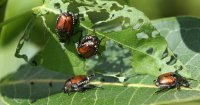
Nowadays, immense crop production areas are comprised of a few plant species. But the domination of a single plant in the landscape, the so-called monoculture, is highly attractive for the vegetarians of the insect world. Given that most organisms face food limitations in the wild (6), the presence of their favorite crop plant in such abundance seems like an invitation to a food heaven, a vast dining room filled with endless food. In such a biodiversity-depleted landscape, farmers and policymakers in the agricultural sector should not be astonished when they encounter large pest infestations (7,8).
This agricultural landscape may be attractive to the intruders that decimate or spoil a percentage of the yield, but it is indifferent to the enemies of the intruders. These carnivorous insects hunt and then kill or parasitize pests, reducing the pest numbers (9,10). These insects provide a valuable service with a monetary value of billions of dollars, without charging the farmers (11,12).
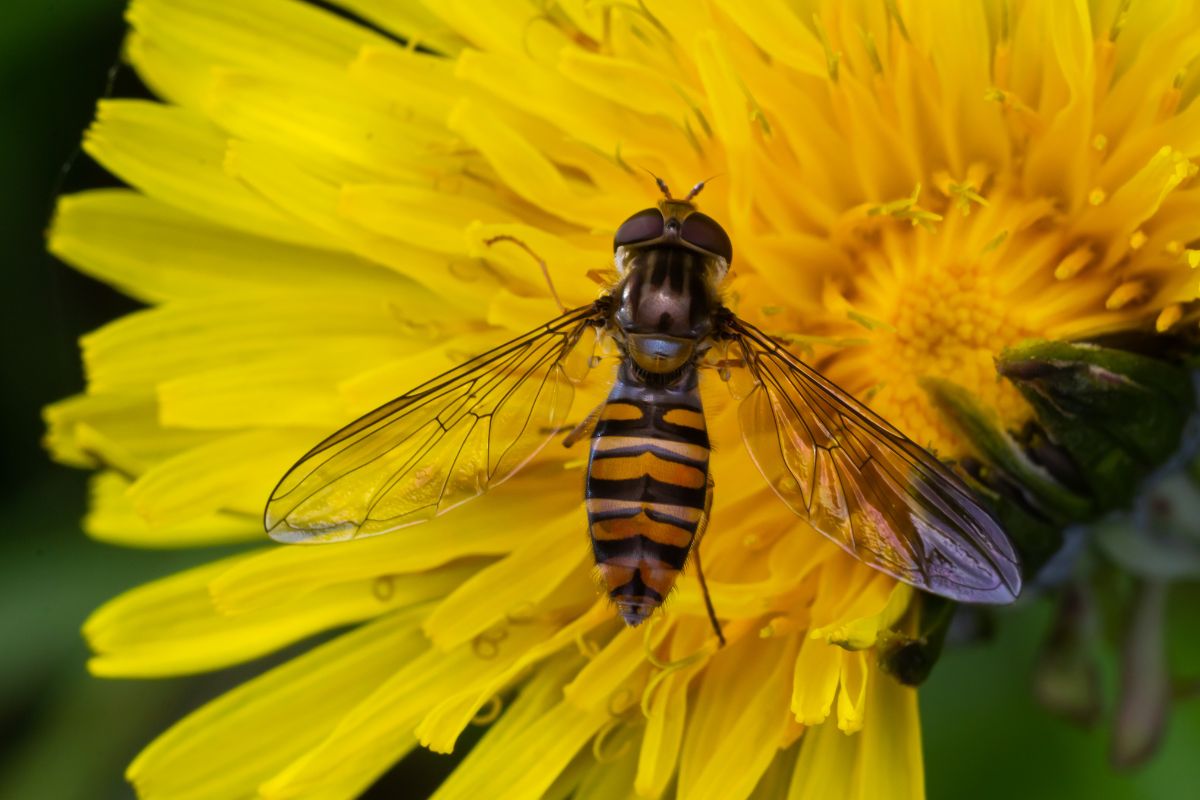
Syrphid flies, which are usually mistaken by untrained eyes as bees due to their black and yellow patterns, are definitely an iconic example (13). Among them, the species Episyrphus balteatus travels during spring from continental Europe to England. Within a year, the survivors of this long journey visit billions of flowers and give rise to the next generation, which consumes trillions of aphids during the larval stage (14). Overall, their absence in the agricultural landscape could cost $20.92 billion due to pest damage in the United States per year.
Another example with a remarkable life history is Hymenoptera, which are called parasitoids or parasitic wasps because they lay their eggs inside the bodies of other insects (15). Then, when their larvae hatch, they eat the insects from the inside out. Just like the movie Alien, this is a horror scenario for the pest itself, but a sustainable way to get rid of insect pests, since parasitoids target only a few species that are harmful and they do not pose a threat to other insects that have nothing to do with our crops (16).
Yet, these beneficial insects are rarely present in intensively agricultural landscapes, which have replaced the once beautiful habitats embellished by colorful flowers (9).
The modern-day landscape planning is not a sustainable option for many other reasons, such as soil erosion, nutrient loss, and depletion (17–19), and therefore, it is misleadingly perceived as profitable, given the high costs of frequent chemical applications (20). In particular, chemical applications pose a further challenge for the enemies of our enemies, the insects that protect our crop production from insect herbivores. Even chemical products with a selective mode of action may harm beneficial insects and arthropods (21,22), while they may also fail to eliminate the target pests (23,24).
What should be done? - And how is nectar even relevant here?
The good news is that consumers’ awareness related to food safety is growing, which establishes the ground for innovative ways to tackle pest infestations (25). And one way is to get inspiration from nature's solutions. To rely less on chemical products and avoid as much as possible the repercussions of their persistence in our foods and environment, we can reintroduce these beneficial insects and arthropods even in greenhouses by restoring the wild flora at the inside space and/ or their surroundings (26–28). Human interventions aiming to protect and enhance the performance of beneficial organisms in the agricultural landscape are usually referred to as Conservation Biological Control strategies (29).
Scientists have found many attractive plants that can nurture beneficial insects (30). For example, buckwheat is a common flowering plant in temperate regions (31), and sweet alyssum from the Mediterranean basin (32). The flower strips with different native flowers suitable for each time's climatic conditions can attract the insects in the fields, where they can detect and attack the pests. Nectar is also the sweet reward these flowers give to predators such as the syrphid flies (33) and parasitoids (34), which need the nectar to survive during adulthood.
The divine drink of the Greek gods, when given to good insects after being altered by… microbes
Nectar, a vital energy drink for many beneficial insects, once thought to nurture and grant everlasting life to the ancient Greek gods, is also home to microbes that can actually ferment it! Indeed, several microbes were isolated from the nectar of buckwheat flowers (3). Among the tiny inhabitants of nectar, some bacteria were given scientific names, which are characteristic of their sugary habitats:
- the friend of sugars Terribacillus saccharophilus (from the Greek σάκχαρον - sákcharon meaning sugar and φίλος - phílos, which means friend) and
- the sugar-Bacillus Saccharibacillus endophyticus.
By adding them individually to a mixture of sugar and amino acids that mimicked the chemical composition of natural nectar, we could obtain different fermented nectars from each microbe.
When we successfully obtained the fermented nectars, we didn't stop there. We fed them to a parasitic wasp that attacks the eggs of the southern green stink bug. Apart from its preference for a huge variety of crops, the stink bug is a well-known nuisance due to its horrible odor when disturbed.
Fermentations worked on our side!
Increased longevity of the parasitic wasps was associated with the consumption of fermented nectars by bacteria from the phylum Bacillota (2) and the fermentation of the nectar by one of them proved attractive to the wasps (3)! So, nectar fermentations by these bacteria can lower the pest pressure on the crop by increasing the number of wasps that are encountered with the pest! And our encounters with the stink bug and its unpleasant odors.
Before any application, we still need to test the efficiency of these nectar fermentations by bacteria in field conditions, where the southern green stink bug gathers to eat our food. The fermented nectar can be made accessible in the fields by spraying the flowers with the right microbes or by selecting flowers that usually have these microbes in their nectar. Under greenhouse conditions, the fermented nectar could also be supplied through feeders adequately designed for insect feeding (35).
And who knows, maybe in the future, other studies will prove that these nectar fermentations boost other beneficial insects that also consume nectar and are known to attack different pests. After all, the Olympian gods who consumed nectar and ambrosia to live longer were twelve in total. All kidding aside, thousands of beneficial species are still waiting to be discovered given the diversity of arthropods (36). Numerous ones have not been taken so much into consideration, such as spiders, even though they can be the first line of defense against insect pest invasions before other beneficials arrive (37,38). Overall, since the efforts of many insects and arthropods to protect our crops are monumental, we should treat them with fermented nectar!
References
1. Gogineni VK, Morrow LE, Gregory PJ, Malesker MA. Probiotics: history and evolution. J Anc Prev Rem. 2013;1(2):1–7.
2. Sarakatsani E, Ermio JDL, Rahman S, Bella P, Agrò A, Pinto ML, et al. Nectar‐inhabiting bacteria differently affect the longevity of co‐occurring egg parasitoid species by modifying nectar chemistry. Ann Appl Biol. 2024;
3. Cusumano A, Bella P, Peri E, Rostás M, Guarino S, Lievens B, et al. Nectar-inhabiting bacteria affect olfactory responses of an insect parasitoid by altering nectar odors. Microb Ecol. 2023;86(1):364–76.
4. Cusumano A, Lievens B. Microbe-mediated alterations in floral nectar: consequences for insect parasitoids. Curr Opin Insect Sci. 2023;60:101116.
5. Quevedo‐Caraballo S, de Vega C, Lievens B, Fukami T, Álvarez‐Pérez S. Tiny but mighty? Overview of a decade of research on nectar bacteria. New Phytol. 2024;
6. Abbott KC, Dwyer G. Food limitation and insect outbreaks: complex dynamics in plant-herbivore models. J Anim Ecol. 2007;1004–14.
7. Root RB. Organization of a plant‐arthropod association in simple and diverse habitats: the fauna of collards (Brassica oleracea). Ecol Monogr. 1973;43(1):95–124.
8. Paredes D, Rosenheim JA, Chaplin‐Kramer R, Winter S, Karp DS. Landscape simplification increases vineyard pest outbreaks and insecticide use. Ecol Lett. 2021;24(1):73–83.
9. Rusch A, Chaplin-Kramer R, Gardiner MM, Hawro V, Holland J, Landis D, et al. Agricultural landscape simplification reduces natural pest control: A quantitative synthesis. Agric Ecosyst Environ. 2016;221:198–204.
10. Buitenhuis R, Cock MJ, Colmenarez YC, De Clercq P, Edgington S, Gadaleta P, et al. Sustainable use and conservation of microbial and invertebrate biological control agents and microbial biostimulants. FAO; 2023.
11. Losey J. The Economic Value of Ecological Services Provided by Insects. BioScience. 2009;56:311–23.
12. Naranjo SE, Ellsworth PC, Frisvold GB. Economic value of biological control in integrated pest management of managed plant systems. Annu Rev Entomol. 2015;60:621–45.
13. Reynolds SK, Clem CS, Fitz-Gerald B, Young AD. A comprehensive review of long-distance hover fly migration (Diptera: Syrphidae). Ecol Entomol. 2024 Dec 1;49(6):749–67.
14. Wotton KR, Gao B, Menz MH, Morris RK, Ball SG, Lim KS, et al. Mass seasonal migrations of hoverflies provide extensive pollination and crop protection services. Curr Biol. 2019;29(13):2167–73.
15. Quicke DL. Parasitic wasps. 1997.
16. Bigler F, Babendreier D, Kuhlmann U. Environmental impact of invertebrates for biological control of arthropods: methods and risk assessment. CABI publishing; 2006.
17. Schneider KR, Fanzo J, Haddad L, Herrero M, Moncayo JR, Herforth A, et al. The state of food systems worldwide in the countdown to 2030. Nat Food. 2023;4(12):1090–110.
18. Goucher L, Bruce R, Cameron DD, Lenny Koh S, Horton P. The environmental impact of fertilizer embodied in a wheat-to-bread supply chain. Nat Plants. 2017;3(3):1–5.
19. Foucher A, Salvador-Blanes S, Evrard O, Simonneau A, Chapron E, Courp T, et al. Increase in soil erosion after agricultural intensification: Evidence from a lowland basin in France. Anthropocene. 2014;7:30–41.
20. Gurr GM, Lu Z, Zheng X, Xu H, Zhu P, Chen G, et al. Multi-country evidence that crop diversification promotes ecological intensification of agriculture. Nat Plants. 2016;2(3):1–4.
21. You Y, Lin T, Wei H, Zeng Z, Fu J, Liu X, et al. Laboratory evaluation of the sublethal effects of four selective pesticides on the predatory mite Neoseiulus cucumeris (Oudemans)(Acari: Phytoseiidae). Syst Appl Acarol. 2016;21(11):1506–14.
22. Theiling & Croft. Pesticide side-effects on arthropod natural enemies: a database summary. Agric Ecosyst Env. 1988;21:191.
23. Janssen A, van Rijn PC. Pesticides do not significantly reduce arthropod pest densities in the presence of natural enemies. Ecol Lett. 2021;24(9):2010–24.
24. Hubbard CB, Murillo AC. Behavioral resistance to insecticides: current understanding, challenges, and future directions. Curr Opin Insect Sci. 2024 Jun 1;63:101177.
25. van Lenteren JC, Bolckmans K, Köhl J, Ravensberg WJ, Urbaneja A. Biological control using invertebrates and microorganisms: plenty of new opportunities. BioControl. 2018;63:39–59.
26. Albrecht M, Kleijn D, Williams NM, Tschumi M, Blaauw BR, Bommarco R, et al. The effectiveness of flower strips and hedgerows on pest control, pollination services and crop yield: a quantitative synthesis. Ecol Lett. 2020;23(10):1488–98.
27. Mele A, Scaccini D, Zanolli P, Pozzebon A. Semi-natural habitats promote biological control of Halyomorpha halys (Stål) by the egg parasitoid Trissolcus mitsukurii (Ashmead). Biol Control. 2022;166:104833.
28. Conboy NJA, McDaniel T, Ormerod A, George D, Gatehouse AMR, Wharton E, et al. Companion planting with French marigolds protects tomato plants from glasshouse whiteflies through the emission of airborne limonene. PLOS ONE. 2019 Mar 1;14(3):e0213071.
29. Stenberg JA, Sundh I, Becher PG, Björkman C, Dubey M, Egan PA, et al. When is it biological control? A framework of definitions, mechanisms, and classifications. J Pest Sci. 2021;94(3):665–76.
30. Wäckers F, Van Rijn P. Pick and Mix: Selecting Flowering Plants to Meet the Requirements of Target Biological Control Insects. In: Biodiversity and Insect Pests: Key Issues for Sustainable Management. 2012. p. 139–65.
31. Virili A, Marusig D, Delle Vedove G, Marraccini E. Buckwheat (Fagopyrum esculentum Moench.) as an emerging companion crop in annual cropping systems: A systematic review. Ital J Agron. 2024;100006.
32. Landis DA, Wratten SD, Gurr GM. Habitat Management to Conserve Natural Enemies of Arthropod Pests in Agriculture. Annu Rev Entomol. 2000;45(1):175–201.
33. van Rijn PCJ, Wäckers FL. Nectar accessibility determines fitness, flower choice and abundance of hoverflies that provide natural pest control. J Appl Ecol. 2016;53(3):925–33.
34. Russell M. A meta-analysis of physiological and behavioral responses of parasitoid wasps to flowers of individual plant species. Biol Control. 2015;82:96–103.
35. Schifani E, Castracani C, Giannetti D, Spotti FA, Reggiani R, Leonardi S, et al. New tools for conservation biological control: Testing ant-attracting artificial Nectaries to employ ants as plant defenders. Insects. 2020;11(2):129.
36. Eggleton P. The State of the World's Insects. Vol. 45, Annual Review of Environment and Resources. Annual Reviews; 2020. p. 61–82.
37. Birkhofer K, Gavish-Regev E, Endlweber K, Lubin Y, Von Berg K, Wise DH, et al. Cursorial spiders retard initial aphid population growth at low densities in winter wheat. Bull Entomol Res. 2008;98(3):249–55.
38. Michalko R, Pekár S, Dul’a M, Entling MH. Global patterns in the biocontrol efficacy of spiders: A meta‐analysis. Glob Ecol Biogeogr.
Further reading
Hormesis: How Low-Dose Insecticides Can Enhance Pest Control
7 Modern and efficient ways to protect crops from pests and diseases
Important Beneficial Insects as Natural Enemies of Crop Pests
Biological control of greenhouse pests using natural enemies
What is Biological Control and how to be used in agriculture
Harnessing the Power of Natural Enemies: Biological Control in Almond Tree IPM