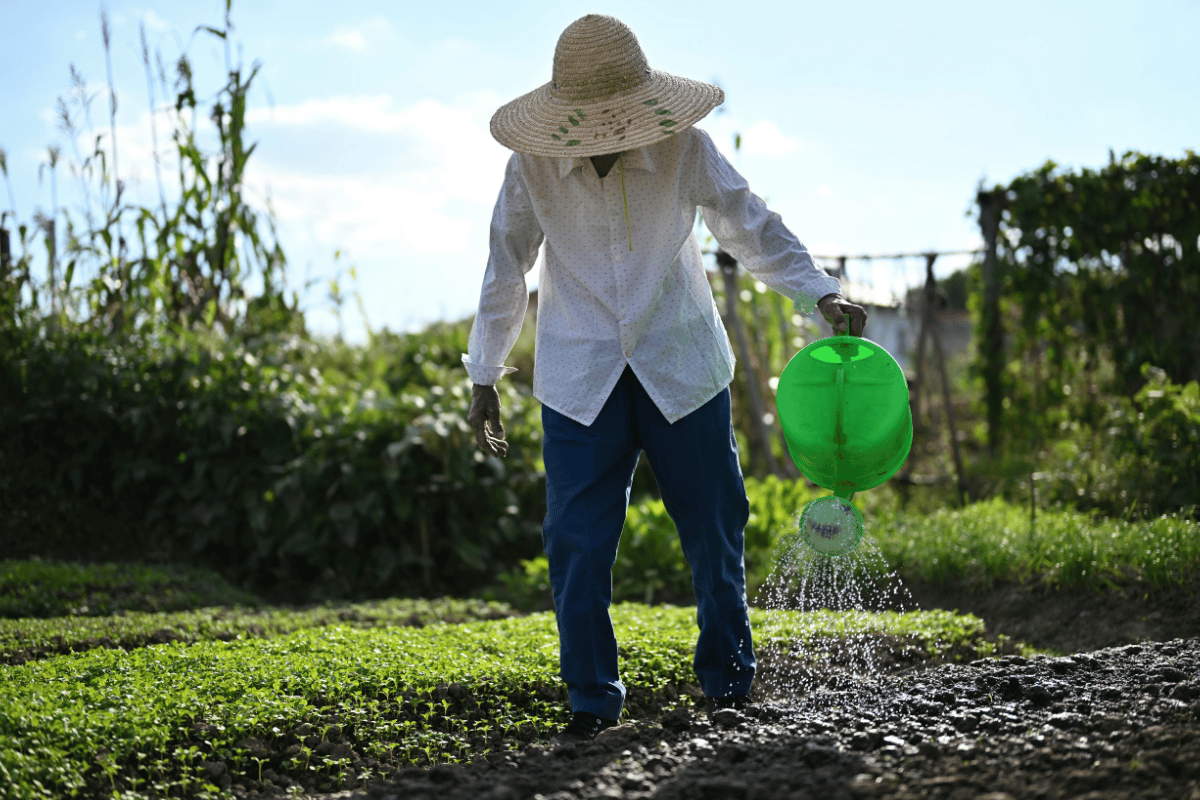
One of the first things many people learn about farming is that they need to water the crops every day. It sounds logical enough. If water helps plants grow, more water should help them grow better. But that is not always true.
The idea that changed how I think about this is that irrigation should imitate the way nature waters plants. It sounded strange at first, and the more I compared it with what I have seen on farms, the more sense it made. Rain does not fall every single day. There are heavy downpours, light showers, and dry periods in between; during those dry spells, roots search deeper into the soil for moisture. That cycle is what produces strong root systems and resilient plants. Many farmers, beginners especially, break the cycle without realising it by watering a little every day.
What happens when we water every day
Daily watering is not automatically wrong. There are situations where it is necessary, particularly for seedlings, for vegetables grown in containers, and during extreme heat. The problem starts when it becomes a habit applied without regard to the crop, the soil, or the weather.
When soil stays constantly wet, three things follow.
Roots receive less oxygen. Healthy roots need air as well as water, and when soil pores are permanently filled, oxygen becomes limited, and roots cannot function properly. Extension research describes this directly: frequent light applications, such as fifteen to twenty minutes three or more times a week, leave a shallow layer of continually wet soil that blocks oxygen movement, and roots deprived of oxygen eventually begin to die.
Constantly wet soil also favours fungal and bacterial disease. Root rot is among the most common consequences of overwatering, and once roots start to decay, the whole plant weakens even though the soil still looks moist.
Shallow watering produces shallow roots. Rather than growing down to where moisture lasts longer, roots stay near the surface because that is where water keeps arriving. The result is a crop that is far less able to cope with drought or heat.
How deep is deep enough, and how do you know
This is where general advice usually stops, so it is worth being specific. The useful rule is to wet the soil to just beyond the bottom of the root system, roughly half an inch deeper than the deepest living roots, in practice that means around 15 to 30 cm for most vegetables and ornamentals, and 30 to 60 cm for trees and shrubs. If only the surface stays moist, most of that water evaporates.
Checking is simpler than it sounds and needs no equipment. Push a finger, a screwdriver, or a thin rod into the soil near the root zone, or dig a small hole with a trowel. If the soil 5 to 10 cm down feels cool and slightly moist, watering can usually wait. If it is dry and crumbly at that depth, it is time. A probe pushed into the ground also tells you how far the last watering actually reached, which is often less than people assume.
The broader principle used in irrigation scheduling is to refill the root zone, then wait until roughly half the available moisture has been used before watering again. How long that takes depends on the weather and the soil, which is exactly why a fixed schedule struggles to get it right.
Different soils behave differently
A common mistake is assuming every field should be managed the same way.
Sandy soils drain rapidly and lose water quickly, so they may need more frequent irrigation, though still not necessarily every day. They also absorb water fastest, at roughly 5 cm an hour. Clay soils behave oppositely. They hold water far longer, absorb it slowly at a rate of little more than 1 cm an hour, and watering them too often leads to waterlogging, poor root growth, and disease. Loamy soils, with their balanced mixture of sand, silt, and clay, generally offer the best compromise between retention and drainage.
Frequency follows from this. On clay during cool weather with no rain, a single deep irrigation a month can be enough. In hot conditions, it might be two to four. A vegetable garden in summer commonly needs watering one to three times a week rather than daily. Understanding your soil matters as much as understanding your crop.
Different crops have different needs
Not every crop responds to irrigation the same way. Leafy vegetables usually need more consistent moisture than cassava or mature maize. Fruit trees develop deeper root systems and generally do better with less frequent but deeper watering.
Requirements also shift as a plant grows. Young seedlings have limited roots and need careful moisture management. Mature plants usually tolerate longer gaps. There is no universal irrigation schedule that suits every farm.
Learning from nature
Nature grew healthy plants long before irrigation systems existed, and rainfall has always been irregular. Dry spells follow several wet days, and plants evolved to handle that variation by developing deeper, stronger root systems.
This does not mean farmers should stop irrigating. It means irrigation should support the crop without undermining the benefit of allowing roots to search for water. The practical version is to water deeply enough to reach the root zone, then let the upper layer of soil begin to dry before watering again. That encourages deeper rooting and reduces disease risk.
Using mulch to reduce unnecessary watering
Mulching is one practice that has helped many farmers cut irrigation frequency. Organic materials such as dry grass, rice straw, or crop residues cover the soil surface and slow evaporation. Mulch also moderates soil temperature, suppresses weeds, and gradually improves soil organic matter as it breaks down. Rather than watering every day because the surface looks dry, mulch keeps moisture where the roots actually need it.
Modern irrigation focuses on efficiency
Irrigation systems are becoming more precise. Drip irrigation delivers water directly to the roots, reducing waste and limiting leaf diseases caused by wet foliage. Clay pot or olla irrigation releases water slowly into the soil, so plants draw moisture as they need it, with very little lost. The goal is no longer to apply more water. It is to apply the right amount at the right time.
Observe your crops, not the calendar
Fixed routines rarely produce the best results. University extension guidance puts it plainly: because water needs change through the season, irrigating by the calendar is not recommended.
So check the soil moisture below the surface rather than judging by the top. Watch for early signs of water stress, such as foliage that turns dull or greyish when it is normally glossy, or growing tips that wilt in the afternoon and recover overnight. Take into account recent rainfall, temperature, humidity, and the stage the crop has reached. Good irrigation decisions come from observation rather than habit.
The question is worth asking
Water is one of agriculture most valuable resources, and like fertiliser, more is not always better. Many farming practices become traditions because they worked under particular conditions, but agriculture keeps changing and good farmers adjust as they learn.
So the next time someone says every crop should be watered every day, there is a better question to ask. Does this crop actually need water today, or am I simply following a routine? Sometimes giving plants a little time before the next irrigation is exactly what makes them stronger.
Sources
UC ANR Small Farms Network. Tips on irrigating vegetables.
UC Master Gardener Program. Irrigation.
UC Statewide IPM Program. Estimating irrigation needs.
USDA Natural Resources Conservation Service. Estimating soil moisture by feel and appearance.
Nebraska Extension. Deep, infrequent irrigation makes lawns and trees healthier.
Oregon State University Extension. Soil moisture monitoring to support irrigation scheduling.
Texas A&M AgriLife. How to estimate soil moisture by feel.