
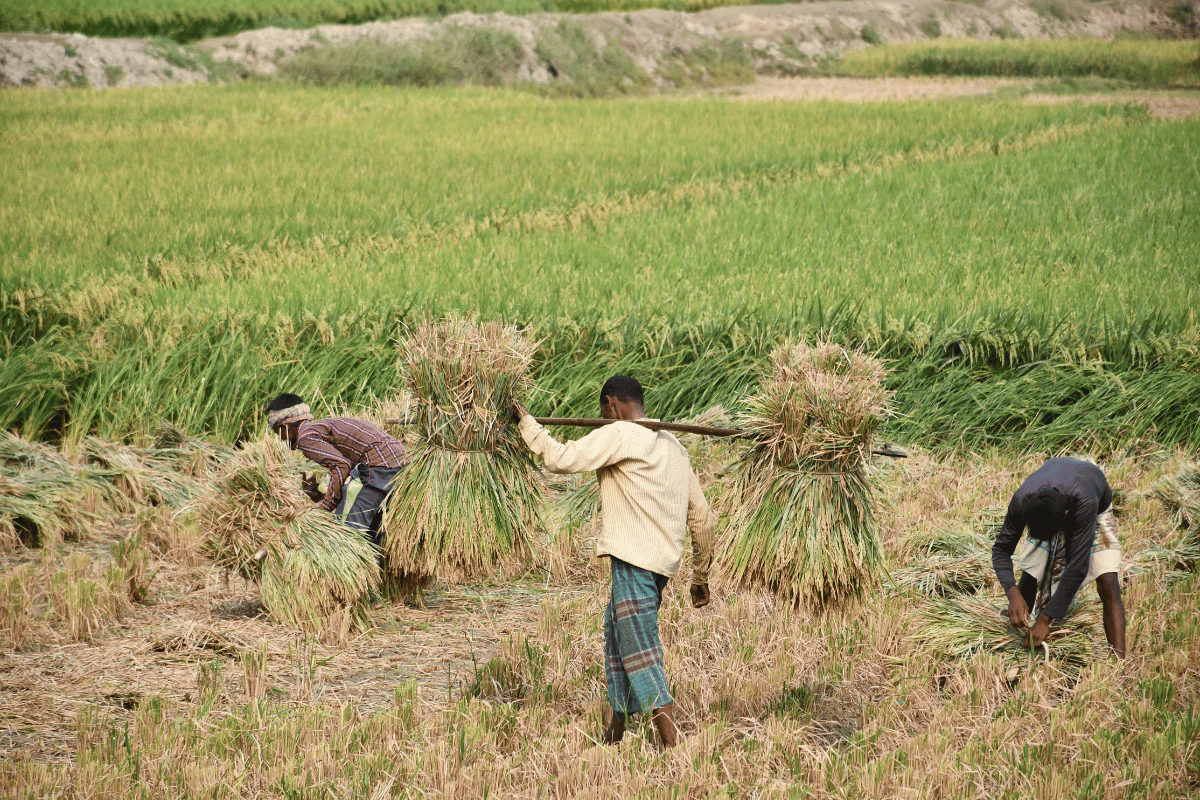
The economic reality of smallholder farming
Smallholder farmers are typically defined as producers operating on relatively small landholdings, often less than two hectares, and relying primarily on family labour for production. This definition, widely used by institutions such as the Food and Agriculture Organisation and the World Bank, reflects both the scale of production and the resource constraints that characterise smallholder systems.
Smallholder farmers account for an estimated 510 million farms worldwide and form the backbone of agricultural production systems in many regions. Despite their scale and importance, smallholder farming is frequently associated with low and unstable incomes. This challenge is not merely a function of low output, but rather the result of structural and managerial constraints that limit efficient resource use and effective market participation. In practical terms, higher production does not automatically translate into higher income. Profitability depends on how well farmers manage costs, plan activities, and align production with market demand. Without these elements, even productive farms can remain financially fragile.
What profitability means in farming
Profitability in farming refers to the farm's ability to generate financial returns after accounting for all costs involved in production. It is the difference between total revenue earned from farm outputs and the total costs incurred, including farm inputs, labour (including family labour), transport, and post-harvest losses. A farm is considered profitable when this margin is consistently positive over time.
Why profitability remains low
Smallholder farmers operate within complex systems where profitability is shaped by both internal management practices and external structural constraints. According to the World Bank, many smallholders face significant barriers that include limited access to inputs, finance, poor soils, unpredictable rainfall, imperfect markets, and broader infrastructure gaps. These constraints reduce productivity and limit farmers' ability to sell output at favourable prices.
Inaccurate record-keeping. Many smallholder farmers assess performance based on sales or cash received rather than actual profit. They often perceive success from the amount earned without accounting for the full cost of seeds, fertiliser, labour, and other expenses. As a result, farming activities that appear profitable may generate minimal or no net returns. Without cost tracking, farmers cannot reliably evaluate input efficiency, compare enterprises, or respond to changing price conditions.
Production without market integration. In many regions, production decisions remain supply-driven rather than demand-driven. A case study from South Africa's Gauteng province shows that smallholders are often excluded from high-value markets due to a lack of market information, quality standards, and consistent supply capacity. Most sales occur at the farmgate or informal markets where prices are lowest and most volatile.
Input access, cost structures, and efficiency gaps. Limited access to affordable finance forces farmers to underinvest or purchase inputs at suboptimal quantities and prices. In Kenya, the Alliance for a Green Revolution in Africa (AGRA) has highlighted how the lack of working capital along value chains reduces both production efficiency and market participation. Profitability improves when financial, agricultural, and market systems are aligned.
Small scale without strategy. Small farm size becomes a constraint when it is not matched with deliberate production strategies such as intensification, specialisation, or enterprise selection. Many smallholders operate diversified but low-intensity systems that spread resources too thinly across multiple activities. According to the FAO and IFAD, improving productivity depends on more efficient use of inputs, labour, and management within sustainable intensification frameworks. Without strategic focus, limited land and capital produce diminishing returns per unit area.
Lack of proper planning and financial management. Beyond record-keeping, many smallholder farmers lack forward-looking financial planning, which limits their ability to make strategic decisions before committing resources. A 2025 IFPRI stochastic frontier analysis of Rwandan smallholders found that farmers operate at only about 45% of their potential productivity given the same inputs and technology, with inefficiencies largely tied to management decisions, resource allocation, and access to information. Across most of sub-Saharan Africa, many smallholder farmers lack the managerial skills required to engage in commercialised agriculture, adjusting decisions after shocks occur rather than anticipating them.
Practical ways to improve profitability
Improving profitability in smallholder systems requires a shift from production-focused farming to decision-driven, market-aware farm management. Between 2022 and 2024, IFAD-supported projects saw smallholder beneficiaries increase their income by an average of 34%, with production rising 35% and market access improving by 34%. In nearly half of sampled projects, this led to "transformational impacts," with some participants increasing income by more than 50%. These results came from integrated interventions that combined improved practices, farmer capacity building, and stronger market linkages.
A foundational step is addressing the widespread challenge of inaccurate profit estimation. Many farmers operate without a clear understanding of their true costs and returns. To address this, smallholder farmers must engage in record-keeping, farm budgeting, and cost analysis. With accurate farm data, it becomes possible to evaluate enterprise performance, identify inefficiencies, and make informed adjustments over time.
Beyond data collection, profitability improves when farmers use this information to guide enterprise selection, input use, and production timing. Programmes such as One Acre Fund have demonstrated that when farmers receive integrated support (inputs, credit, and advisory services), they are better able to coordinate decisions and improve both yields and incomes. Sustainable profitability is achieved through a combination of accurate information, deliberate planning, and effective market engagement.
How to check if your farm will make profit
Before starting any farming activity, estimate expected revenue and total costs to determine potential profit. Revenue depends on yield and selling price, while costs include inputs, labour, transport, and post-harvest losses. A simple tool farmers can use is a gross margin calculation:
Gross Margin = Total Revenue – Variable Costs
If the margin is positive and sufficient to cover risks, the enterprise is worth pursuing. Farmers should also compare alternatives and consider price fluctuations. Using basic budgeting tools helps farmers avoid unprofitable investments and supports better decision-making before resources are committed.
Moving towards sustainable farm profitability
Smallholder farmers do not struggle with profitability simply because they produce less, but because production is often disconnected from planning, cost awareness, and market realities. Profitability depends on how effectively farmers manage resources and make informed decisions. For many smallholders with limited land, this means increasing returns per unit of land, labour, and inputs through better planning and efficient resource use. By adopting record-keeping, budgeting, and market-oriented practices, farmers can move beyond subsistence and build more resilient, income-generating systems. Improving profitability is not about doing more, but about doing better, and treating the farm as a business.
References
Sources are hyperlinked throughout the article. Key references include:
- World Bank. Working with Smallholders: A Handbook for Firms Building Sustainable Supply Chains.
- Ngarava, S., et al. (2019). Supply chain risks and smallholder fresh produce farmers in the Gauteng province of South Africa. Southern African Business Review.
- Alliance for a Green Revolution in Africa (AGRA). Building resilience of Kenyan smallholder farmers.
- Benimana, G. U., Warner, J., & Missiame, A. K. (2025). Unlocking agricultural efficiency: A stochastic frontier analysis of smallholder farmers in Rwanda. IFPRI Rwanda SSP Working Paper 17.
- IFAD. (2025). IFAD pledges to transform the lives of at least 70 million small-scale food producers. 34% income increase, 35% production increase, 34% market access improvement across 2022–2024 projects.
- One Acre Fund — integrated smallholder support programme (inputs on credit, training, market access).