

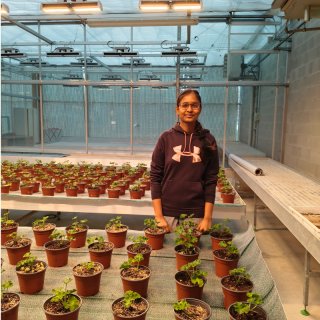
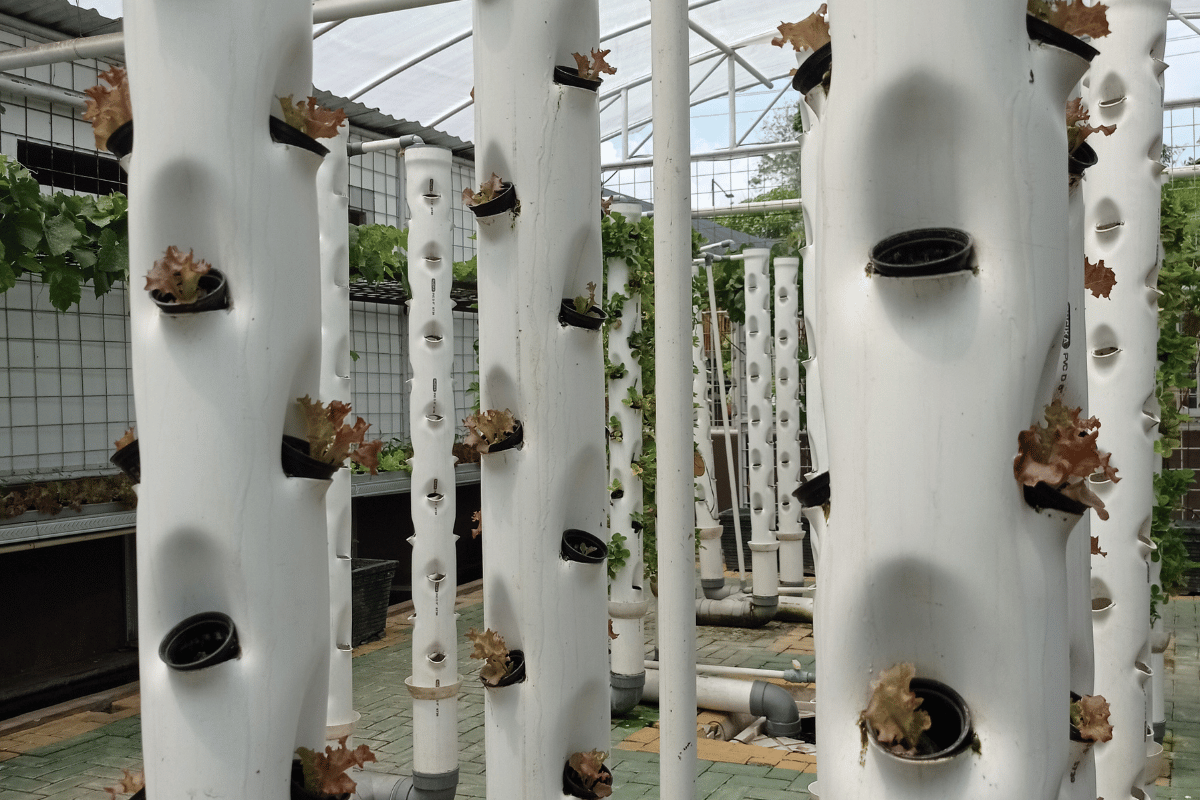
Modern vertical farms integrate two types of crop cultivation systems: hydroponics (in water) and aeroponics (in air or mist). In hydroponics, soilless substrates such as coconut coir or perlite serve as the growing medium, with nutrients circulated through water. The commercially used techniques include nutrient film technique, deep water culture, drip irrigation, and ebb-and-flow systems. Short-cycle, quick-growing leafy greens such as lettuce, kale, bok choy, spinach, mint, and basil are grown with the goal of obtaining high yield per unit area.
The growing trend toward high-value, nutrition-focused food consumption has enabled vertical farms to focus on high productivity with minimal pesticide use. The two major sustainability challenges of hydroponic farming in highly controlled environments are high energy use for lighting and reliance on inorganic mineral nutrient sources. Meanwhile, agri-food processing industries generate around 1 billion tonnes of organic waste (Hasan et al., 2025) in the form of pomace and peel. This trade-off opens scope for exploring the use of agri-food waste as an organic nutrient input that could supplement non-renewable mineral fertilizers.
Crop production trials using organic nutrient solutions
In the context of a circular bioeconomy, organic fertilizers can be prepared from plant residues and waste by-products of the fruit and vegetable processing industry. A recent study experimenting with olive mill wastewater and olive pits as a growing medium in lettuce cultivation showed a 40% increase in consumer purchase preference, with no signs of phytotoxicity observed during cultivation (Oliveira et al., 2026). A fruit and vegetable waste-based organic fertilizer study reported that it could potentially replace chemical liquid fertilizer in cucumber and lettuce production in a hydroponic system, though not significantly in cherry tomato cultivation (Siddiqui et al., 2023).
Another experiment with lettuce using a bio-product (a mix of coffee grounds, brown sugar, wood ash, chicken manure, and wood shavings) demonstrated improvement in root and shoot development at a concentration of 50 ml/litre (Vogelmann et al., 2025). Organic waste-based fertilizer obtained from pig manure digestion improved fruit size, but in terms of quality parameters such as firmness, acidity, and soluble solids, it was less effective than high-mineral cultivation. The leaves showed high chlorine concentration and low phosphorus and sulphur content (Kechasov et al., 2021).
Waste valorization approaches for nutrient recovery
Waste valorization in agriculture refers to the recycling, reuse, or composting of agro-industrial wastes into valuable products. Pelayo Lind et al. (2021) experimented with an approach of using biogas digestate (the liquid by-product after anaerobic digestion of organic waste) as the sole fertilizer source in a nutrient film hydroponic cultivation of bok choy. Initially, all plants showed a slower growth rate. Improvements in shoot and root weight followed after extending the cultivation period by one week. Apart from anaerobic digestion, aerobic microbial digestion and compost tea methods are among the other waste valorization methodologies.
There are currently no effective, consistent conversion methods or cost-comparison studies with conventional hydroponic nutrient solutions. Another waste valorization approach uses fish waste as a nitrogen source for plants in a system called aquaponics, a method combining aquaculture with hydroponics in an open (non-circulating) or closed-loop (circulating) system. With equivalent production costs for purchased fertilizers, the aquaponics system reached equilibrium, while compost tea did not (SARE, 2012).
Limitations
Even though the use of organic nutrient solutions appears attractive, a recent commentary from the University of Bologna highlighted the biological complexity of nutrient availability for plant uptake and the challenge of evaluating mineralization ratios as major obstacles in vertical farming (Arcas-Pilz & Orsini, 2026). The two primary challenges in producing food waste-based hydroponic fertilizers are nutrient density relative to salinity and microbial activity (Wang et al., 2025). There is also an ongoing debate in the US, where traditional organic farmers stress the role of healthy soil for healthy food production, pushing back against organic hydroponics operations that present their cultivation practices as sustainable and compliant with USDA regulations (Di Gioia & Rosskopf, 2021).
Future perspectives
The emerging concept of converting agri-food waste into organic fertilizer for use in hydroponic systems as a replacement for mineral fertilizer is called "bio-ponics." Despite the challenges outlined above, a research gap remains around the study of secondary metabolites such as phenols, terpenoids, and alkaloids, and how their content changes when agri-food waste-based organic liquid fertilizer is used in hydroponics compared to commercial mineral fertilizers. Further experiments should explore all commonly cultivated hydroponic leafy greens paired with widely available horticulture industry by-products, such as apple and grape pomace in Europe or mango peel from pulping industries in India, where large-scale food processing operations are concentrated.
References
Arcas-Pilz, V., & Orsini, F. (2026). Rethinking organic fertilization in soilless systems: Context, circularity and the need for a common framework. European Journal of Horticultural Science.
Di Gioia, F., & Rosskopf, E. N. (2021). Organic hydroponics: A US reality challenging the traditional concept of "organic" and "soilless" cultivation. Acta Horticulturae, 1321, 275–282.
Hasan, M., Maheshwari, C., & Rudra, S. G. (2025). Editorial: Agri-food waste utilization for sustainable future: challenges and opportunities. Frontiers in Sustainable Food Systems, 9.
Kechasov, D., Verheul, M. J., Paponov, M., Panosyan, A., & Paponov, I. A. (2021). Organic Waste-Based Fertilizer in Hydroponics Increases Tomato Fruit Size but Reduces Fruit Quality. Frontiers in Plant Science, 12.
Oliveira, M., Ferreira, R. A., Almeida, A., Fernandes, A., Carvalho, F., & Afonso, A. (2026). Valorization of Treated Olive Mill Wastewater and Olive Pits in Hydroponic Systems for Lettuce Production. Water, 18(3).
Pelayo Lind, O., Hultberg, M., Bergstrand, K.-J., Larsson-Jönsson, H., Caspersen, S., & Asp, H. (2021). Biogas Digestate in Vegetable Hydroponic Production: pH Dynamics and pH Management by Controlled Nitrification. Waste and Biomass Valorization, 12(1), 123–133.
SARE. (2012). Reducing Input Costs for Urban Aeroponic and Hydroponic Farming. SARE Grant Management System.
Siddiqui, Z., Hagare, D., Liu, M.-H., Panatta, O., Hussain, T., Memon, S., Noorani, A., & Chen, Z.-H. (2023). A Food Waste-Derived Organic Liquid Fertiliser for Sustainable Hydroponic Cultivation of Lettuce, Cucumber and Cherry Tomato. Foods, 12, 719.
Vogelmann, E. S., Júnior, J. B., & Tiruneh, G. A. (2025). Bio-product as a nutritional approach for sustainable hydroponic lettuce cultivation. Discover Applied Sciences, 7(8), 881.
Wang, O., Deaker, R., & Van Ogtrop, F. (2025). A systematic review of food-waste based hydroponic fertilisers. Agricultural Systems, 223, 104179.