


How Plants Reprogram Their DNA to Fight Disease: The Role of Chromatin Remodeling in Plant Immunity
Plants don’t have immune systems like ours and no antibodies or white blood cells. Yet, they're constantly fighting off infections from bacteria, fungi, and viruses. So, how do they defend themselves? The answer lies in their DNA and how they control it.
Plants can reprogram their genetic material, their DNA, to fight diseases, a process known as chromatin remodelling, which helps plants activate their immune defences. Understanding this could be the key to breeding stronger, disease-resistant crops, reducing the need for chemical pesticides and improving food security.
How plants defend themselves against disease
Plants and harmful microbes have been fighting each other for millions of years. Unlike animals, plants can’t run away or make antibodies, so they've developed their own clever ways to protect themselves (Ausubel, 2005).
Before a plant pathogen can infect a plant, it has to get past its natural barriers. These include the waxy coating on leaves, tough cell walls, and special chemicals that stop microbes from growing. Most pathogens fail at this stage, a natural resistance that keeps many diseases at bay. However, the few that break through then have to face the plant’s immune system, which can remember past infections and respond faster next time (Reimer-Michalski & Conrath, 2016).
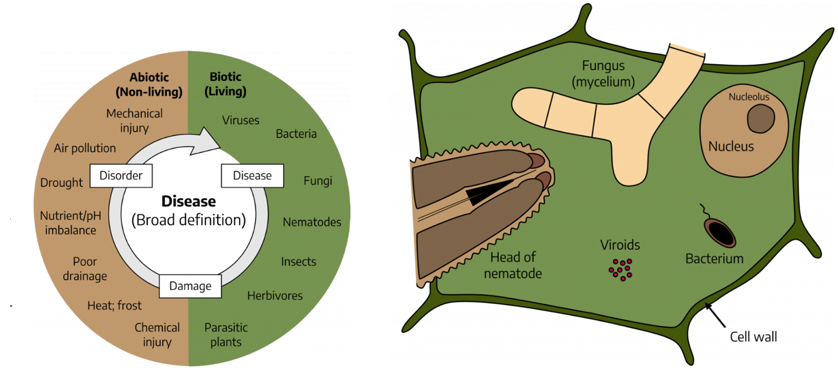
Figure 1. a) Abiotic and biotic factors of plant diseases. b) Schematic diagram of the shapes and sizes of certain plant pathogens in relation to a plant cell. Picture from Chapter 4 — Extension Master Gardener training, Virginia Tech Pressbooks .
Different pathogens attack in different ways. Bacteria slip in through tiny openings like stomata or wounds, then spread between plant cells. Fungi grow thin threads that pierce through plant tissues. But no matter how they attack, all pathogens must avoid being detected by the plant and weaken its immune response.
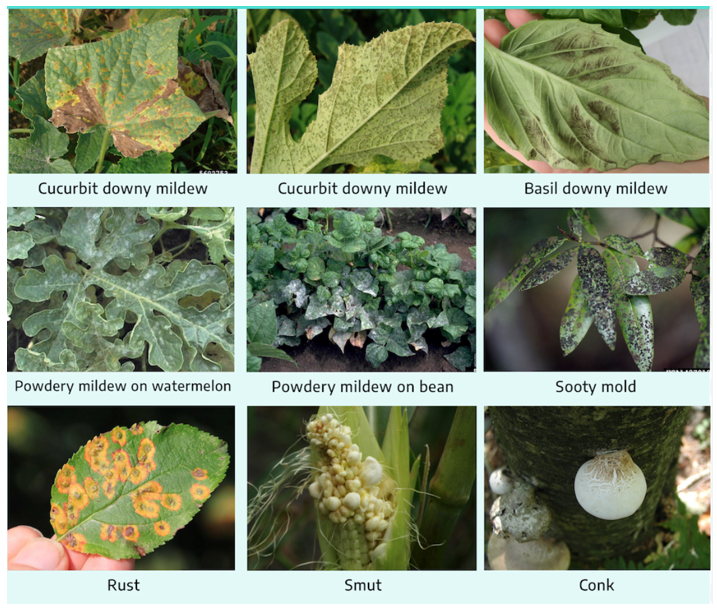
Figure 2. Visible structures produced by plant pathogens. Picture from Chapter 4 — Extension Master Gardener training, Virginia Tech Pressbooks .
What is chromatin remodeling, and why does it matter?
In every plant cell, DNA is packed tightly with proteins into a structure called chromatin. This compact packaging controls which genes are turned “on” or “off.” When a plant detects a pathogen, it rapidly activates a defense response by opening up certain regions of its DNA, allowing immune-related genes to be expressed. This dynamic shift is called chromatin remodeling, and it is reprogramming the gene expression (Bannister and Kouzarides 2011; Tao, Xie et al. 2003; Tsuda, Sato, et al. 2009).
The plant resistance depends on how quickly and effectively the plant can activate its immune genes when under attack. One key part of this defense is chromatin remodeling, a process that unlocks specific regions of DNA to turn on the right genes at the right time. There are two forms of the chromatin:
- Euchromatin: When chromatin is in an open, accessible state, the plant can rapidly produce the proteins and signals needed to fight off bacteria, fungi, or viruses, and
- Heterochromatin: If the chromatin remains tightly packed, the immune response is slower or blocked entirely, making the plant more vulnerable (Fig. 1).
This balance works like a switch; only when the chromatin is relaxed can key defense genes be read and activated. When a pathogen invades, the plant must act quickly. It does this by reshaping its chromatin to “unlock” defense-related genes, allowing them to be turned on and mobilize an immune response.
Strengthening this natural resistance through breeding or better-growing conditions can help crops respond faster and more effectively to disease threats.
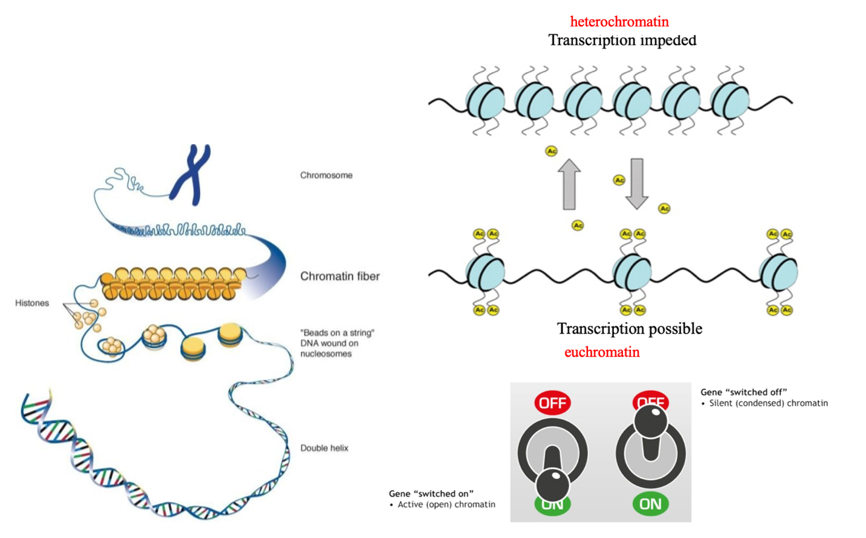
Figure 3. Heterochromatin and euchromatin formation regulate transcription. A) chromatin is composed of DNA and histones that are packaged into thin, stringy fibers. The chromatin undergoes further condensation to form the chromosome. The chromatin is a lower order of DNA organization, while chromosomes are the higher order of DNA organization. B) When open chromatin, the transcription is possible. When the chromatin is condensed, the transcription is inactive.
What does this mean for farmers and agriculture worldwide?
In many regions of the world, farmers lose up to 30% of their crops to disease. With climate change accelerating the spread and severity of plant pathogens, building disease-resistant varieties has never been more urgent. Traditional chemical controls are becoming less effective and more environmentally problematic.
As climate change brings new diseases and pests, understanding plant immunity gives us new tools to protect harvests naturally. Understanding how plants internally rewire themselves to fight infection opens the door to natural, genetic solutions. By identifying key chromatin remodeling events that enhance resistance, we can breed crops that are faster and stronger in their immune responses, reducing losses, improving yields, and promoting ecological farming. By linking fundamental biology with agricultural applications, we can build a roadmap to climate-resilient, disease-resistant crops.
As the world faces increasing food insecurity and climate instability, rethinking how we protect plants is more important than ever. Chromatin remodeling may be invisible to the naked eye, but its impact on the future of farming could be transformative.
References:
Ausubel, F. M. (2005). "Are innate immune signaling pathways in plants and animals conserved?" Nature Immunology 6(10): 973-979.
Reimer-Michalski, E. M. and U. Conrath (2016). "Innate immune memory in plants." Semin Immunol 28(4): 319-327.
Bannister, A. J. and T. Kouzarides (2011). "Regulation of chromatin by histone modifications." Cell Research 21(3): 381-395.
Tao, Y., Z. Xie, W. Chen, J. Glazebrook, H.-S. Chang, B. Han, T. Zhu, G. Zou and F. Katagiri (2003). "Quantitative Nature of Arabidopsis Responses during Compatible and Incompatible Interactions with the Bacterial Pathogen <em>Pseudomonas syringae</em>." The Plant Cell 15(2): 317-330.
Tsuda, K., M. Sato, T. Stoddard, J. Glazebrook and F. Katagiri (2009). "Network properties of robust immunity in plants." PLoS Genet 5(12): e1000772.
Further reading