


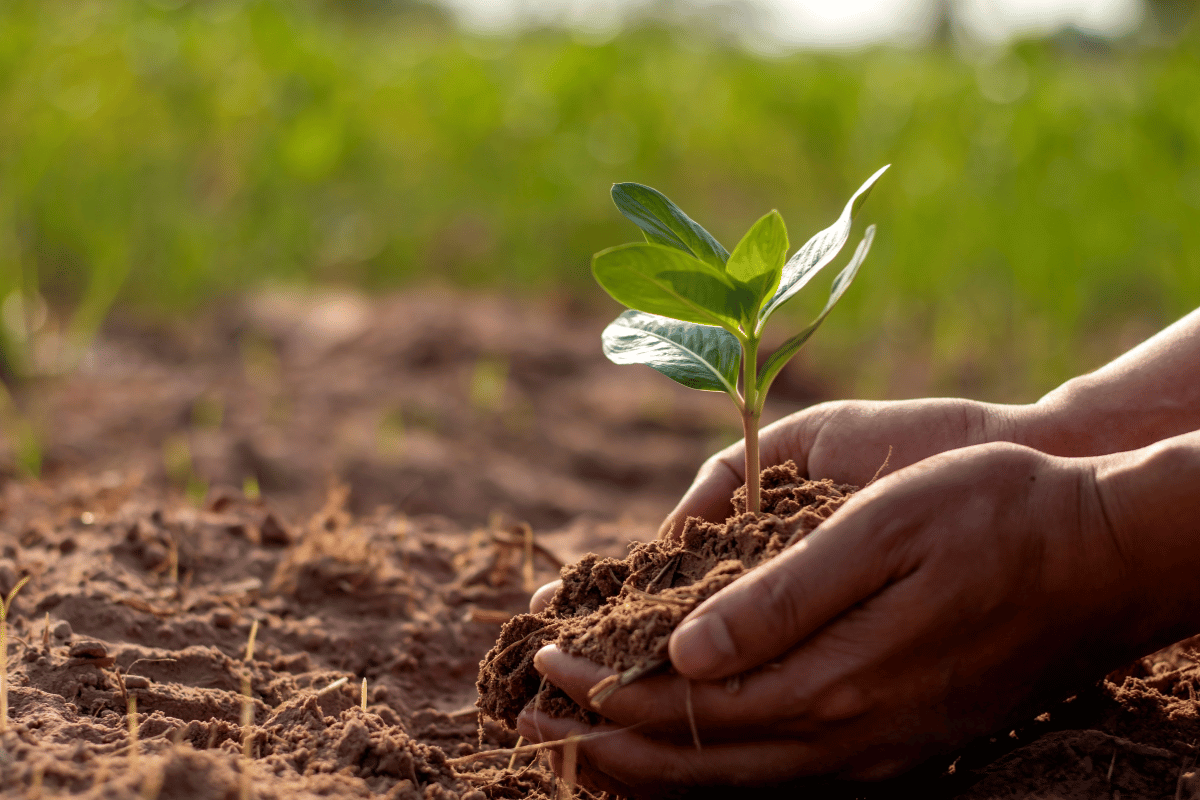
Did you know that your most powerful farm workers are invisible and already beneath your feet?
Under the surface of every thriving field lies a secret world most farmers never see, but one they depend on every day. This often-overlooked universe of multiple kinds of living beings, like bacteria, fungi, tiny protozoa, and microscopic worms, forms the foundation of healthy soil and strong crops. Let’s explore how these invisible helpers work for your farm.
The tiny workforce below our feet
Picture your soil as a bustling little town where everyone has a job to do. Bacteria run fertilizer factories, fungi lay down highways for nutrient transport, protozoa graze like microscopic cattle, and nematodes work as both waste managers and pest control. When this community thrives, our crops do, too. According to recent research, these microbes can reduce fertilizer needs while protecting crops from diseases (Andrade et al., 2023). The best part? They work for free if we just give them what they need.
Nature’s Fertilizer Factories: Bacteria
The most numerous workers in this underground world are bacteria. Some of these microscopic helpers, known as plant growth-promoting rhizobacteria (PGPR), set up shop near plant roots where they perform remarkable services. They can pull nitrogen right from the air and turn it into plant food (Igiehon et al.,2018), dissolve locked-up phosphorus in the soil (Kashyap et al., 2017), and even produce natural growth hormones that help crops thrive (Aguilar-Paredes et al., 2023; Di Benedetto et al., 2017). Other bacteria act as the soil’s security team, producing compounds that fight off harmful pathogens or help plants to resist diseases (Chandrasekaran et al., 2023). When farmers add organic matter like compost, they feed these bacterial allies, creating a richer soil community (Gouda et al., 2018).
The soil’s internet: Fungi
As previously discussed, bacteria are the most numerous, but fungi are the master connectors of the soil world. Their thread-like networks stretch through the soil like nature’s internet, sometimes connecting multiple plants together. Mycorrhizal fungi are another example of special partnerships with plant roots, acting like extensions of the root system that can reach water and nutrients much farther than the plant could access alone (Filho et al., 2017). These fungal networks often reduce the need for phosphate fertilizers, as they are especially good at supplying phosphorus. Other fungi serve as nature’s recyclers, breaking down tough materials like crop residues and wood, slowly releasing their nutrients back into the soil (Kour et al., 2019). Some even protect plants by attacking harmful fungi or helping crops withstand drought (Lugtenberg et al., 2016).
The grazers that keep things moving: Protozoa
In this underground world, protozoa act like tiny livestock, grazing on bacteria and keeping the microbial community in balance. As they feed, they release nutrients that were locked up inside bacterial cells, making them available to plants (Jousset, 2017). This grazing activity stimulates helpful bacteria to grow, creating a natural cycle of nutrient release. Some protozoa even help control plant diseases by eating harmful microbes (Bodur et al., 2024).
The underground cleanup crew: Nematodes
Despite the common belief, most nematodes are actually helpful neighbors in the soil. These microscopic worms help break down organic matter and release nutrients, especially nitrogen, as they feed (Mekonen et al., 2017). Some others specialize in eating harmful insects, providing natural pest control (Lazarova et al., 2021), potentially reducing the need for extra chemical preparations. Diverse nematode communities often indicate healthy soil with good biological activity (Mekonen et al., 2017). Farmers can encourage these beneficial nematodes by reducing tillage and avoiding harsh chemicals.
Why healthy soil biology matters for productive and resilient farms
How it all works together
The real magic happens when these organisms interact, not as a coordinated team, but as individual players, each pursuing their own survival. Yet, through their complex web of processes and competition, the ultimate beneficiaries are us, the farmers and growers.
Here's how they do this:
Bacteria and fungi break down organic matter and make nutrients available. Protozoa and nematodes keep the bacterial and fungal populations in check while releasing more nutrients. Together, they build good soil structure, suppress diseases, and help plants withstand stresses like drought (Pandey & Saharan, 2025). Modern research is now helping us understand these relationships better, leading to new biological products that can boost these natural processes.
Working with your soil's natural systems
The key to harnessing this natural power is simple: feed the soil life, protect their habitat, and avoid practices that harm them. Adding organic matter through compost or cover crops provides food for the whole soil community. Reducing tillage protects fungal networks and microbial habitats. Rotating crops maintains diversity in the soil food web. And minimizing chemical inputs allows these natural systems to flourish. As we learn more about these underground partners, one thing becomes clear: the healthiest farms work with nature’s own systems rather than against them.
Previous generations may not have known better. But now that we do, what’s our excuse?
References
- Aguilar-Paredes, A., Valdés, G., Araneda, N., Valdebenito, E., Hansen, F., & Nuti, M. (2023). Microbial Community in the Composting Process and Its Positive Impact on the Soil Biota in Sustainable Agriculture. In Agronomy (Vol. 13, Issue 2). MDPI.
- Andrade, L. A. de, Santos, C. H. B., Frezarin, E. T., Sales, L. R., & Rigobelo, E. C. (2023). Plant Growth-Promoting Rhizobacteria for Sustainable Agricultural Production. In Microorganisms (Vol. 11, Issue 4). MDPI.
- Bodur, S. O., Fujino, M., & Asiloglu, R. (2024). Predatory Protists: The Key Players in the Quest for Sustainable Agricultural Practices. Tarım Bilimleri Dergisi.
- Chandrasekaran, M., Paramasivan, M., & Sahayarayan, J. J. (2023). Microbial Volatile Organic Compounds: An Alternative for Chemical Fertilizers in Sustainable Agriculture Development. In Microorganisms (Vol. 11, Issue 1). MDPI.
- Di Benedetto, N. A., Corbo, M. R., Campaniello, D., Cataldi, M. P., Bevilacqua, A., Sinigaglia, M., & Flagella, Z. (2017). The role of plant growth promoting bacteria in improving nitrogen use efficiency for sustainable crop production: A focus on wheat. In AIMS Microbiology (Vol. 3, Issue 3, pp. 413–434). AIMS Press.
- Filho, J. A. C., Sobrinho, R. R., & Pascholati, S. F. (2017). Arbuscular mycorrhizal symbiosis and its role in plant nutrition in sustainable agriculture. In Agriculturally Important Microbes for Sustainable Agriculture (Vol. 2, pp. 129–164). Springer Singapore.
- Gouda, S., Kerry, R. G., Das, G., Paramithiotis, S., Shin, H. S., & Patra, J. K. (2018). Revitalization of plant growth promoting rhizobacteria for sustainable development in agriculture. In Microbiological Research (Vol. 206, pp. 131–140). Elsevier GmbH.
- Igiehon, N. O., & Babalola, O. O. (2018). Rhizosphere microbiome modulators: Contributions of nitrogen fixing bacteria towards sustainable agriculture. In International Journal of Environmental Research and Public Health (Vol. 15, Issue 4). MDPI AG.
- Jousset, A. (2017). Application of Protists to Improve Plant Growth in Sustainable Agriculture. In Microorganisms for Sustainability (Vol. 2, pp. 263–273). Springer.
- Kashyap, A. S., Pandey, V. K., Manzar, N., Kannojia, P., Singh, U. B., & Sharma, P. K. (2017). Role of plant growth-promoting rhizobacteria for improving crop productivity in sustainable agriculture. In Plant-Microbe Interactions in Agro-Ecological Perspectives (Vol. 2, pp. 673–693). Springer Singapore.
- Kour, D., Rana, K. L., Yadav, N., Yadav, A. N., Kumar, A., Meena, V. S., Singh, B., Chauhan, V. S., Dhaliwal, H. S., & Saxena, A. K. (2019). Rhizospheric Microbiomes: Biodiversity, Mechanisms of Plant Growth Promotion, and Biotechnological Applications for Sustainable Agriculture. In Plant Growth Promoting Rhizobacteria for Agricultural Sustainability (pp. 19–65). Springer Singapore.
- Kour, D., Rana, K. L., Yadav, N., Yadav, A. N., Singh, J., Rastegari, A. A., & Saxena, A. K. (2019). Agriculturally and Industrially Important Fungi: Current Developments and Potential Biotechnological Applications. In Recent Advancement in White Biotechnology Through Fungi (pp. 1–64).
- Lazarova, S., Coyne, D., Rodríguez, M. G., Peteira, B., & Ciancio, A. (2021). Functional diversity of soil nematodes in relation to the impact of agriculture—a review. In Diversity (Vol. 13, Issue 2, pp. 1–22). MDPI AG.
- Lugtenberg, B. J. J., Caradus, J. R., & Johnson, L. J. (2016). Fungal endophytes for sustainable crop production. FEMS Microbiology Ecology, 92(12), fiw194.
- Mekonen, S., Petros, I., & Hailemariam, M. (2017). The Role of Nematodes in the Processes of Soil Ecology and Their Use as Bioindicators. AGRICULTURE AND BIOLOGY JOURNAL OF NORTH AMERICA.
- Pandey, K., & Saharan, B. S. (2025). Soil microbiomes: a promising strategy for boosting crop yield and advancing sustainable agriculture. Discover Agriculture, 3(1), 54.