Cover picture credits: NASA
Hydroponics, a soilless cultivation system where plants receive water and nutrients directly at their roots, emerges as a promising and extensively studied technique for space farming.
Current plant growth chambers aboard the International Space Station (ISS) are equipped with artificial lights and hydroponic systems, where water is delivered to the roots with forced movement. Systems such as VEGGIE and the Advanced Plant Habitat (APH), and others that we are going to discuss in this article, use different methods of water and nutrient delivery, from capillary mats and porous tubes to aeroponics irrigation systems. These techniques have been successfully used to grow several plant species in microgravity, including flowers, cereals, herbs, and vegetables, and it is well-suited for controlled environment agriculture (CEA) systems, such as space greenhouses, where space and resources are limited. To demonstrate that, allow me to introduce Veggie.
- Vegetable Production System (Veggie)
.PNG)
Source: https://www.nasa.gov/stem-content/lesson-1-identifying-criteria-and-constraints/ (left), dx.doi.org/10.2478/gsr-2017-0002 (middle), and doi.org/10.1016/j.plaphy.2022.12.017 (right)
Veggie is a simple, low-power system used to grow fresh and nutritious food for the astronauts while supporting astronaut relaxation and recreation. It is a 0.16m² space garden for pick-and-eat crops that allowed the first space-grown salad to be consumed in space in 2016. However, this system runs on red, blue, and green LEDs, fans, and control electronics that were responsible for fundamental research on the application of these CEA technologies, especially those that are applied in modern terrestrial farming systems, such as high-tech greenhouses and vertical farms. One of the greatest space-related innovations of Veggie is its contained irrigation system: Pillows filled with a clay-based growth media and a wick system for fertilizer delivery were used to distribute water, nutrients, and air around the roots.
Despite its many advantages, gravity-independent irrigation systems such as the one in Veggie still require further improvements to overcome several challenges before they can become fully reliable for feeding future space civilizations. The absence or reduction of gravity alters the behavior of liquids and gases, making uniform water distribution and moisture control in the root zone problematic. Moreover, these systems often require active systems for nutrient delivery, such as pumps and tubing. Lastly, the design of hydroponic systems for space should consider water and air management in the root zone, demonstrating both water delivery and removal, including the appropriate integration with the life support system of the spacecraft.
- Advanced Plant Habitat (APH)
.PNG)
Source: https://doi.org/10.3389/fpls.2020.00673
Another ongoing space farming system aboard the ISS is the APH. This is a fully enclosed, closed-loop plant life support system with an environmentally controlled growth chamber designed for conducting both fundamental and applied plant research during experiments extending as long as 135 days. The APH’s environmental control system contains +180 sensors, real-time monitoring, and remote operation for plant physiology experiments.
As Dr. Monje and his collaborators said: “The APH facility is a platform that permits the collection of physiological and environmental data to test specific hypotheses on plant sciences research in the spaceflight environment. The APH is a controlled environment chamber (0.2 m² by 0.4m tall) that is teleoperated from the ground, permitting minimal crew involvement to conduct science. Crew operations are limited to adding water to the APH reservoirs, collecting biological samples, harvesting plants, and conducting periodic system maintenance. APH irrigation system uses a porous granular substrate (argillite) as rooting media.
The media is watered using a manifold of porous ceramic tubes, and moisture content is actively controlled with negative pressure or suction to provide optimum root zone water and O2 in microgravity. Also, according to him, the amount of consumable media (∼4 kg per experiment) required by the current APH configuration makes this growth system unsustainable for future food production missions beyond low Earth orbit. Still, it is adequate for conducting space biology and life-cycle crop production experiments."
Source: science.nasa.gov/biological-physical/investigations/xroots/ (left) and hdl.handle.net/2346/94619 (right)
- eXposed Root On-Orbit Test System (XROOTS)
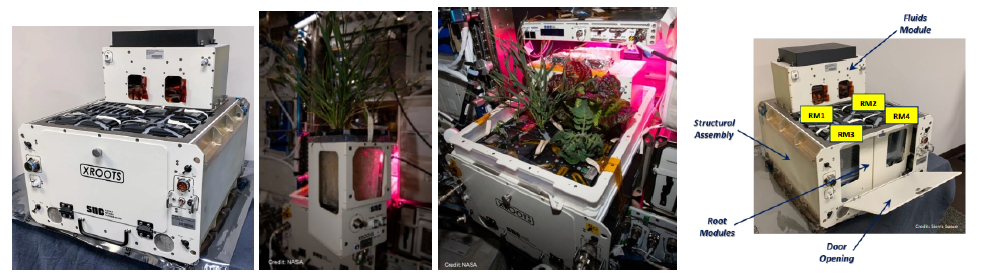
Parallel to NASA efforts, the space company Sierra Space developed and sent to the ISS the XROOTS. The XROOTS technology demonstration experiment explores nutrient delivery by aeroponics and hydroponics in microgravity. Aeroponics is a Nutrient Delivery System (NDS) where plant roots are exposed to air and receive water and nutrients through mist. Ideal droplet sizes in an aeroponic system range between 30 to 100 μm, and this is the critical parameter responsible for determining the absorption effectiveness ratio at the root zone as well as gases that drive the growth. As presented in the XROOTS Tech Demo at NASA’s portal: "Current space-based plant systems are small and use particulate media-based water and nutrient delivery systems.
These systems do not scale well in a space environment due to mass, containment, maintenance, and sanitation issues. Hydroponic and aeroponic techniques could provide a vital alternative for plant systems of sufficient size to contribute to future space exploration. XROOTS allows for root zone and crop observation through video and still images, as well as short periods of crew observations. These enable the evaluation of multiple independent growth chambers for the entire plant life cycle. Results could identify suitable methods to produce crops on a larger scale for future space missions."
- Ohalo III
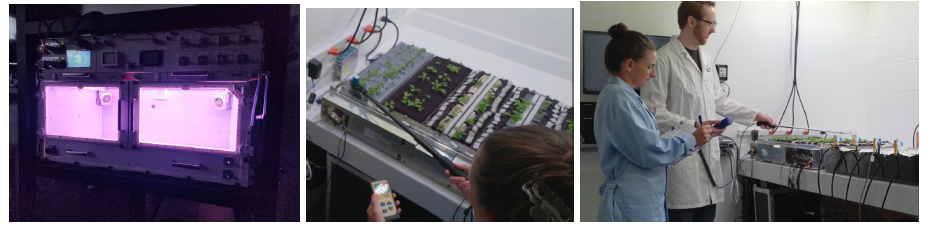
Source: https://techport.nasa.gov/projects/97036 (left) and linkedin.com/posts/activity-7257497517985017857-H_VQ?utm_source=share&utm_medium=member_desktop&rcm=ACoAACnEyeoBltFkDVxnYC0yN6O0j2PujsLXbh8 (right)
As you we see, the hydroponics techniques have been successfully used to grow several plant species in space, including flowers, cereals, herbs and vegetables, and it is particularly well-suited for controlled environment agriculture (CEA) systems, such as space greenhouses, where space and resources are limited. For that reason, a group of NASA scientists and researchers from American universities are now working on the development of OHALO III, the first operational crop production system and prototype for the Lunar Gateway and the Mars transit vehicle.
According to NASA TechPort: "Ohalo III will serve as a platform to develop advanced water delivery and volume optimization concepts that will enable future crop production operations on long-duration exploration missions. Following these evaluations, Ohalo III will continue to serve as the first operational crop production system in space, providing valuable information on the productivity, reliability, and operations associated with growing crops as a component of the exploration food system. In this capacity, Ohalo III will serve as a prototype for the crop production system that will eventually be deployed on the Mars Transit Vehicle and will also inform early lunar and Mars surface crop production systems."
In a nutshell, hydroponics allows for efficient use of resources and enhances crop yields and quality. Its nutrient and water dosing capacity can achieve more consistency and homogeneous yields, and incredible operational efficiency and control. Compared to soil-based systems, such as lunar or Martian regolith, hydroponic systems offer advantages in terms of weight and resource efficiency. On the one hand, regolith can provide greater structural support as a growing medium and has unique physical properties that would need to be considered.
On the other hand, water and nutrient solutions can be easily contained and recycled when we use hydroponics. Moreover, it has a more versatile operation, allowing irrigation schedules to be adjusted together with the quality and pH of nutrients according to the specific needs of each plant. As investments in research, technology, and training increase, the potential for hydroponics to revolutionize the production of plants in harsh environments, either on Earth or in space, becomes increasingly tangible.
Space Farming 101 (SF101)
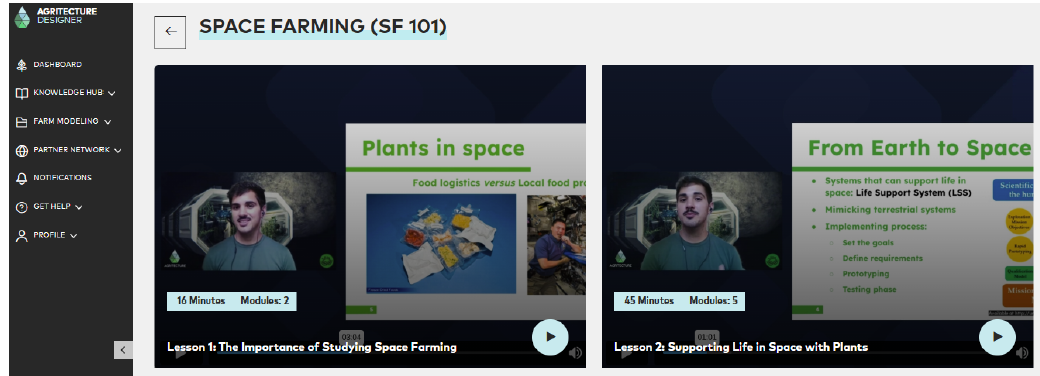
The SF101 online course is meticulously designed to provide a foundational understanding of space farming, covering the basics of growing plants in extraterrestrial environments to advanced farming systems. The course is composed of 14 modules + 2 case studies dedicated to presenting important projects developed for space farming research. The SF101 is accessible through Agritecture Designer at the following link: Premium Courses Public – Agritecture
Further reading
How urban vertical farms can help cities become food-sufficient
How to Choose the Best Growing Medium for Hydroponic Farming
Different types of hydroponics systems and how they work