
How solar power cut chick deaths on Ethiopian poultry farms
By Tekeba Eshetie Nega (PhD), Regenerative Agriculture Advisor, SNV Ethiopia
Keeping day-old chicks alive is mostly a question of heat. In the first weeks of life, chicks cannot regulate their own body temperature, so they need a steady, reliable source of warmth around the clock. Where that heat is unreliable, chicks die, and for a small poultry enterprise every dead chick is lost income. In rural Ethiopia, where more than 80% of people depend on agriculture and reliable power is scarce, this is one of the quiet reasons small poultry businesses struggle to grow.
Most small and medium chick brooders in Ethiopia meet that heat demand with charcoal, which supplies roughly 75% of their brooding energy, topped up with unreliable grid electricity and the occasional diesel generator. Charcoal is expensive, it pollutes the air the chicks and their keepers breathe, and its price rose by about 300% between 2022 and 2023. Under this system, chick mortality during the 45-day brooding period can reach 5%, often alongside poor growth. A micro-pilot in southern Ethiopia set out to test whether solar power could do the job better.
The problem with charcoal brooding
Charcoal brooding carries costs that go well beyond the fuel bill. Someone has to attend to the stoves through the night, which exposes both workers and chicks to smoke and the respiratory illness that comes with it, and open flames bring a real risk of fire. The heat itself is uneven, and it is that irregular warmth, as much as the cost, that drives chick deaths. When the price of charcoal tripled in two years, the economics of the whole operation came under strain.
Evidence from elsewhere pointed to a better option. In Nigeria, trials comparing brooding systems recorded around 3% chick mortality under solar power against 7% for kerosene and 10% for grid electricity, with markedly lower energy costs. A review in the United Kingdom found renewable-energy systems could cut poultry energy use by up to 85%, with payback periods of three to eight years, and in Lebanon solar water heaters in poultry houses saved up to 60% on fuel and electricity while improving chick health. The question for Ethiopia was whether the same would hold on small rural enterprises.
The intervention
The pilot ran over two years, in 2023 and 2024, in WondoGenet District in the Sidama region, about 270 km south of Addis Ababa, at altitudes between 1,761 and 1,918 metres. Three small and medium enterprises took part, two brooding 2,000 chicks per batch and one brooding 3,000. Two were owned or run mainly by women, one by a group of six members, half of them women.
Before the change, the sheds were rehabilitated to hold heat better, then fitted with solar systems. The installation used a standard 4.11 kW of solar capacity per 2,000 chicks, sized against the chicks' daily energy needs, with a 250-watt infrared lamp serving 150 to 200 chicks for both heat and light, hung about 60 cm above the floor. Panels, inverters, and battery storage were installed, and after the change roughly 80% of the brooding heat and lighting came from solar power, with the remaining 20% from grid electricity under a hybrid arrangement. The enterprise members were trained to run, clean, and troubleshoot the systems and to keep daily records of mortality, energy use, and costs.
What changed
The results were clear enough to change how the farmers ran their businesses.
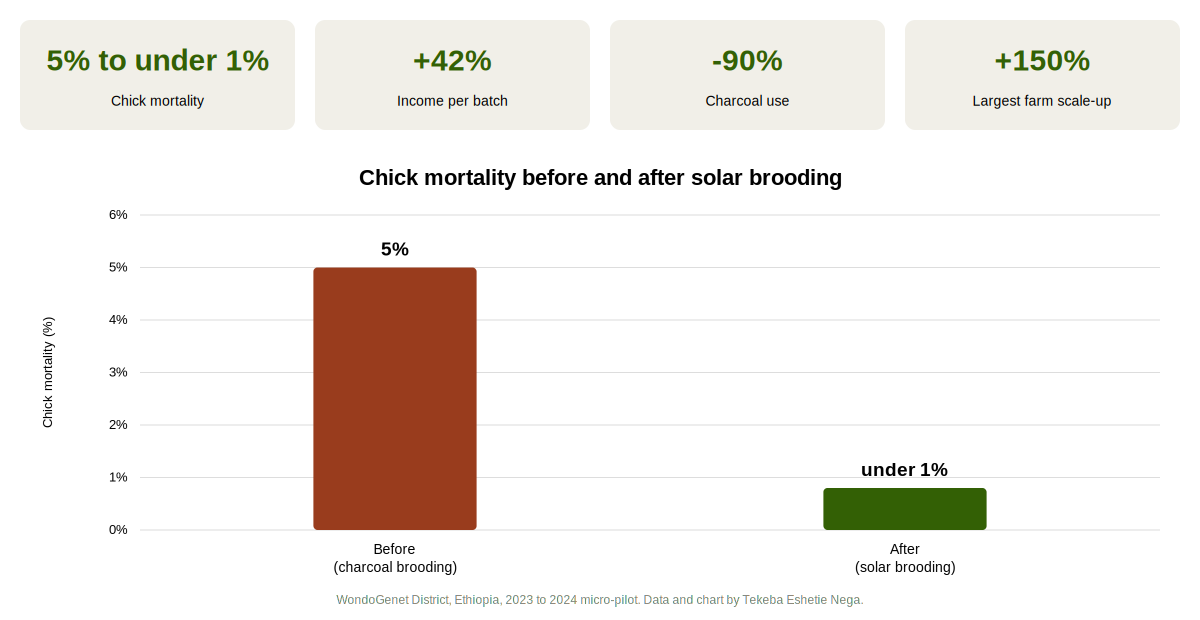
Results of the WondoGenet solar brooding micro-pilot, Ethiopia, 2023 to 2024. Data and chart by Tekeba Eshetie Nega.
Chick mortality fell from 5% to under 1%. Because fewer chicks died, income per batch rose by about 42%, helped further by lower brooding costs and less labour spent tending stoves overnight. Charcoal use for brooding dropped by around 90%, which cut both the fuel bill and the pollution. With the night-time smoke gone, respiratory problems among both the workers and the chicks eased noticeably.
The confidence those results gave the farmers may matter most. One enterprise expanded from 2,000 to 5,000 chicks per batch, a 150% increase in scale, and brooders in neighbouring areas began asking solar suppliers about installing their own systems. With a payback period of under three years, the systems proved economically viable, enough that banks and microfinance institutions started to look at how they might lend against them.
What it means for other farmers
The pilot was small, and it is honest to treat it as a promising business case, not a finished blueprint. The main barrier is the upfront cost of solar equipment, which is still high for most rural enterprises, and closing that gap will depend on suppliers, banks, and microfinance institutions building financing that fits how a small poultry business actually earns. Grid electricity still has a place too, which is why the pilot used a hybrid design instead of solar alone.
Even so, the direction is clear. For a small poultry enterprise in a place where power is unreliable and charcoal is dear, steady solar heat can turn chick brooding from a gamble into a dependable business. The same logic points to the next steps, applying solar energy to hatcheries, egg production, and feed processing, where reliable power is just as decisive. Clean energy, used productively, is emerging as one of the practical enablers of a more resilient rural food system in Ethiopia.
Sources
Tekeba, E., et al. (2026). Effects of solar power on chick brooding efficiency in rural Ethiopia, a case study under micro-pilot interventions. Digital Journal of Science, 3(2), 154. DOI 10.63592/DJS/154.
Okonkwo, W. I., et al. (2022). Socio-economic importance of solar energy application in poultry production system. Journal of Scientific Research and Reports, 28(11).