


Disease outbreaks are one of the biggest problems facing poultry farmers, and small and medium-scale operations feel them hardest. A single outbreak can wipe out months of work, cut production, push up treatment costs, and in the worst cases, take an entire flock. The damage runs past the money, too. An outbreak can harm a farmer's reputation, close off market access, and take months or years to recover from.
Many farmers invest heavily in good chicks, feed, housing, and vaccines while paying little attention to biosecurity. Vaccination alone cannot protect a farm when disease organisms keep arriving through people, equipment, vehicles, wild birds, rodents, feed, water, or other animals.
From my own experience managing broiler production, biosecurity is not a one-time activity. It is a daily discipline. During one outbreak on our farm, the attending veterinarian confirmed Gumboro disease. The exact source was never established, but one suspected route was a visitor who had come to buy birds. That experience taught me a lesson I have not forgotten: every unnecessary lapse carries a real risk.
What follows are practical measures any poultry farmer can put in place to reduce that risk, improve productivity, and protect the farm's long-term profitability.
What biosecurity actually means
Biosecurity covers all the management practices that stop disease entering a farm, spreading within it, and leaving it. Put simply, it means building barriers that keep disease-causing organisms away from the birds. Prevention is always more effective than treatment, and it is very much cheaper.
Why it is worth the effort
A working biosecurity programme helps a farm prevent outbreaks and reduce mortality, improve growth rate and feed conversion, hold egg production steady, and cut veterinary and medication costs. It also improves bird welfare, reduces the need for antibiotics, protects farm income, and builds customer confidence in the product. Every individual practice feeds into the same two things, the health of the flock and the future of the business.
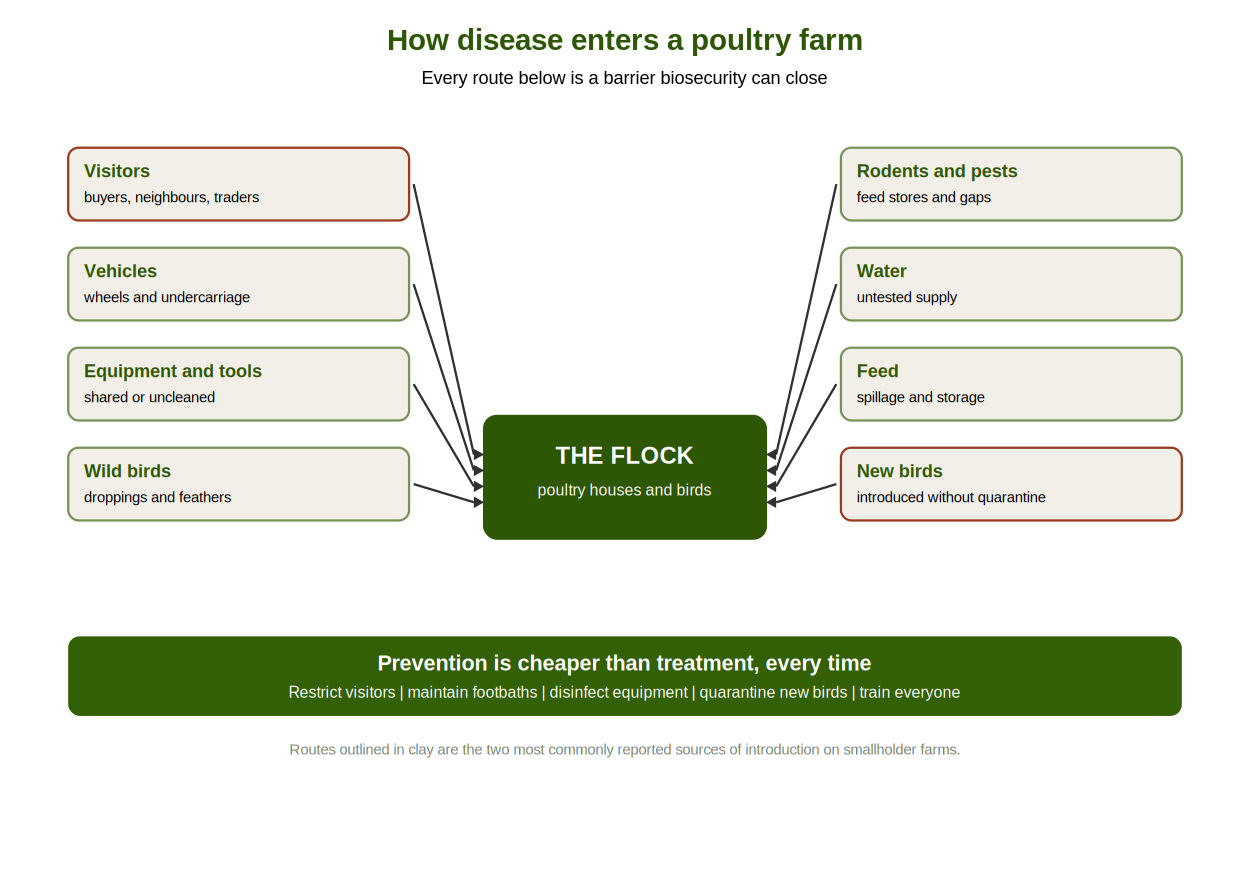
How disease enters a poultry farm. Every route shown is a barrier biosecurity can close.
What one mistake can cost
When disease gets into a poultry farm, the consequences reach well past bird health. Farms face high mortality, poorer feed efficiency and growth, lower egg production, and rising veterinary bills. Business is interrupted, customer trust is lost, and in serious cases the farm closes temporarily or for good. Recovery often takes months or years. The money spent on prevention is almost always a fraction of the cost of recovering from an outbreak.
The measures that matter most
1. Restrict farm visitors. Every visitor is a potential route for disease. Farmers routinely let buyers, neighbours, friends, and traders into poultry houses without asking where those people have been, and disease organisms travel easily on footwear, clothing, hands, and equipment. Keep unnecessary visitors out, maintain a visitor register, allow only essential people into the houses, and require everyone who does enter to follow the farm's procedures.
2. Keep footbaths working. A footbath only works if it is maintained, because dirty disinfectant loses its effect quickly. Place one at every house entrance, mix the disinfectant at the correct concentration, replace it regularly, and knock the dirt off footwear before stepping in, since a boot caked in muck will not disinfect.
3. Use farm-specific clothing and footwear. Nobody should wear clothing or boots from outside the farm into a poultry house. Dedicated boots, overalls, and gloves cut transmission substantially, and they need washing and disinfecting on a routine.
4. Clean and disinfect equipment. Equipment is one of the main ways disease moves between houses and between farms. Feeders, drinkers, egg trays, crates, cages, weighing equipment, and vehicles should all be cleaned and disinfected. Never share equipment with another farm without cleaning and disinfecting it first.
5. Quarantine new birds. New birds should never go straight into an existing flock. Isolate them for at least two to four weeks and watch for signs of illness, and note that official guidance often recommends a full 30 days. Quarantine is one of the most effective single barriers against bringing disease into a healthy flock.
6. Keep the farm clean. Daily sanitation means removing wet litter, clearing spilled feed, washing drinkers, cleaning feeders, removing manure, and generally keeping the environment tidy. Poor sanitation gives harmful microorganisms the conditions they need to multiply and spread.
7. Control rodents, wild birds, and other animals. Rodents and wild birds are significant carriers of poultry disease. Store feed properly, seal openings in the houses, run a rodent-control programme, keep wild birds out, and keep domestic animals away from the poultry units.
8. Dispose of dead birds properly. Dead birds should never be left in or around the houses. Use deep burial or incineration where it is available, and follow veterinary recommendations for your area. Anyone handling dead birds should wash and disinfect their hands afterwards.
9. Follow a proper vaccination programme. Vaccination complements biosecurity rather than replacing it. Follow veterinary advice, buy vaccines from reliable suppliers, store them correctly, vaccinate at the recommended ages, and keep records. Healthy birds also respond better to vaccination than stressed or already-diseased ones, which is another reason the two work together.
10. Train everyone on the farm. Biosecurity works only when everyone applies the same standard. Every worker should understand why visitors are restricted, how cleaning and disinfection are done properly, what the signs of common poultry diseases look like, how to report an emergency, and what their own responsibility is. One careless mistake can expose thousands of birds.
The mistakes that come up again and again
The most common failures are letting visitors in without control, sharing equipment with neighbouring farms, ignoring footbaths, wearing outside footwear into the houses, mixing birds of different ages, introducing new birds without quarantine, waiting too long to isolate sick birds, weak rodent control, and cleaning and disinfection that is done carelessly. Avoiding these alone takes a large share of the risk out of a farm.
A practical biosecurity checklist
Daily. Restrict unnecessary visitors, check the footbaths, observe the birds for signs of illness, remove dead birds immediately, and clean drinkers and feeders.
Weekly. Inspect the poultry houses, check for rodent activity, deep-clean equipment, and review the visitor records.
Monthly. Review the farm's biosecurity plan, train or refresh staff on procedures, inspect vaccination records, and evaluate how well the plan is actually being followed.
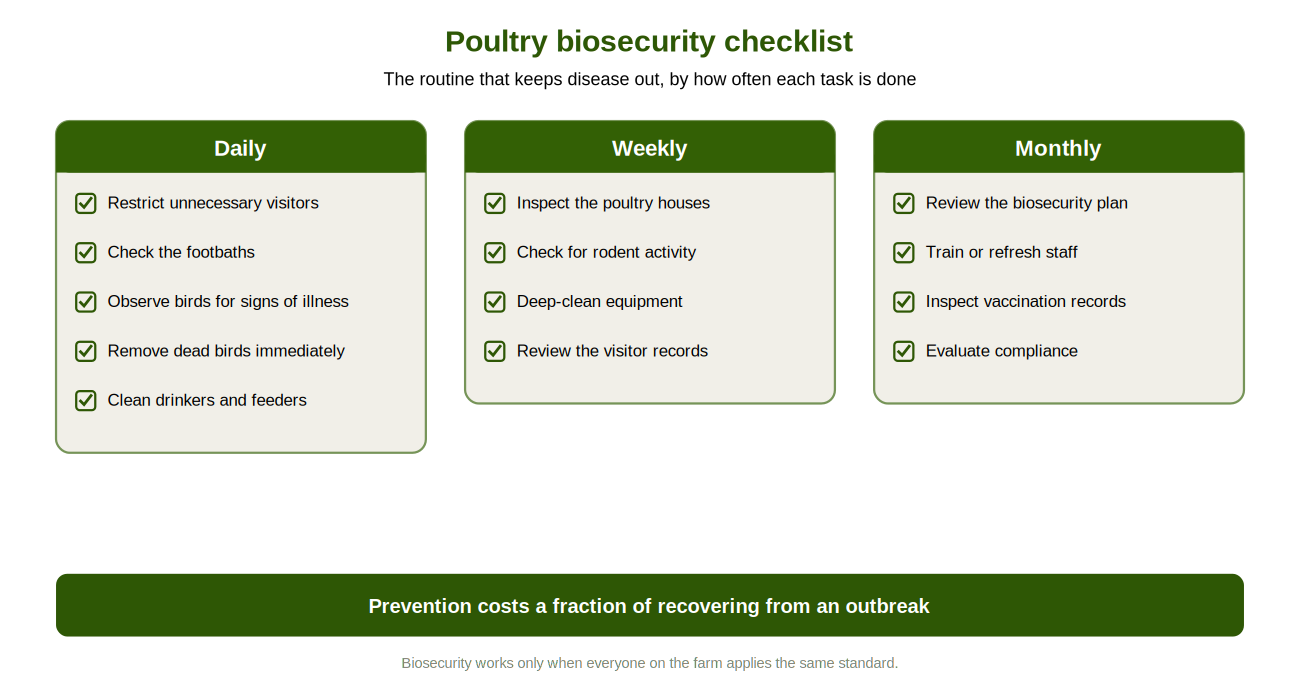
The same checklist as a single graphic, for printing or pinning up in the farm office.
Biosecurity is an investment rather than an expense
Some farmers see biosecurity as an extra cost, since it means buying disinfectants, protective clothing, fencing, and sanitation materials. Set against the losses an outbreak causes, those costs are small. Strong biosecurity protects the birds, improves productivity, reduces treatment costs, and raises profitability, and in poultry farming, prevention consistently returns more than treatment does.
The discipline is the point
Successful poultry farming takes more than good chicks, good feed, and modern housing. It takes discipline to protect the birds from disease every single day, and that is as true for early flock management, from brooding onwards, as it is at any later stage.
Biosecurity is not a one-off exercise or a checklist you complete only when an outbreak is underway. It is a continuous management practice that belongs in the daily routine. Restricting visitors, keeping facilities clean, disinfecting equipment, quarantining new birds, and training workers are simple actions that prevent devastating losses. No farm can eliminate every risk, but every farm can reduce it substantially by being consistent. Healthy birds produce better results, healthier businesses are more profitable, and profitable farms make for a stronger poultry sector.
Sources
United States Department of Agriculture. Defend the Flock, biosecurity for poultry. APHIS.
Food and Agriculture Organization of the United Nations. Good practices for biosecurity in the pig and poultry sectors.
World Organisation for Animal Health. Terrestrial Animal Health Code.