


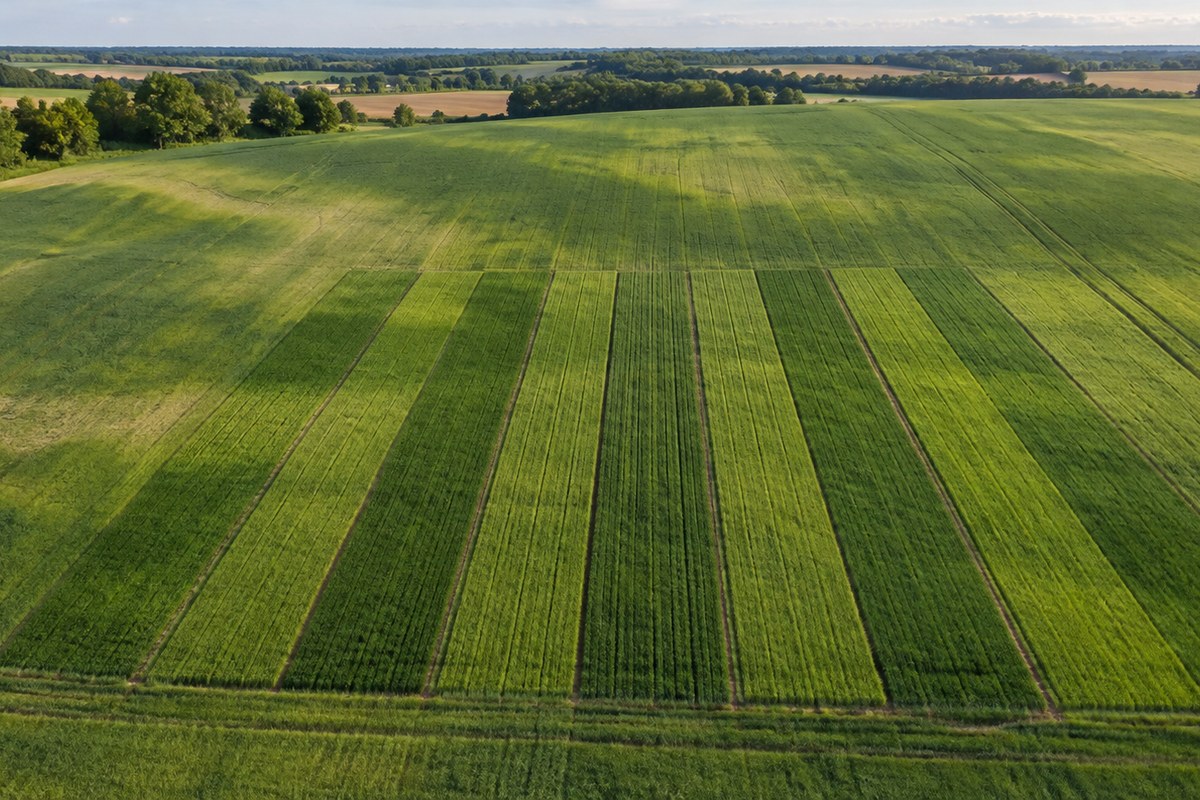
Every season, farmers and agronomists make thousands of decisions. Which hybrid should they plant, at what seeding rate? When should they apply fertiliser, and which crop protection product will work best? Good decisions raise productivity and profit, while poor ones cut yields, waste resources and cost money. Agriculture is an empirical science at heart, so the value of any technology has to be shown in the field, under real growing conditions. Precision agriculture can turn those everyday on-farm experiments into decisions you can rely on.
When a field trial becomes a lottery
There are two main ways to run an agricultural experiment: small-plot trials with several replications, and on-farm trials, where farmers test products directly in commercial fields. Organising a replicated experiment is difficult for most farmers, so they choose something simpler. They divide a field into two, apply one product to the first half and another to the second, and compare yields after harvest. That is not a reliable experiment.
Agricultural fields are not uniform. Almost every field has areas that consistently yield more and areas where productivity stays lower year after year. Put a new product in a naturally productive area and you may conclude that it works. Put the same product in a low-productivity area and you may conclude that it does not. This is the field trial lottery, in which where a treatment sits decides whether it appears to win or lose, and on the strength of those results farmers make strategic decisions affecting hundreds or thousands of hectares. Precision agriculture provides the tools to make field trials far more objective.
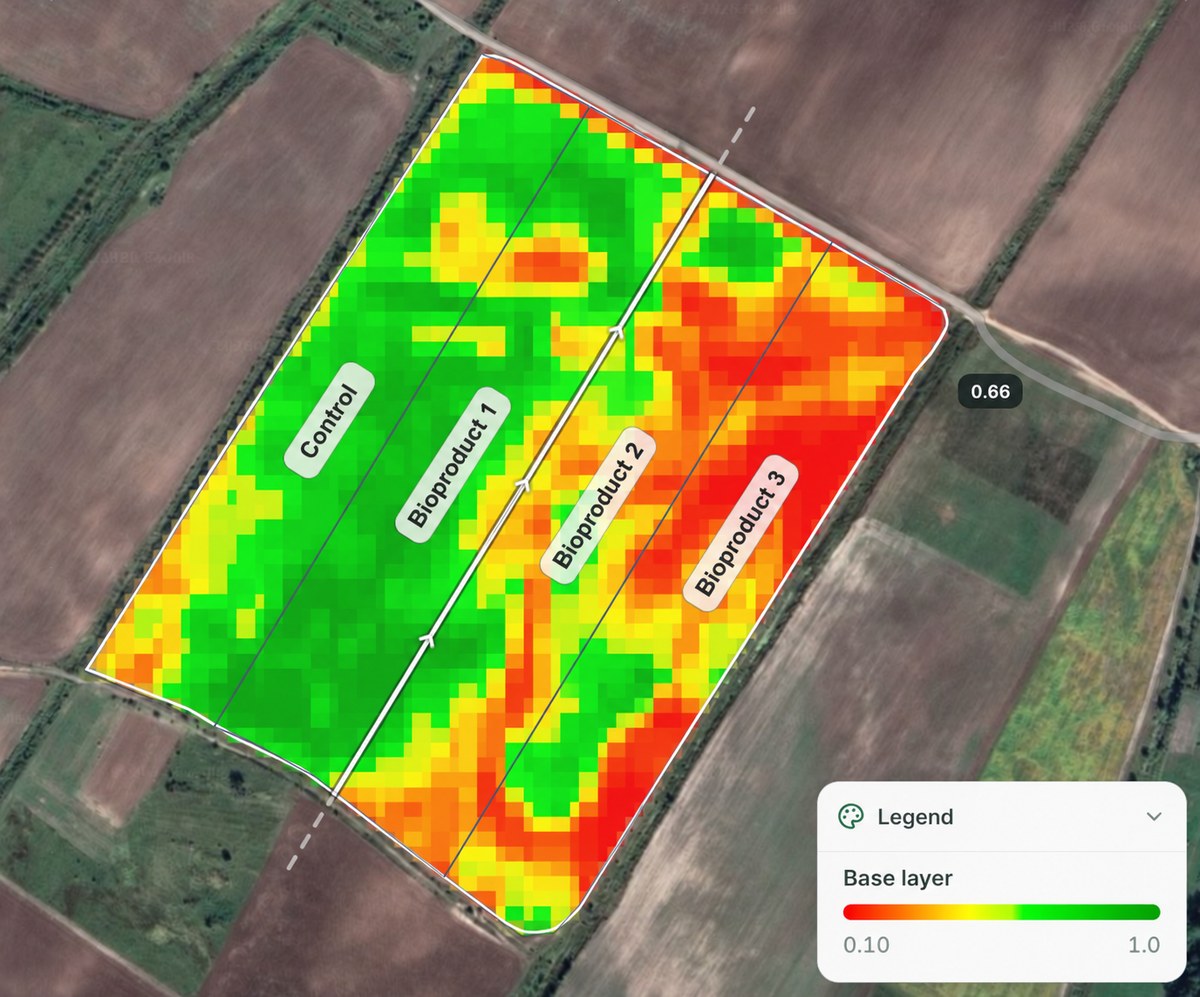
Bioproduct 3 starts the trial at a disadvantage, because its strip lies mostly in a historically low-productivity zone where yields were lower in previous seasons. It may look worse than the control and the other products because of its location rather than the product itself. Image provided by the author.
Understand your field before testing anything
The first step is to understand the field's historical productivity. Productivity zones are areas that perform differently across growing seasons, some repeatedly yielding above average and others consistently underperforming. The differences may come from soil properties, topography, water availability, drainage or other environmental factors, and what makes the zones useful is that they are stable and repeat from season to season.
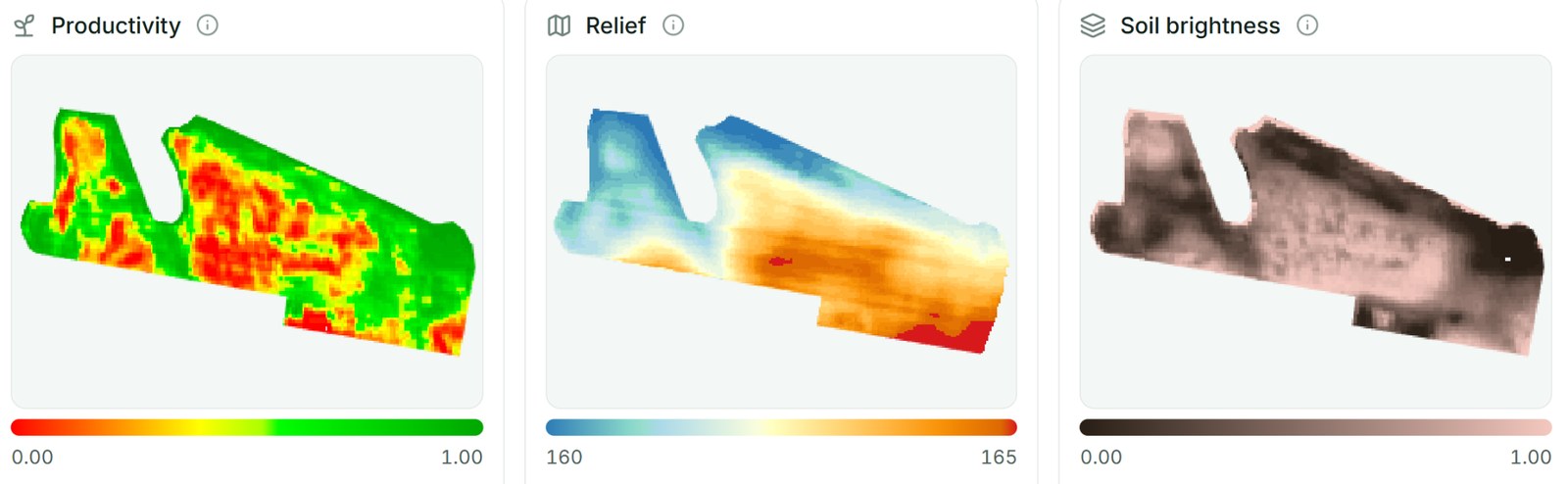
In this field the low-productivity zone lies on higher ground with lighter-coloured soil, which suggests that erosion and the downslope movement of fine soil particles and water lower its yields. The lower-lying areas have darker soil with more moisture and humus, which support higher productivity. Image provided by the author.
There are two main ways to identify them.
Yield maps: modern combine harvesters record how yield is distributed across the field, which shows the areas that consistently perform better or worse.
Satellite imagery: historical vegetation data can reveal recurring patterns in crop development. At certain growth stages, vegetation indices correlate strongly with final yield, so choosing the right satellite images across several seasons can show productivity patterns even where no yield maps exist.
How do you know whether the zones are accurate? Historical productivity zones should predict where yield will be higher or lower in the following season. The aim is to know which parts of the field are likely to perform better or worse, rather than to predict the exact yield in tonnes per hectare. And one rule always applies: the farm's own agronomist has to verify the resulting productivity map. No satellite algorithm or outside company knows a field better than the people who work it every season.
Design the experiment
Once you understand the field, choose the right place for the trial. Look at historical productivity, soil characteristics, elevation and the other factors that influence crop performance, and find relatively uniform areas where treatments can be compared under similar conditions.
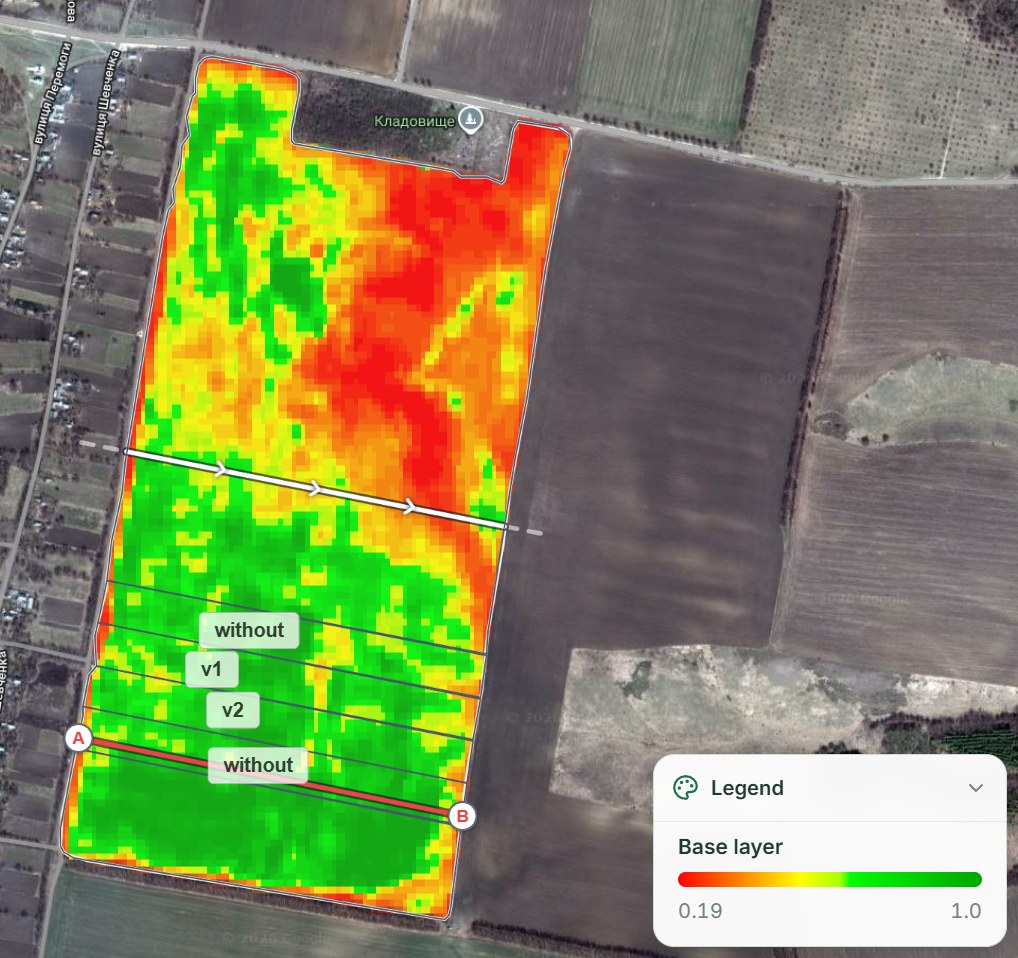
Once the field’s variability is known, the trial can be designed with suitable replication and plot placement. Designs differ, but treatments should always be compared under similar baseline conditions. Image provided by the author.
Here precision agriculture has a real advantage. If your combine supports yield mapping, hundreds of spatial comparisons across the field can replace the traditional hand-harvested replications. Instead of three or four hand-harvested plots, high-resolution yield data lets you analyse many spatially matched sections, as long as the trial layout supports reliable comparisons. If yield mapping is not available, plan at least three replications, with the treatments arranged in comparable conditions.
Then take the design into the field. If your machinery supports precision agriculture, load the trial layout onto the onboard computer. If not, export a simple KML file, open it on your smartphone, walk the field and mark where each treatment starts and ends. A better experiment does not need expensive technology.
Collect reliable data
With a calibrated yield monitor on the combine, data collection is fairly straightforward. Harvest the experimental strips and the machine records yield with its geographic coordinates. Without yield mapping, harvest and weigh each plot separately, recording the harvested weight, the area and the grain moisture so that the yields can be compared. Note application rates, treatment dates and any departures from the original plan as well, because good results depend on good data.
Measure the real treatment effect
By this stage you have chosen the most uniform area available, designed the experiment and collected the harvest data. Now comes the most important question: did the technology you tested actually raise yield, and how confident can you be in that result?
Compare the treatment and the control under similar conditions, calculate the yield difference, and see how consistently the result appears across your comparisons. With yield mapping you can analyse hundreds of spatially matched observations, and without it you compare the harvested replications. Historical productivity data also helps confirm that the compared areas really were similar and accounts for any remaining variability in the field. The aim is to establish whether the improvement you see is real, consistent and statistically reliable, beyond simply naming the treatment with the highest yield.
What thousands of field trials have shown
I have analysed thousands of agricultural field trials across different countries and growing conditions, and one finding stood out. In 85% of them, we could predict which treatment would appear to win from historical field productivity and treatment location alone, without looking at the actual yields. The analysis covers more than 5,000 on-farm trials worldwide, including trials in Ukraine and other European countries, the United States, Argentina and Brazil.
Before seeing the harvest results, we already knew which treatment was likely to look more successful. We did not know which fertiliser, hybrid or technology was better. We knew which treatment had been placed in the more productive part of the field. When location predicts the winner, a trial compares places as much as it compares technologies, and a farmer can spend a whole season testing a product, collect thousands of measurements, and still base a strategic decision on the natural differences within the field.
Why even replicated trials can fail
Many people assume that three or four replications guarantee reliable results. But what happens when those replications sit in a highly variable part of the field?
In those conditions, the one advantage of replication is that it exposes the problem. The result can be a statistical disaster, with huge differences between replications, inconsistent treatment rankings and so much variability that the treatment effect cannot be separated from the natural differences in the field. Replications can reveal the problem, but they cannot recover the information lost to excessive variability, which is why understanding the field and choosing the right location before the trial starts matters so much.
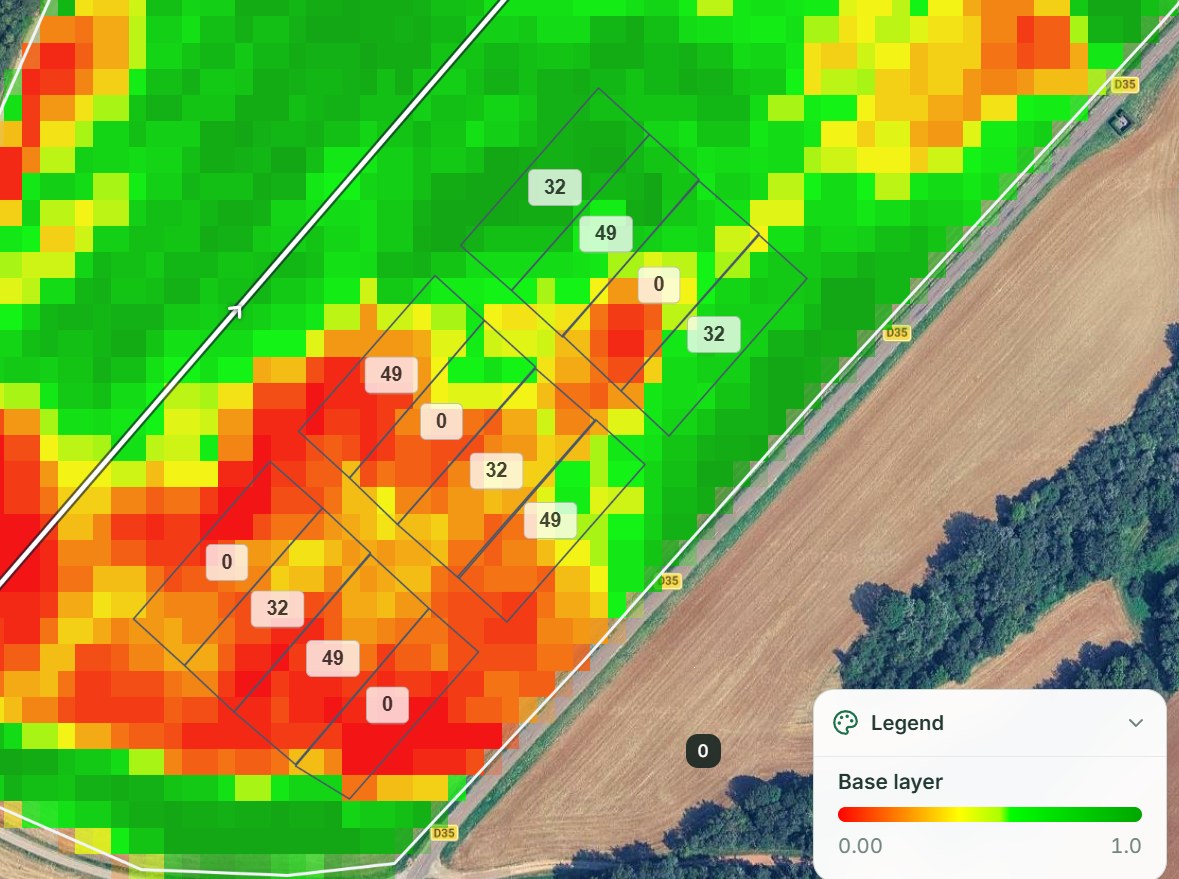
Three treatments with four replicates each, laid out in a highly variable field where the plots differ widely in baseline productivity. Image provided by the author.
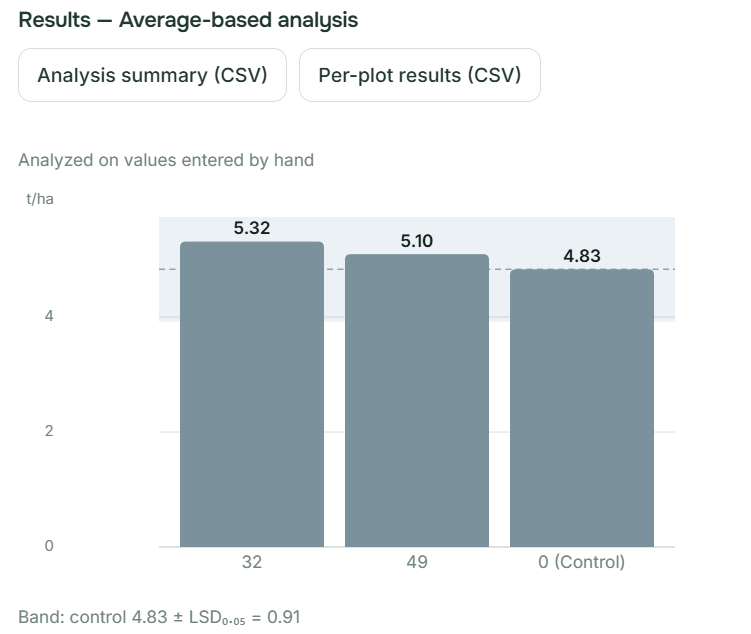
Average yields of 5.32, 5.10 and 4.83 t/ha. The differences fall within the least significant difference of 0.91 t/ha at the 5% level, so they are not statistically significant. Image provided by the author.
Precision agriculture is about making better decisions as well as applying fertiliser and seed more efficiently, and better decisions start with reliable knowledge. The most expensive field trial is the one that gives you the wrong answer, whatever it cost to run.