


Lately, more and more discussion has been circulating around the circular economy. Journalists, media shows, features, advertising campaigns, and academic discussions focus on economic circularity.
But what does "circular economy" truly mean?
Essentially, the circular economy marks the end of the transition from the linear economy that every Westerner was accustomed to, to a circular one. It is a production-and-consumption model composed of varied activities. These activities aim primarily to extend the product’s lifecycle. This can be achieved through reuse, exchange, repair, recycling, and renovation, both of the final product and of its individual materials (Arruda et al., 2021).
Why is the circular economy important today?
Many may wonder: why now? Why this discussion at this moment? Is it a trend? A new marketing strategy? Or is it an urgent necessity? Why do we hear everywhere about climate change and the need for a circular economy?
The answer is that this conversation is certainly not premature; in fact, in a pessimistic scenario, it might even be late.
The effects of the climate crisis are now evident at every stage of daily human life. Rising temperatures, prolonged droughts, intense rainfall are just a few components of the modern environmental problem, which is escalating, while the Mediterranean is among the regions most visibly affected by the environmental crisis.
The circular economy is rooted in the waste management problem, which is part of the broader environmental issue. It’s worth noting that global waste production is expected to surge dramatically in the coming decades. By 2050, waste generation per year is projected to increase by 70% compared to today’s levels (World Bank, 2018).
However, the problem isn’t just about waste generation—it’s about how waste is managed. In other words: what happens to waste after it’s produced? What truly occurs with waste management?
The following chart shows the proportionate waste management by geopolitical boundaries and waste streams.
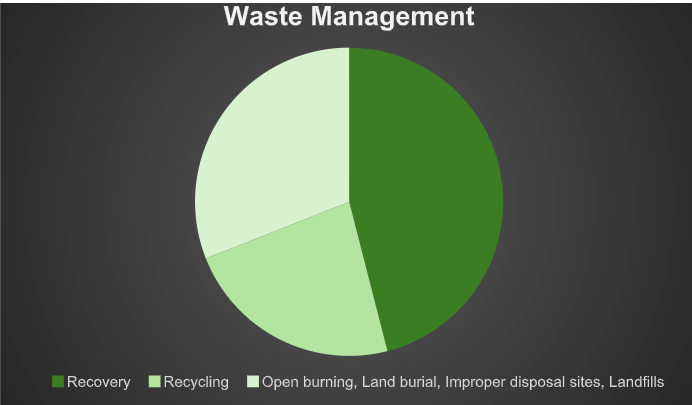
Geopolitical borders and waste
The issue of waste management predates 2018; however, it intensified after that year. 2016 was a milestone year because, as The Guardian reported, China accounted for 51% of global plastic-waste imports. But in 2018, China changed its policy as a recipient of plastic waste.
In Greece, agricultural waste exceeds 30% of total solid waste, while it remains deeply concerning that the country has no strategy for managing it. Naturally, difficulty in managing waste exacerbates greenhouse-gas emissions. This highlights how urgent a circular economy strategy has become.
Goal of the Circular Economy
The core objective of the Circular Economy is to achieve what the European Union has already adopted: to become the first climate-neutral continent by 2050. The announced circular-economy action plan includes measures for every stage of a product’s life cycle (Arruda et al., 2021). It addresses design, consumption, and every other step—ensuring that resources remain in the EU economy, that consumption is sustainable, and that waste is prevented. Essentially, the circular economy seeks to eliminate planned obsolescence, which characterizes all products. These goals are pursued through numerous legislative and non-legislative measures, adding value to products (European Commission, 2023b).
Benefits of the Circular Economy
Adopting the circular economy goes beyond environmental awareness; it brings many advantages. Some of these benefits include:
- Reducing greenhouse-gas emissions
- Reducing waste volumes
- Encouraging product recycling
- Encouraging raw-material recycling
- Reducing landscape disruption
- Protecting biodiversity
- Boosting Europe’s economic recovery
Although the EU’s exports grow faster than its imports, it still imports more than it exports. The circular economy helps close this gap by encouraging innovation and creating new green jobs (Buchmann-Duck & Beazley, 2020).
What does the circular economy include?
It’s clear that the circular economy is a modern system capable of mitigating numerous current and future crises. In combination with various measures and regulations, many actions taken under the circular economy framework are extremely important and useful. Such measures include:
- Eco-design of products
- Waste reduction
- Securing the right to repair
- Promoting sustainable products
- Empowering and informing consumers
- Improved environmentally friendly packaging
- Bio-based plastics
- Biodegradable plastics and more
An essential prerequisite for achieving the circular economy model is proper public awareness. Information about environmental issues, new actions, methodologies, and innovative practices and systems—such as the circular economy—must not exclude any group of citizens; it should be understandable to everyone and delivered by scientists in a clear and comprehensible way, without being oversimplified.
References
- Arruda, E. H., Melatto, R. A. P. B., Levy, W., & de Melo Conti, D. (2021). Circular economy: A brief literature review (2015–2020). Sustainable Operations and Computers, 2, 79-86.
- World Bank (2018). Available online: Global Waste to Grow by 70 Percent by 2050 Unless Urgent Action is Taken — World Bank
- European Commission (2023b). Available online: Circular Economy Action Plan
- Buchmann-Duck, J., & Beazley, K. F. (2020). An urgent call for circular economy advocates to acknowledge its limitations in conserving biodiversity. Science of the TotalEnvironment, 727, 138602.