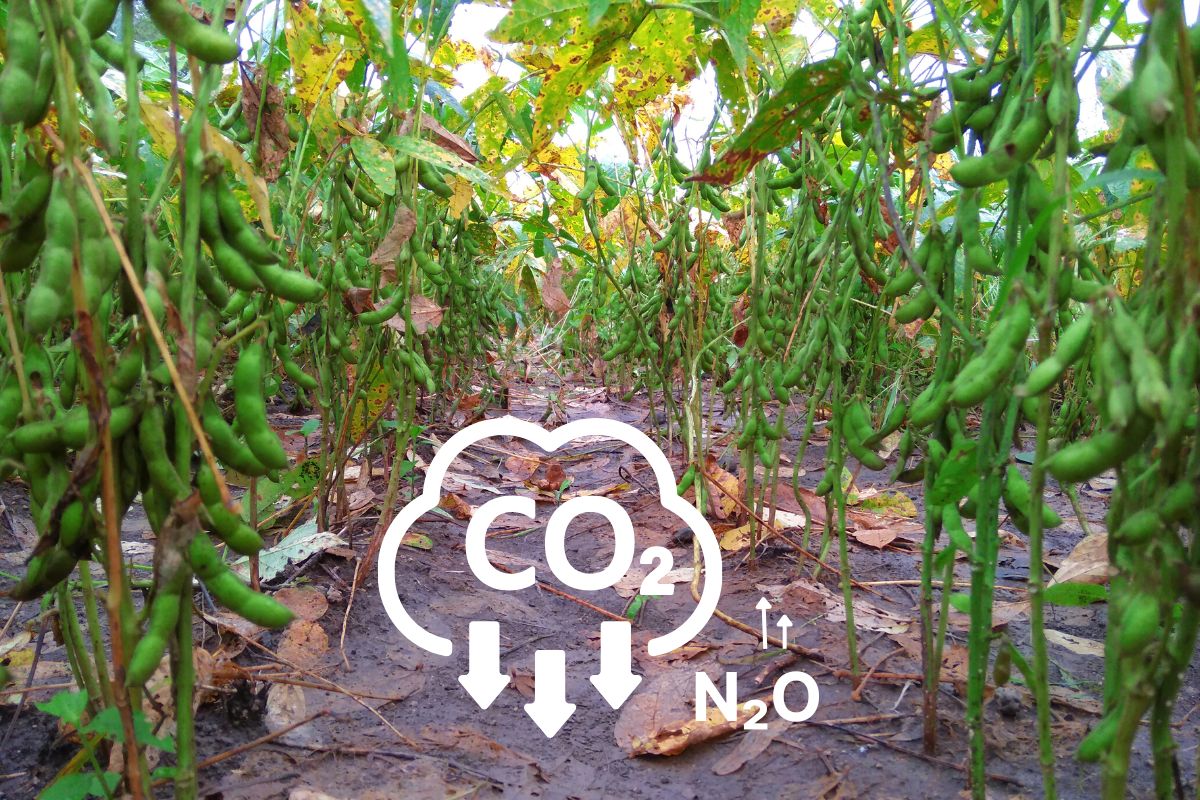
The benefits of introducing legumes to agricultural systems - How legumes boost soil carbon storage and fight climate change in agriculture
Soil organic carbon (SOC) is the largest carbon store in the terrestrial biosphere, containing more than twice as much carbon as the atmosphere and vegetation combined. Increasing SOC is crucial for mitigating climate change, and legume-based cropping systems are considered an effective approach for this purpose.
Legumes contribute to SOC by providing organic carbon through the decomposition of their residues and by promoting soil aggregation through their dense and extensive root systems. In addition, legumes naturally fix nitrogen through biological nitrogen fixation (BNF), a process that supports biomass production and increases carbon input into the soil. Including legumes in cropping systems also improves microbial activity and soil structure, which are closely linked to long-term carbon stability. These attributes make legumes an important tool for reducing greenhouse gas emissions.
The role of legumes in soil carbon sequestration
Legumes play a crucial role in enriching soils with organic carbon. Their residues decompose and contribute to the soil organic matter (SOM) pool, which consists of about 58% carbon. Management of these residues also promotes soil aggregation, a process that helps stabilize carbon in the soil. Certain legumes, such as sunn hemp (Crotalaria juncea), have dense root systems that support the formation of macro aggregates in the soil, while others, such as alfalfa (Medicago sativa), are known to greatly enhance the stability of aggregates. These aggregates physically protect the carbon and contribute to its long-term presence in the soil.
Compared to grasses, legumes contribute more carbon to soil systems. Studies show that legumes can sequester about 0.90 Mg C ha−¹ per year, while grasses sequester about 0.70 Mg C ha−¹ per year. This difference is mainly due to the higher nitrogen content in the residues of legumes and the greater biomass input from roots and shoots. These contributions support microbial activity and promote aggregation processes that sequester carbon.
Legumes also influence soil carbon dynamics through rhizodeposition, namely the release of organic compounds from plant roots into the surrounding soil. These root exudates serve as an energy source for soil microbial communities, thereby stimulating biological activity and contributing to soil aggregation. The microbial activity enhances the formation of macro-aggregates, which provide a protective environment where organic carbon is less exposed to decomposition.
Introduction of legumes into cropping systems
The use of legumes as cover crops is a proven method to improve SOC, especially during periods when the main crops are not grown in the field. Their combination of deep and fibrous roots helps to limit erosion and promote the build-up of organic carbon in the soil layers. Long-term trials have shown, for example, that a forage crop-based rotation with alfalfa and ryegrass (Lolium perenne) sequesters more SOC than a cereal-based cropping system.
Including legumes in crop rotations increases carbon sequestration and supports carbon stabilization. Crop rotations with legumes and non-legumes, such as wheat–lentil and maize–pulse systems, have been shown to improve biomass production and soil carbon sequestration by slowing the decomposition of organic matter and increasing the retention time of carbon in the soil. In addition, legumes improve nitrogen availability in the root zone and thus promote the growth and residue production of subsequent crops. Some legume species, such as pigeon pea (Cajanus cajan) and soybean (Glycine max), contribute more to SOC than others due to their higher leaf shedding and root biomass compared to legumes such as cowpea (Vigna unguiculata). It has been demonstrated that legumes in rotational systems can increase SOC by 10–11% compared to traditional maize–wheat combinations.
Legumes are also often used as green manure between main crops. When grown and incorporated into the soil, especially species such as vetch (Vicia sativa) and soybeans, they help replenish organic carbon that might otherwise be lost during fallow periods. In a long-term study, it was reported that the use of green manures from legumes resulted in an increase of 10 Mg C ha−¹ in SOC over 13 years. As their residues usually have a narrow carbon-to-nitrogen (C:N) ratio and a low lignin content, they decompose quickly and contribute to faster integration of carbon into the soil. For example, sunn hemp improved SOC by 0.92%, which was favored by its favorable residue composition.
Deep-rooted legumes and long-term carbon storage
Perennial legumes and legume shrubs contribute significantly to the long-term carbon accumulation in the soil, especially in deeper soil horizons. Species such as alfalfa and pinto peanut (Arachis pintoi) have shown considerable carbon accumulation due to their extensive root systems and long growing seasons. One study found that peanuts increased SOC in the top 1.0 m of soil by 7.8 Mg ha−¹ per year.
Woody legumes such as bush clover (Lespedeza davurica) and milk vetch (Astragalus adsurgens) were also associated with significant increases in SOC: 19.9 and 14.6 Mg C ha−¹, respectively, over a 7-year period. These increases are primarily due to root turnover, litterfall, and the release of carbon compounds such as carboxylic acids, which help stabilize carbon in the lower soil layers.
Reduction of greenhouse gas emissions
Apart from storing carbon in the soil, legumes help reduce nitrous oxide emissions (N₂O). Since legumes can naturally fix nitrogen, their use reduces the demand for synthetic nitrogen fertilizers, which are one of the main sources of N₂O emissions in agriculture.
Several studies underline this mitigating effect:
- Pea crops emitted 69 kg N₂O ha−¹, while wheat and rapeseed fields emitted 368 kg N₂O ha−¹ and 534 kg N₂O ha−¹, respectively.
- Barley crops showed 2.5 times more fertilizer-derived N₂O emissions than fields planted with vetch or lentil.
- The intercropping of fava beans with wheat led to a 31% reduction in cumulative N₂O emissions compared to the cultivation of fertilized wheat alone.
These results underline the dual role of legumes: not only do they sequester carbon, but they also help to reduce the impact of agriculture on the climate by reducing greenhouse gas emissions. In this context, the VALERECO Horizon project is driving this transition by promoting the integration of legumes into diversified cropping systems across Europe. Through its living labs, digital tools, and strategies to valorize ecosystem services, VALERECO supports the reduction of synthetic inputs and promotes climate-friendly agricultural solutions that are directly aligned with the EU Green Deal and Sustainable Development Goals.
References
Diekow J, Mileniczuk J, Knicker H, Bayer C, Dick DP, Kögel-Knabner I (2005) Soil C and N stocks affected by cropping systems and nitrogen fertilization in a southern Brasil Acrisol managed under no-tillage for 17 years. Soil Tillage Res 81:87–95
Martin M, Dos R, Angersd A, Coraj E (2012) Carbohydrate composition and water-stable aggregation of an Oxisol as affected by crop sequence under no-till. Soil Sci Soc Am J 76:475–484
Kumar R, Pandey S, Pandey A (2006) Plant roots and carbon sequestration. Curr Sci 9(7):885–890
Venkatesh MS, Hazra KK, Ghosh PK, Praharaj CS, Kumar N (2013) Long-term effect of pulses and nutrient management on soil carbon sequestration in indo-Gangetic plains of India. Can J Soil Sci 93:127–136
Sisti CPJ, Dos Santos HP, Kochhann RA, Alves BJR, Urquiaga S, Boddey RM (2004) Change in carbon and nitrogen stocks in soil under 13 years of conventional or zero tillage in southern Brazil. Soil Tillage Res 76:39–58
Chaudhury ST, Bhattacharyya SPW, Pal DK, SahrawatKL NA, Chandran P, Venugopalan MV, Telpandel B (2016) Use and cropping effects on carbon in black soils of semi-arid tropical India. Curr Sci 110(9):1652–1698
Fisher MJ, Rao IM, Ayarza MA, Lascono CE, Sanz JI, Thomas RJ, Vera RR (1994) Carbon storage by introduced deep-rooted grasses in South American savannas. Nature 371:236–238
Guan XK, Turner NC, Song L, Gu YJ, Wang TC, Li FM (2016) Soil carbon sequestration by three perennial legume pastures is greater in deeper soil layers than in the surface soil. Bio Geosci 13:527–534
Jeuffroy MH, Baranger E, Carrouée B, Chezelles ED, Gosme M, Hénault C (2013) Nitrous oxide emissions from crop rotations including wheat, oilseed rape and dry peas. Biogeosciences 10:1787–1797
Guardia G, Tellez-Rio A, García-Marco S, Martin-Lammerding D, Tenorio JL, Ibáñez MÁ, Vallejo A (2016) Effect of tillage and crop (cereal versus legume) on greenhouse gas emissions and Global Warming Potential in a non-irrigated Mediterranean field. Agric Ecosyst Environ 221:187–197
Senbayram M, Wenthe C, Lingner A, Isselstein J, Steinmann H, Kaya C, Köbke S (2016) Legume- based mixed intercropping systems may lower agricultural born N2O emissions. Energy Sustain Soc 6:2
Further reading
Cowpea Plant Information and Variety Selection
Groundnut: Plant Information, History, Uses and Nutrition Value
Soybean Pre-Planting Practices: Soil Preparation and Planting Dates and Distances
Runner Beans Information and Production Steps
Desmodium Legumes: A Climate Resilient Adaptation in Coffee Production
The Benefits of Crop Rotation with Legumes: Boost Soil Health and Farm Productivity
A more Resilient Cereal-Cropping System with Legumes