

Honey bee color preferences and foraging behavior
Honey bees (also known as Apis mellifera) are social insects belonging to the insect order Hymenoptera, with their origins tracing back between 120 and 130 million years ago (Crane, 1983). They exist in a caste system consisting of a queen, drones (males), workers (females), and brood (babies). Across the board, honey bees are widely known for their role in pollination. They are even considered to be the most superior of all pollinator species, due to their efficiency in improving crop yields and increasing plant genetic diversity (Tan et al., 2022). Honey bees are so crucial to human existence that they have been directly associated with the successful harvest of 87 of the leading food crops worldwide (Spaventa, 2021).
The efficiency with which honey bees can successfully pollinate a variety of crops and plants is attributed to their unique foraging behavior. For instance, color plays a fundamental role in honey bee foraging, as these pollinators are able to interpret different pigments on the color spectrum, thus allowing them to identify various floral species. Furthermore, the ability with which honey bees are able to detect and decipher various color pigments is so sophisticated that it has been likened to that of human beings and primates, making them truly remarkable creatures (Ibarra et al., 2014).
Honey bees are equipped with a visual apparatus that allows them:
- to decipher different pigments on the color spectrum under different lighting conditions
- to differentiate different color contrasts against each other
- to process the brightness or intensity of different colors against each other.
Honey bees are able to achieve these feats due to the fact that they possess photoreceptors that are able to pick up light that reflects under ultraviolet (UV), blue, and green wavelengths (Lunau et al., 2011; Reser et al., 2012; Ibarra et al., 2014; Leslie et al., 2018). As a result, honey bees have an intrinsic preference for colors characterized by short, high-energy wavelengths compared to colors characterized by longer-energy wavelengths. For instance, honey bees have been reported to prefer colors reflecting wavelengths, particularly in the blue-green range between 410nm and 530nm (Lunau et al., 2011).
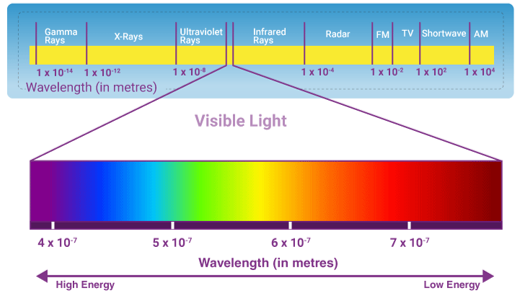
Figure 1. Visible light spectrum
However, color preference in honey bees is not entirely fixed as it is regarded as a behavioral response that is modifiable by newly discovered reward systems and learned olfactory information (Reser et al., 2012; Koethe et al., 2020). This plasticity in honeybee color preference was seen in a study by Lunau et al. (2011), whereby bees were observed to visit red, achromatic flowers despite their low sensitivity to the red color wavelength.
Study overview: Testing honey bee color preferences
Study site
The study was undertaken at the North West University Agricultural Research Farm, Molelwane. The data was be collected at the farm’s residential apiary. Molelwane farm is located in the town of Mahikeng in the Northwest province, South Africa. This study was conducted during the spring months of September and October 2023.
Experiment setup and design
The experiment involved three beehives, positioned 2 meters apart to ensure consistent foraging behavior. Four steel wires, each 12 meters long, were securely stretched across the width of the enclosure. The wires were spaced 1 meter apart, with the wire closest to the hives mounted 2 meters from the hive entrances.
Color treatments were administered using DIY honey bee feeders. These feeders were constructed from twenty 250 mL plastic bottles. Small holes were drilled at the base of each bottle using a sewing needle, and the bottles were attached to plastic petri dishes with super glue for stability.
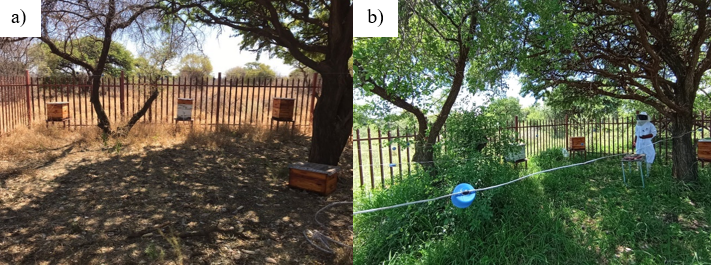
Figure 2 (a) Experimental hive placement (b) Mounting of the four galvanized steel wires
The twenty feeders were arranged along the wires, with each bottle spaced 1.7 meters apart. Each wire carried five feeders, representing the five different treatments: yellow, red, blue, green, and a colorless control. This setup allowed for consistent and controlled observation of honey bee color preferences.
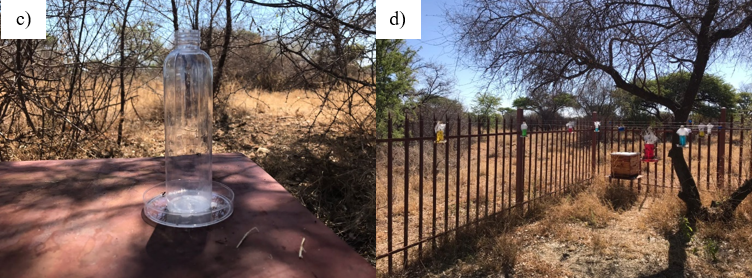
Figure 3 (c) Honey bee feeder (d) Honey bee feeder placement
Preparation of color treatments
Each honey bee feeder was filled with a 3:4 sugar solution, made by dissolving 150 g of white sugar in 200 mL of water. This solution served as the base for all five treatments: blue, yellow, red, green, and a colorless control.
To create the colored solutions, food-grade liquid pigments were carefully added to the sugar syrup using a syringe, ensuring even distribution. A total of 200 mL of each solution (colored or uncolored) was poured into the feeders using a funnel. The bottles were then quickly sealed with square polythene pieces and capped to prevent spillage.
Once prepared, the feeders were mounted onto the steel wires according to the planned layout and spacing. Honey bee color preference was measured by recording the volume of sugar solution consumed over a three-hour period, starting at 13:00. This setup allowed for a clear comparison of foraging activity across the different colors.
Experiment layout
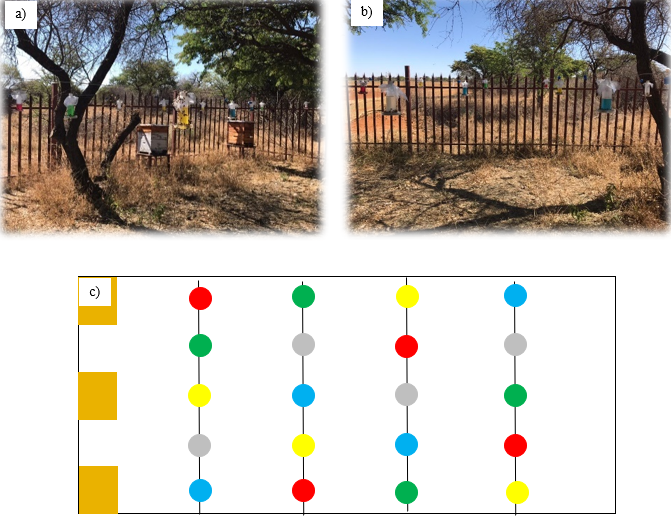
Figure 4 (a) and (b) show the actual experiment (c) is an aerial view of the distribution of the color treatments from the three experimental hives.
Results: Which colors did bees prefer?
Among the different color treatments, honey bees showed a clear preference and foraging frequency toward red and blue pigmented treatments, as was outlined by their high average consumption quantities (148 mL and 149 mL) at the end of the five-week period, according to Table 1 and Fig. 5. On the contrary, yellow pigmented treatment was least preferred by foraging bees after the five-week period as this treatment had the lowest average consumption (133 mL), according to Table 1 and Fig 5.
Table 1 Quantity of treatment consumed over the five-week experimental period
|
Quantity Consumed (ml) |
||||||
|
Treatment |
Week 1 |
Week 2 |
Week 3 |
Week 4 |
Week 5 |
AVRG Consumption |
|
Control |
142 |
146 |
125 |
139 |
149 |
140 |
|
Yellow |
123 |
152 |
111 |
138 |
141 |
133 |
|
Red |
156 |
180 |
130 |
133 |
140 |
148 |
|
Green |
139 |
144 |
124 |
139 |
149 |
139 |
|
Blue |
144 |
150 |
135 |
134 |
180 |
149 |
|
AVRG Consumption |
141 |
154 |
125 |
137 |
152 |
|

Figure 5 Honey bee color consumption assessment over a five-week period
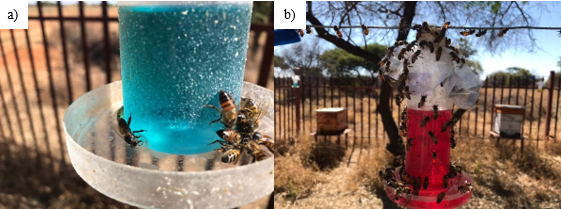
Fig 6 (a) Honey bees showing preference for blue treatment (b) Honey bees loving red treatment
Discussion: Why blue and red?
Blue preference
Table 1 and Figure 5 make it clear: honey bees can tell colors apart—and they definitely have favorites. As Koethe et al. (2020) previously described, bees in this study showed a strong preference for treatments with blue and red pigments by the end of the feeding period.
The attraction to blue is not surprising. Honey bees are naturally sensitive to light in the blue wavelength range, making blue objects stand out to them. Rohde et al. (2013) also point out that bees are drawn to colors with strong contrast against their background. This means that the blue treatments probably popped visually, helping the foraging bees easily spot the suspended bottle feeders and quickly link them to a sweet reward.
The surprising attraction to red
But here's where things get interesting: the bees also favored red treatments. This might seem counterintuitive since light in the red wavelength range (620–750 nm) is usually considered invisible to bees (Lunau et al., 2011). And yet, they still showed a strong response. How? Evidence suggests that bees do forage on red-flowered plants—like the red poppy (Papaver rhoeas) and the bottlebrush tree (Callistemon viminalis), which is common in the Mahikeng biome (Chittka & Waser, 1997; Lunau et al., 2011). This indicates that bees may rely on cues such as UV patterns, contrast, or learned associations to find and exploit red-colored food sources.
In short, the results confirm what we already know about bees’ love for blue, but they also highlight an intriguing puzzle: why do bees respond so strongly to red, a color they supposedly cannot see?
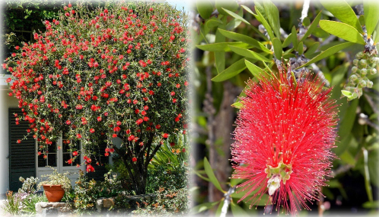
Figure 7 The nectar rich bottlebrush tree (Callistemon viminalis).
This rather unusual event has been attributed to the fact that certain shades of red can reflect light within the UV wavelength range, a range that honey bees are naturally sensitive to. This was also confirmed in a study that saw honey bees prefer red flowers that reflected UV light over red flowers that absorbed UV light, further outlining the complexity of honey bee vision (Lunau et al., 2011).
Likewise, certain flowers which appear red to the naked eye, i.e., red tulips and roses, have also been reported to reflect in the blue wavelength (Chittka and Waser, 1997). The broad spectral range of certain red hues indicates why honey bees may have shown a strong preference for red-pigmented treatments. Moreover, it is also plausible that natural conditioning to red flowers, particularly those of the bottlebrush tree littered across the Mafikeng biome, could have resulted in the strong preference toward red treatments as demonstrated by the bees.
Conclusion
Based on the results, honey bees demonstrated a strong affinity to colors dominated by blue and red wavelengths. This tendency toward blue pigmented treatments has been well documented (Lunau et al., 2011; Koethe et al., 2020) and can be attributed to honey bees' natural sensitivity toward colors that reflect at shorter wavelengths i.e. 400-500 nm. However, the preference towards red pigmented treatments was rather uncharacteristic as colors within the red wavelength range are considered invisible to honey bees; thus, revealing the complex nature of honey bee vision.
References
- Crane E. 1983. The archaeology of beekeeping. Duckworth, London, United Kingdom.
- Ibarra NH, Vorobyev M, Menzel R. 2014. Mechanisms, functions and ecology of color vision in the honeybee. J Comp Physiol A. 200:411–433.
- Koethe S, Fischbach V, Banysch S, Reinartz L, Hrncir M, Lunau K. 2020. A Comparative Study of Food Source Selection in Stingless Bees and Honeybees: Scent Marks, Location, or Color. Front. Plant Sci.
- Leslie N, Garcia JE, Dyer AG. 2018. Why color is complex: Evidence that bees perceive neither brightness nor green contrast in color signaling processing. Facets 3:800–817.
- Lunau K, Papiorek S, Eltz T, Sazima M. 2011. Avoidance of achromatic colors by bees provides a private niche for hummingbirds. The Journal of Experimental Biology 214:1607-1612.
- Reser DH, Witharange RW, Rosa MGP, Dyer AG. 2012. Honey bees (Apis mellifera) Learn Color Discriminations via Differential Conditioning Independent of Long Wavelength (Green) Photoreceptor Modulation. PLOS One 7:11.
- Rohde K, Papiorek S, Lunau K. 2013. Bumblebees and honeybees prefer similar colours of higher spectral purity over trained colours. J Comp Physiol A 199: 197-210.
- Spavenka S. 2021. The Vital Role of Pollinators in Agriculture. Farm Together. Accessed on [20/05/2022].
- Tan S, Li G, Liu Z, Wang H, Guo X, Xu B. 2022. Effects of glyphosate exposure on honeybees. Environmental Toxicology and Pharmacology 90:103792.