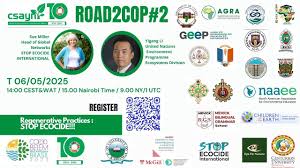
This is the second session of the "Road to COP" / "Road to BM" series hosted by the Global Climate Smart Agriculture Youth Network (GCSAYN). The session focuses on Regenerative Practices and features a presentation and discussion centered around the concept and proposed implementation of Ecocide Law. What the full video here: and the key highlights below.
Background and Rationale
The Climate Smart Agriculture Youth Network Global (GCSAYN) is committed to empowering young people in sustainable agri-food systems and actions on sustainability. As COP30 approaches, it is crucial to equip young farmers with the knowledge, skills, and networks necessary to effectively participate meaningfully in global negotiations on sustainability. The GCSAYN Road2 Belem+30 agenda is designed to build and strengthen capacity among young farmers, foster active engagement in discussions on sustainability and drive impactful actions aligned with the Agenda 2030 for Sustainable Development (SDG Pavillion).
Main Participants:
Cham Divine (Divine) - Founder Executive Director of GCSAYN. He hosts the session and provides welcome remarks and introductions. He shares the personal history of meeting Polly Higgins and being involved in the early days of the ecoside initiative.
Sue Miller - Head of the global network of Stop Ecoside International. She is the main guest speaker, presenting on what ecoside is, why an ecoside law is needed, progress towards its implementation, and its relevance to GCSAYN's mission.
Dominico - Helps host the session and introduces Sue Miller.
Alex - Helps monitor the chat and relays questions to Sue Miller.
Various representatives from GCSAYN Centers of Excellence and partners in different regions and countries (Nigeria, West Africa, SADC region, Zambia, Zimbabwe, Kenya, South Sudan, DRC, Uganda, Ivory Coast, Botswana). These individuals share their perspectives on how the ecoside agenda fits into their local work and the challenges they face.
Paul - Discusses upcoming First Ladies summits in Nairobi and London, highlighting collaboration with GCSAYN and the Flare awards.
Key Highlights and Discussions:
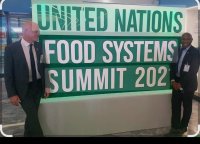
The session is part of the "Road to COP 30" and is timely, coinciding with the UN Food System Summit +4 stock-taking for the African region in Nairobi.
A minute of silence is held for Polly Higgins, the visionary lawyer who revived the ecoside law movement and is considered the founder of Stop Ecoside International. Divine shares his personal experience meeting her and being asked to be the first ambassador for the program in 2011.
Ecoside is introduced as a concept meaning "to kill your home" (from Greek 'oikos' and Latin 'caedere'). It was first used around 1970 by Professor Arthur Goldston.
The objective of the ecoside law movement is to have ecoside recognized as the fifth crime against peace within the jurisdiction of the International Criminal Court (ICC), alongside genocide, crimes against humanity, war crimes, and crimes of aggression. This requires amending the ICC's founding document, the Rome Statute.
The current legal and regulatory framework is deemed insufficient to protect the planet, being "fragmentary" and lacking effective enforcement mechanisms like those seen in the Paris Agreement. Company law is outdated, designed to protect profits rather than the planet.
Ecoside law aims to fill gaps in existing frameworks and provide "teeth". It creates personal criminal liability for key decision-makers behind severe environmental damage, fundamentally changing boardroom decisions. This is intended to have a powerful deterrent effect.
Ecoside law is also seen as supporting social justice by providing redress to communities in the Global South disproportionately affected by environmental damage often caused by corporations in the Global North. It elevates environmental destruction to an international crime, raising the status of environmental protections and promoting a shift in consciousness.
The definition of Ecoside adopted by Stop Ecoside International in 2021, formulated by an independent panel of international legal experts, is: "Ecoside means unlawful or wanton acts committed with knowledge that there is a substantial likelihood of severe and either widespread or long-term damage to the environment being caused by those acts". Each word has legal significance, and a full commentary is available.
The International Criminal Court (ICC) is the preferred venue because it already exists, has a tested amendment procedure (the crime of aggression was recently added), offers consistency across countries that ratify it, embodies the principle of complementarity (national courts have primary jurisdiction unless unable or unwilling to prosecute), and ecoside was originally intended to be included in the Rome Statute but "mysteriously" dropped off in 1996.
Significant progress was highlighted in 2024:
Belgium became the first state to introduce a domestic ecoside law based on the independent expert definition.
The European Union revised its environmental crimes directive to include a "qualified offense of crimes comparable to Ecoside," obliging member states to bring these provisions into their laws by May 2026.
Vanuatu, Fiji, and Samoa formally proposed the independent expert definition as an amendment to the Rome statute at the ICC.
The Democratic Republic of Congo announced its support.
The Parliamentary Assembly of the Council of Europe recommended including the definition in a convention on protecting the environment through criminal law.
Discussions and bill processes are ongoing in many other countries globally.
Ecoside law is not anthropocentric, meaning damage to the environment itself is sufficient for it to be a crime, even if no human has suffered a direct loss. However, it has a strong human rights connection, affecting rights to life, health, and culture, particularly for indigenous communities and those on the front line of climate change. It strengthens the intersection of environmental and human rights law.
Ecoside law is relevant to GCSAYN's mission because it protects the ecosystems agriculture depends on, empowers youth advocacy by providing a legal language, amplifies calls for climate justice and intergenerational equity, and promotes regenerative farming and responsible business by creating legal incentives for sustainable innovation.
Regarding awareness of impact for an act to be ecoside, the definition explicitly requires "knowledge that there is a substantial likelihood of severe..." damage. It is targeted at the "very worst and the most severe" environmental damage.
The need for tailoring ecoside laws to each country's specific environmental concerns was discussed, and it was noted that this is indeed happening as countries see the value of domestic implementation.
Regarding participation in the ecoside project, options mentioned include joining networks like the farming and land network or youth groups such as "Youth for Ecoside Law" and the "Student Ambassadors group". The most important action is to spread the message about ecoside law. Resources are available for this.
The ICC's supra-national nature provides recourse if national legal or political systems prevent the enforcement of domestic ecoside laws.
Ecoside law supports sustainable development by discouraging unsustainable practices that might cross the line into ecoside.
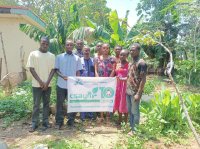
Representatives from GCSAYN Centers of Excellence share how they plan to integrate the ecoside agenda into their work, including creating awareness among women in agriculture, training youth, working with rural communities, addressing environmental damage from deforestation and mining, and advocating for policy changes. Specific regional issues mentioned include acid spillage and water contamination from plastics in the SADC region, and mining pollution affecting rivers and wildlife in Zimbabwe.
The concept of the three Ps of sustainability (People, Planet, Profit) or three pillars (Environmental, Social, Economic) is discussed in relation to balancing livelihoods, environmental protection, and profit.
Information is shared about a "Town Hall COP" initiative to organize country-level events contributing to COP 30, with registration and potential seed funding available. Funding mechanisms for proposals are also shared.
Discussion covers empowering citizens and NGOs to act when a country fails to enforce its own ecoside laws, suggesting action through national criminal courts first and then potential recourse to the ICC if necessary.
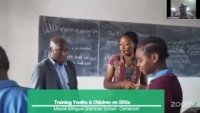
GCSAYN's structure working through universities and high schools as "Centers of Excellence" is highlighted. An official process for universities to become Centers of Excellence and for students/members to become involved as ecoside ambassadors is discussed.
Upcoming First Ladies summits in Nairobi (University of Nairobi) and London are announced, focusing on women's transformative leadership and collaboration with GCSAYN.
The discussion concludes with brief remarks from various participants sharing their takeaways and enthusiasm for the ecoside agenda and networking. Divine mentions collaboration with NASA on an upcoming event.