


Why feed mill operations matter
Feed represents the single largest cost in any livestock or aquaculture operation—often 60-70% of total production expenses. Whether you're running a poultry farm, managing cattle, or operating fish ponds, the quality and cost of your feed directly determines your bottom line. A well-run feed mill doesn't just mix ingredients together. It combines nutrition science, mechanical processing, quality control, and smart management to turn raw commodities into feeds that help animals grow faster, stay healthier, and convert feed more efficiently.
The challenge? Raw material prices fluctuate wildly. Regulations keep tightening. And producers demand ever-better results at lower costs. This is why systematic feed mill operations matter more than ever.
The economics of feed production
Here's the reality most producers face: maize prices spike during drought, soybean meal costs jump when export markets shift, and fish meal availability changes with fishing quotas. Meanwhile, your customers, whether you're selling to farms or feeding your own animals, expect consistent quality at predictable prices.
Smart feed mill operations help you navigate these challenges. When you can formulate precisely, process efficiently, and minimize waste, you protect margins even when market conditions turn difficult.
Managing raw materials effectively
Your feed mill's performance starts at the receiving dock. The ingredients coming through your gates determine everything downstream—no amount of fancy processing can fix poor-quality raw materials.
Procurement and quality specifications
Major ingredients include maize, wheat, sorghum, rice bran, soybean meal, oil cakes, fish meal, meat and bone meal, DDGS, and a range of minerals, vitamins, amino acids, enzymes, and probiotics. Each needs clear quality specs. Don't just accept what suppliers send—define your standards for moisture content, protein levels, mycotoxin limits, and physical quality.
Work with approved suppliers who understand your requirements. Keep performance records. When a supplier consistently delivers sub-standard material, find alternatives. The few dollars you might save aren't worth the production problems and animal performance issues you'll face. Understanding livestock feed ingredients thoroughly helps you make informed sourcing decisions.
Storage and inventory control
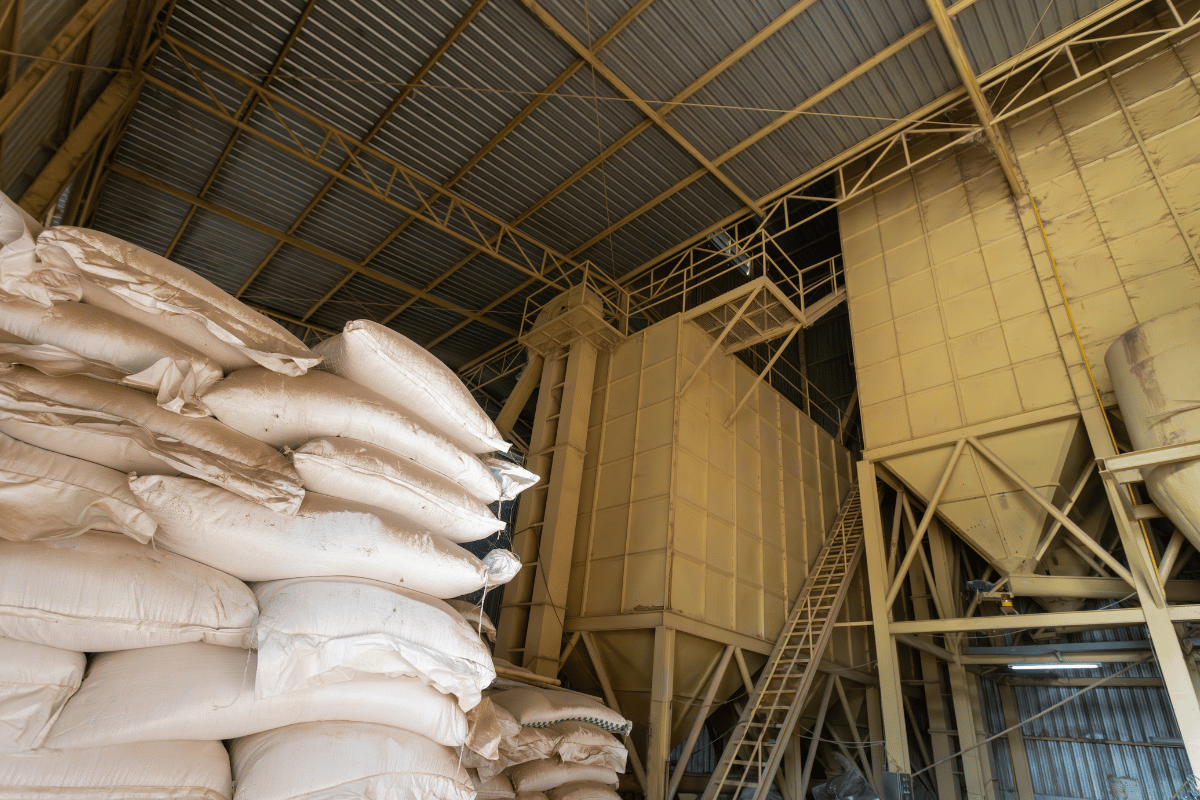
Once materials arrive, proper storage becomes critical. Bulk commodities are stored in silos equipped with aeration systems, temperature sensors, and fumigation capabilities. Watch those temperatures; hot spots mean trouble. For bagged materials, use dry, ventilated warehouses. Keep bags on pallets, off the floor, with space between stacks for air circulation.
Implement strict first-in, first-out (FIFO) protocols. Materials sitting too long lose nutritional value, especially vitamins and enzymes. ERP systems help track batch numbers, receipt dates, and expiry information. This isn't bureaucratic overhead—it's how you prevent expensive ingredient losses and maintain traceability when problems arise.
Feed formulation strategies
Formulation is where nutrition meets economics. You're balancing animal requirements against ingredient costs and availability, trying to hit nutritional targets at the lowest possible cost.
Species-specific nutritional requirements
Different animals have completely different needs. Poultry nutrition varies dramatically between broilers, layers, and breeders, and changes through growth stages. Cattle nutrition differs for calves, growing heifers, lactating cows, dry cows, and fattening cattle. Aquaculture feed management depends heavily on species, life stage, water temperature, and production system.
Work with qualified nutritionists who understand your specific operations. Generic formulas rarely perform optimally. You need recipes tailored to your ingredients, local conditions, and production goals.
Using least-cost formulation software
Software like Bestmix, Brill Formulation, and FeedSoft revolutionized feed formulation. These programs balance multiple nutrients simultaneously while finding the cheapest combination of ingredients that meets all requirements.
But remember: garbage in, garbage out. The software is only as good as the ingredient analysis data you feed it. Test your raw materials regularly, don't rely on book values. Maize protein can vary by 2-3 percentage points between batches. That variation matters. Integrating knowledge about protein supplements enhances your formulation accuracy.
Review and adjust formulations regularly. When ingredient prices shift significantly or seasonal quality changes occur, reformulate. The optimal recipe in March probably isn't optimal in September.
Production and process control
Now comes the mechanical side, actually making the feed. This is where theory meets hardware, and where attention to detail prevents expensive mistakes.
Grinding and particle size management
Grinding is your first major processing step. Particle size dramatically affects digestibility, pellet quality, and animal performance. Too coarse and animals can't digest efficiently. Too fine and you get dusty feed, segregation problems, and potential digestive upsets.
Hammer mills and roller mills each have advantages. Hammer mills are versatile and handle various materials, but consume more energy. Roller mills are more efficient for grains but less flexible. Whichever you use, maintain screens and hammers regularly. Worn equipment produces inconsistent particle sizes.
Test particle sizes are routinely determined using sieve analysis. Don't guess but measure. Different species have different optimal ranges, and knowing what you're actually producing beats assumptions every time.
Mixing for uniform distribution
Poor mixing is one of the most common and expensive problems in feed mills. When micro-ingredients like vitamins, amino acids, and medications distribute unevenly, some animals get overdosed while others get shortchanged. The result? Inconsistent performance and potential toxicity issues.
Test your mixer efficiency using the coefficient of variation (CV) analysis. A good batch mixer should achieve a CV below 10% for tracer materials. If you're not hitting this, your mixer needs attention, worn ribbons, short mixing times, or overloading could be the culprit.
Batch mixers suit smaller operations and provide excellent mixing when properly operated. Continuous mixers work for high-volume plants but require careful calibration and monitoring. Choose what fits your scale and manage it properly.
Pelleting for improved feed quality
Pelleting transforms mash feed into durable pellets. The benefits are real: less segregation during handling, reduced feed waste, improved feed conversion, and in many cases, better animal performance due to heat treatment effects on starch and proteins.
Key parameters include conditioning temperature (typically 80-90°C), steam quality, die specifications, and throughput rates. Push too hard through the die and pellet quality suffers. Run too slowly and production costs soar. Finding the sweet spot requires experience and careful monitoring.
After pelleting, cooling is essential. Hot pellets straight from the pellet mill are soft and will crumble. Good coolers bring pellets down to within 5°C of ambient temperature before bagging or bulk loading.
Quality control essentials
Quality control isn't about catching bad batches before they ship—though that's important. It's about understanding your processes well enough to prevent problems in the first place.
Test incoming raw materials for moisture, crude protein, fat, fiber, ash, and critical contaminants like aflatoxin. Finished feeds must meet declared specifications. Keep an in-house lab with rapid testing equipment for quick feedback during production. Send samples to accredited external labs periodically to validate your results.
Standard operating procedures for hygiene and sanitation aren't optional extras. Cross-contamination between batches can cause serious problems, especially with medicated feeds. Clean equipment between runs when necessary. Maintain strict protocols for handling sensitive ingredients.
Traceability systems let you track any batch from raw materials through to delivery. When problems emerge—and they will eventually—good records mean you can identify affected batches quickly and take corrective action before widespread damage occurs.
Equipment maintenance practices
Feed mills run on grinding, mixing, pelleting, and conveying equipment that works hard under demanding conditions. Breakdown during peak season can be devastating.
Implement preventive maintenance schedules for all major equipment. This means regular inspections, lubrication, and timely replacement of wear parts like hammer mill screens, mixer ribbons, pellet mill dies and rollers, and conveyor flights. Track maintenance activities and equipment performance. Patterns in breakdown data reveal problems before they cause major failures.
Calibrate weighing scales, batching systems, and micro-dosing units regularly. Formulation accuracy means nothing if your batching system is adding wrong amounts. Many quality problems trace back to calibration issues.
Keep critical spare parts in stock. Yes, inventory costs money. But the production downtime from waiting three days for a replacement part costs far more. Stock strategic spares based on equipment age, failure history, and supplier lead times.
Managing your workforce
Equipment doesn't run itself. You need skilled operators, competent technicians, quality control staff, and supervisors who understand the entire operation.
Invest in training. Operators need to understand not just which buttons to push, but why processes work the way they do. When they understand cause and effect, they spot problems earlier and make better decisions when things go wrong.
Maintain clear production logs and reporting systems. Document batch weights, processing times, quality test results, and any deviations from standard procedures. This documentation supports troubleshooting, validates processes, and creates accountability.
Safety matters. Feed mills present real hazards—dust explosions, grain engulfment, chemical exposure, moving machinery, and fire risks. Provide proper personal protective equipment. Implement machine guarding. Maintain fire suppression systems. Train employees on safe work practices and chemical handling. Most accidents are preventable.
Controlling costs and improving efficiency
With feed costs dominating production economics, even small efficiency improvements deliver significant returns.
Least-cost formulation helps, but operational efficiency matters just as much. Grinding and pelleting are energy-intensive. Monitor power consumption and look for improvement opportunities. Sometimes a worn hammer mill screen or clogged die increases energy use by 15-20% while reducing throughput.
Minimize waste. Dust collection systems should recover material, not just clean air. Every kilogram of feed that ends up on the floor or gets rejected for poor quality hurts profitability. Reduce spillage through better equipment design and operator training.
Track key performance indicators: production per hour, energy consumption per ton, percentage of fines or rejects, and material recovery rates. These metrics reveal where you're losing money and where improvements would pay off. Exploring sustainable feed production methods can also reduce costs while improving sustainability.
Compliance and record keeping
Feed regulations exist for good reasons, animal health, food safety, and environmental protection. Non-compliance creates legal headaches and threatens your business.
Understand the regulations that apply to your operation. Requirements vary by country and region, but generally cover ingredient approvals, medication use, labeling, and quality standards. Certifications like GMP+, ISO, and HACCP demonstrate compliance and may be required by customers.
Comprehensive record keeping is your protection. Document everything: raw material receipts and test results, batch production records, quality control data, equipment maintenance, employee training, and customer complaints. Good records prove compliance, support product recalls if necessary, and help troubleshoot problems.
Digital systems make this easier. Modern software can link ingredient receipts, formulation records, production data, quality results, and sales information. This integration provides full traceability and generates compliance reports automatically.
Automation and digital systems
Many feed mills still operate largely manually, but automation offers real advantages. PLC and SCADA systems control batching, mixing, and pelleting with precision that manual operation can't match. Automated systems reduce human error, improve consistency, and generate detailed production records automatically.
Real-time monitoring catches problems immediately. Temperature sensors, flow meters, and scale feedback let you intervene before quality suffers or production stops. Integration with ERP systems connects production data with inventory, quality, and sales information. This holistic view supports better decision-making.
Start with critical control points. You don't need to automate everything at once. Focus on areas where precision matters most—ingredient weighing, steam conditioning control, pellet temperature monitoring. Build from there as budget and experience permit.
Conclusion
Running an effective feed mill requires attention to multiple interconnected systems. You need to source quality ingredients, formulate accurately, process consistently, maintain equipment reliability, manage skilled staff, control costs, and comply with regulations. Miss any piece and the performance suffers.
The good news? Most improvements don't require massive capital investment. Better procurement practices, regular equipment maintenance, operator training, and systematic quality control deliver significant returns with modest investment. Start with basics, measure performance, identify bottlenecks, and improve systematically.
For producers in poultry, cattle, and aquaculture, feed quality fundamentally determines profitability. A well-run feed mill producing consistently good feed at controlled costs gives you a competitive advantage that's hard to beat. Focus on operational excellence, and the results will follow.