What is carbon farming?
Carbon is not just a component of gas in the air but a major building block of life in the soil. Imagine your soil as a savings account that will save the nutrients and carbon in it. When you manage your land in such a way that this saving account of soil saves more carbon, that’s termed as Carbon Farming. Various smart practices like cover cropping, compost use, and reduced tillage make the plants pull carbon dioxide (CO₂) from the air and store it in roots and soil. This process not only improves soil structure but also leads to Carbon Credits, which emerge as a future source of income for farmers.
Why carbon farming matters?
Carbon Farming is not just a buzzword but a way to fight climate change while boosting your farm's productivity sidewise. By storing more and more carbon, soils become more fertile, improve water retention, and support healthier root systems. For a bonus, if the carbon market becomes accessible to smallholder farmers, you could get paid for every ton of carbon your soil holds, that we'll discuss in the next sections.
How does stored carbon improve soil health?
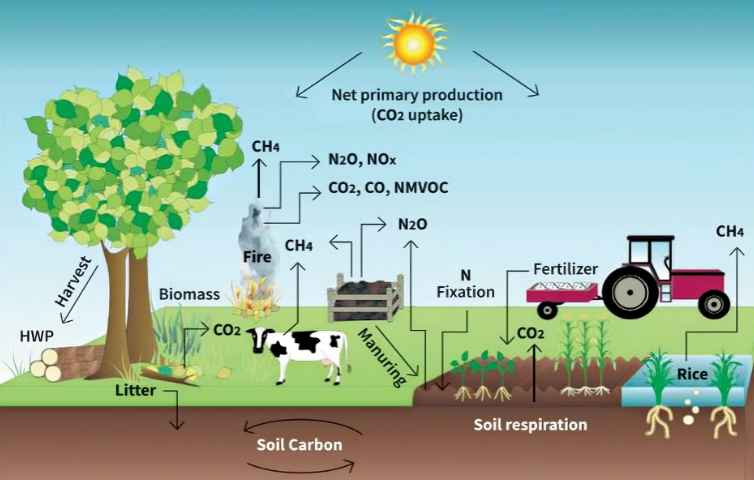
When carbon is stored in the soil, it is mostly in the form of Organic Matter, like dead plant roots, compost, manure, crop residue, and microbial by-products. Soil organic carbon plays a central role in improving the soil's physical, chemical, and biological quality by improving soil structure, increasing water retention, boosting nutrient availability, feeding soil microbes, reducing soil erosion, and many other factors.
What practices store carbon in soil?
Various science-backed practices like Cover cropping, Reduced Tillage, Agroforestry, crop rotation, etc. help build soil carbon. For these practices, the processes involved and additional benefits are given as:
Table 1: Process involved and benefits associated with various carbon farming strategies
|
Practice |
How it stores Carbon |
Additional Farmer Benefits |
|
Adds organic matter through root biomass and residues |
Reduces erosion, improves fertility |
|
|
Reduced Tillage/No-till |
Limits soil disturbance, preserves carbon-rich layers |
Saves fuel and labour |
|
Compost/FYM Application |
Directly adds stable organic carbon |
Improves structure, microbial life |
|
Trees store carbon in biomass and roots |
Shade, fuelwood, windbreak |
|
|
Promotes diverse root biomass and microbial activity |
Breaks pest cycles, improves yield stability |
|
|
Adds fast-decomposing organic matter |
Quick soil fertility boost |
|
|
Slows decomposition, protects carbon in soil |
Retains moisture, suppresses weeds |
Signs you're building soil carbon!
You can't directly see carbon, but some good signs that show your soil is on the right track. These signs include:
- Darker and more crumbly soil with better moisture retention
- Stronger root growth and higher crop resilience
- Increased beneficial microbes and earthworm activity
- Reduced need for synthetic fertilizers over time
Can farmers earn from carbon credits?
In the global carbon markets, many companies pay farmers for every ton of Carbon (CO₂) captured in their soils. While many of these programs are still pilot-based or focused toward large landholders, India is exploring its own Carbon Credit Models by both government and private initiatives. Many NGOs and agri-tech-based Startups have started measuring soil carbon and connecting with farmers for payment systems. For this benefit, farmers need consistent practice and proper documentation. In a short time, these systems are possible to become accessible even for smallholders.
Ways to start carbon farming on a budget
You don't need any costly or fancy tools to begin storing carbon. Here are some basic strategies on how to start:
- Keep crop residues in the field and don't burn them
- Regularly add compost or FYM to the soil
- Use Mulching to cover bare soil
- Grow intercrops or cover crops during the off-season
- Avoid deep tillage unless necessary.
It must be kept in mind that not all practices store the same amount of carbon. Here’s a simple comparison on how much CO₂ different carbon farming methods can potentially store per hectare each year:
Table 2: Potential Carbon Sequestration Rates (for awareness, based on global data)
|
Practice |
Estimated Carbon Storage (t CO₂/ha/year) |
|
Reduced Tillage |
0.3-0.9 |
|
Cover Cropping |
0.4-1.5 |
|
Compost Application |
1.0-2.5 |
|
Agroforestry |
2.0-5.0 |
|
Improved grazing (pastures) |
0.5-2.0 |
Note: Actual rates depend on soil type, climate, and management.
Final thoughts: From soil care to climate repair
By following these practices, your soil can do more than grow crops- it can help cool the planet. By storing carbon naturally, under low-cost practices, farmers can restore soil health, increase resilience, and even explore new ways of income through carbon markets.
It’s not just about saving the environment; it's about Smart Farming for a Better Future