



Bacterial inoculants are formulations containing live bacteria applied to seeds, soil, or plants to improve crop nutrition, protect against pests, or stimulate growth. They are one of the fastest-growing categories of agricultural inputs worldwide, and for good reason: when chosen well, soil biologicals and biofertilizers based on bacteria can reduce fertilizer costs, replace chemical pesticides, and improve crop resilience to drought, heat, and disease.
But choosing well is the hard part. Most farmers today select biological crop protection and biostimulant products based on what a sales representative recommends, not on a clear understanding of what each product actually does at the microbial level. That gap between the biology and the buying decision is where most of the money and performance get lost.
This article is a practical guide to closing that gap.
Why most farmers still choose inoculants by brand, not by function
Multiple studies on the adoption of agricultural biologicals point to the same conclusion: the primary barrier is not cost, availability, or product performance. It is a lack of understanding of the underlying biology (O'Callaghan, 2016; Marrone, 2025).
But this gap looks different depending on where you farm.
In Brazil, where bacterial inoculants have been used at a commercial scale for decades, farmers can choose from hundreds of registered products. The challenge there is making informed choices among many options. In much of Europe, Africa, and Southeast Asia, the situation is almost the opposite: regulatory frameworks are still catching up, product availability is limited, and farmers may have only a handful of options for the specific function they need.
These are different stages of the same transition. And in both cases, the underlying problem is the same: the microbiological knowledge required to evaluate, choose, and use bacterial inoculants well remains fragmented. It is scattered across academic journals, confined to specific research groups, or passed informally between specialists and a small number of large operations.
Where products are abundant, this knowledge gap leads to poor choices. Where products are scarce, it slows down the demand that would bring better products to market in the first place.
What bacterial inoculants do
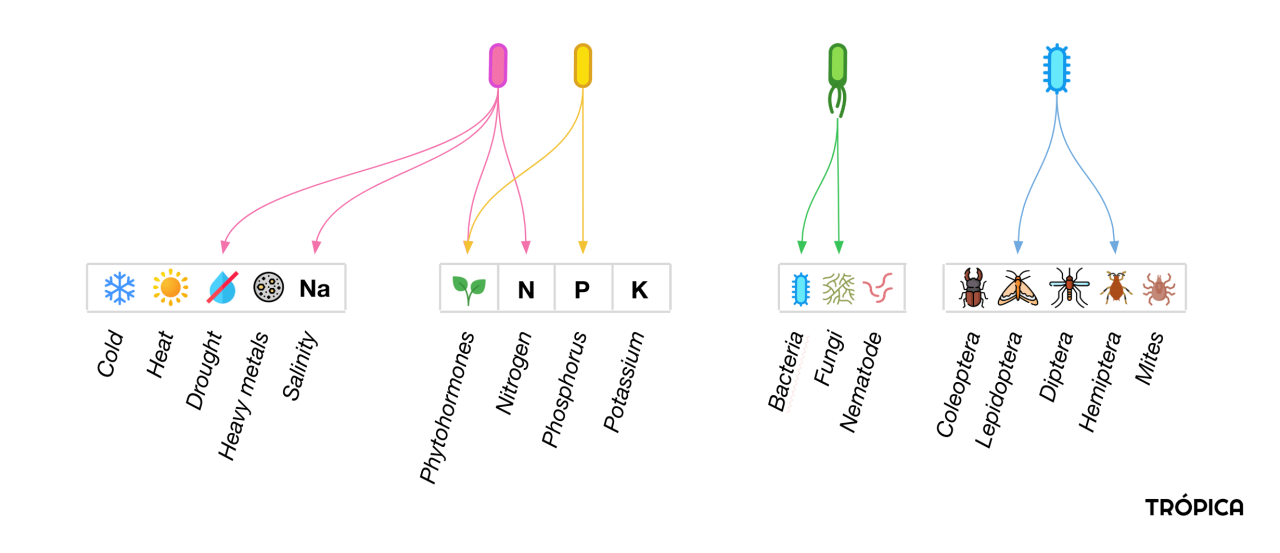
The main functions of bacterial inoculants fall into two categories: biostimulation and biocontrol.
Biostimulation
Biostimulants include bacteria that fix atmospheric nitrogen (such as Bradyrhizobium in soybean or Azospirillum brasilense in corn and wheat), solubilize phosphorus and potassium, produce phytohormones like auxins and gibberellins, or help the plant cope with abiotic stress through mechanisms like ACC deaminase production (Glick, 2012; Backer et al., 2018). These bacteria play a direct role in soil fertility and nutrient cycling, making essential nutrients more available to plants.
Biocontrol
Biocontrol includes bacteria that suppress pathogens or pests through the production of antibiotics, lytic enzymes, siderophores, or volatile organic compounds (Dimkić et al., 2022; Etesami et al., 2023). These organisms are part of the broader family of microbial biopesticides, which target specific pests through biological mechanisms rather than broad chemical toxicity.
Some species can do both. But rarely in the same strain. This distinction is critical and often overlooked.
A single species, such as Bacillus subtilis, can include strains that are excellent biofungicides and others optimized for phosphorus solubilization. They share a name, but their functional profiles may be entirely different (Fan et al., 2018; Miljaković et al., 2020). The same applies to Pseudomonas fluorescens, where some strains are commercialized for nutrient solubilization and others for fungicidal activity.
This happens because metabolic pathways compete for energy and cofactors inside the cell. A bacterium that invests heavily in producing antimicrobial compounds may divert resources away from phytohormone production, and vice versa. Evolution pushes strains toward specialization, not universality.
Why the same species name can mean completely different products
In markets with many products, the dynamics are familiar: products with higher margins attract more sales representatives, more representatives mean more visibility, and more visibility drives adoption. This is not unique to biological inputs.
But with bacterial inoculants, there is an additional complication. The difference between two products carrying the same species name can be enormous, because the strain determines what the product actually does.
Consider Bacillus thuringiensis, the most widely commercialized bioinsecticidal bacterium and the most common active ingredient in biopesticides. Different varieties of this single species produce different toxin profiles, each targeting specific insect groups. The kurstaki variety is effective against lepidopterans (caterpillars), while the israelensis variety targets dipterans (mosquitoes and flies). A farmer buying a B. thuringiensis product without knowing the variety and toxin profile might be applying a product that has little effect on the pest they are trying to control (Jouzani et al., 2017).
The same principle applies across the board. Two products labeled Bacillus amyloliquefaciens may contain strains with completely different biocontrol spectra. One might target Fusarium; the other might be more effective against nematodes. The species name alone does not tell you which one you need.
If you farm in a country where only two or three bacterial products are even available, this might seem like a distant concern. But understanding the biology changes your position in a different way. It allows you to identify which functions your operation actually needs, check whether viable solutions already exist elsewhere in the world, and start asking your suppliers, regulators, and industry associations why those solutions have not reached your market yet.
In Brazil, the biological input market did not grow because companies decided to sell more products. It grew because a critical mass of large-scale producers understood the biology, saw the economic advantage, and actively demanded products that worked. Informed demand created the market. The same pattern can happen anywhere, but it requires farmers who understand what they are asking for.
A better starting point: "Which function do I need, and does a bacterial strain exist that can deliver it?"
How to evaluate a bacterial inoculant before buying
Shifting from brand-based to function-based thinking does not require a degree in microbiology. But it does require asking better questions. The specific questions depend on your market.
If you have access to multiple products, these six questions help you choose wisely:
- What is the strain, not just the species? Bacillus subtilis is a universe of strains. The commercially dominant fungicidal strain (QST 713) and a biostimulant strain used for drought mitigation in Brazil are both B. subtilis, but they serve completely different purposes. Ask for the strain code.
- What is the registered and proven function of this specific strain? Is it registered as a biofungicide, a bionematicide, a biostimulant, or an insecticide? Some products combine strains, which can be effective, but you should know what each component is supposed to do.
- Under what soil and climate conditions was it tested? A strain that performs well in temperate clay soils may behave differently in tropical sandy soils. Soil pH, temperature, and the resident microbial community all influence how well an introduced bacterium establishes and functions (Kaminsky et al., 2019). Understanding the role of soil microorganisms in sustainable agriculture helps clarify why local soil conditions matter so much for inoculant performance.
- What is the concentration of viable cells at the time of application? Bacteria are living organisms. Shelf life, storage conditions, and formulation type (liquid, powder, granule) all affect how many cells are still alive when they reach the field. A product with a high cell count at the factory may arrive with significantly fewer viable organisms if the cold chain was broken.
- Are there field trial data for my crop and region? Laboratory assays showing antagonistic activity in a petri dish do not always translate to field performance. Biocontrol agents that work in vitro frequently fail to adapt to local soil conditions or compete with the native microbiome (O'Callaghan, 2016). Ask for field-level evidence.
- Is the product compatible with my current management system? Some bacterial inoculants are sensitive to specific fungicides or herbicides. Timing and method of application (seed treatment, in-furrow, foliar spray) also affect performance. Compatibility with existing crop protection programs, including integrated pest management strategies, should be addressed before purchase, not after.
If your market has limited product availability, a different set of questions becomes equally important: What biological functions does my operation need most? Do strains with proven efficacy for those functions exist in other countries? Is my country's regulatory framework keeping pace with the science? And are there microbial culture collections in my region that hold strains worth developing into products?
Resources like the CABI BioProtection Portal, which lists registered biological products across nearly fifty countries, can help you see what is already available globally, even if it has not reached your local market yet.
How understanding biology creates better markets
Farmers who develop a working understanding of agricultural microbiology tend to spend less, solve problems faster, and depend less on commercial pressure to make input decisions. But the impact goes beyond the individual farm.
In every country where biological inputs have reached a meaningful scale, the pattern is the same: adoption was driven not by supply, but by informed demand. Producers who understood the science started asking for products that worked. They tested, compared, rejected what did not perform, and scaled what did. Over time, this created pressure on manufacturers to improve quality, on regulators to update frameworks, and on researchers to translate their findings into practical tools.
That cycle has not yet started in many parts of the world. The science is there. The strains exist. What is often missing is a critical mass of farmers who understand the biology well enough to demand better.
For a structured, science-based exploration of how agricultural bacteria work, from cell biology to field application, Trópica's course on bacterial inoculants covers this ground in detail, including a global survey of commercially available strains organized by function, not by brand.
The future of bacterial inoculants in agriculture
The biological input sector will continue to grow. New species and strains will be commercialized. Regulatory frameworks will evolve. And farmers everywhere will face an increasingly complex landscape of choices, or, in many countries, will need to build that landscape themselves.
The producers who will benefit most from this transition are not necessarily those with the most products on their shelves. They are the ones who understand what bacterial inoculants do, how to evaluate them, and what their operations actually need. That understanding turns a farmer from a passive buyer into an active force shaping the market.
It starts with biology.
References
- Backer, R., Rokem, J. S., Ilangumaran, G., Lamont, J., Praslickova, D., Ricci, E., … & Smith, D. L. (2018). Plant growth-promoting rhizobacteria: context, mechanisms of action, and roadmap to commercialization of biostimulants for sustainable agriculture. Frontiers in Plant Science, 9, 1473.
- Dimkić, I., Janakiev, T., Petrović, M., Degrassi, G., & Fira, D. (2022). Plant-associated Bacillus and Pseudomonas antimicrobial activities in plant disease suppression via biological control mechanisms: a review. Physiological and Molecular Plant Pathology, 117, 101754.
- Etesami, H., Jeong, B. R., & Glick, B. R. (2023). Biocontrol of plant diseases by Bacillus spp.. Physiological and Molecular Plant Pathology, 126, 102048.
- Fan, B., Wang, C., Song, X., Ding, X., Wu, L., Wu, H., … & Borriss, R. (2018). Bacillus velezensis FZB42 in 2018: the Gram-positive model strain for plant growth promotion and biocontrol. Frontiers in Microbiology, 9, 2491.
- Glick, B. R. (2012). Plant growth-promoting bacteria: mechanisms and applications. Scientifica, 2012, 963401.
- Jouzani, G. S., Valijanian, E., & Sharafi, R. (2017). Bacillus thuringiensis: a successful insecticide with new environmental features and tidings. Applied Microbiology and Biotechnology, 101(7), 2691–2711.
- Kaminsky, L. M., Trexler, R. V., Malik, R. J., Hockett, K. L., & Bell, T. H. (2019). The inherent conflicts in developing soil microbial inoculants. Trends in Biotechnology, 37(2), 140–151.
- Miljaković, D., Marinković, J., & Balešević-Tubić, S. (2020). The significance of Bacillus spp. in disease suppression and growth promotion of field and vegetable crops. Microorganisms, 8(7), 1037.
- O'Callaghan, M. (2016). Microbial inoculation of seed for improved crop performance: issues and opportunities. Applied Microbiology and Biotechnology, 100(13), 5729–5746.
- O'Callaghan, M. (2022). Soil microbial inoculants for sustainable agriculture: limitations and opportunities. Soil Use and Management, 38(3), 1340–1369.
- Marrone, P. G. (2025). Increasing the use of biological pesticides in integrated pest management programs. Frontiers in Insect Science, 5, 1552361.