


Efficient CEA system design for urban farming: space, energy, and sustainability
According to a 2018 UN report, 55% of the world’s population lives in urban areas today, a proportion that is expected to increase to 68% by 2050. That means billions of people are competing for limited space and there is a growing demand for fresh food that can’t always be met by traditional farming.
Where Controlled Environment Agriculture (CEA) offers a solution by regulating light, temperature, humidity, and nutrients, CEA makes it possible to grow crops anywhere—whether on a rooftop in Mumbai, in a converted warehouse in London, or inside a shipping container in Dubai.
But urban farming comes with its own set of challenges: space is scarce, weather is unpredictable, and transporting fresh produce into cities is costly.
In this article, we’ll explore how to design an efficient, cost-effective CEA system for urban settings—one that maximizes yield, minimizes waste, and works sustainably in the heart of the city.
Understanding CEA & its role in urban farming:
Controlled Environment Agriculture (CEA) is a modern method of growing crops where all important factors—such as light, temperature, humidity, water, and nutrients—are carefully managed. Unlike traditional farming, CEA does not depend on natural weather conditions, which makes it reliable and predictable. This means that fresh vegetables, fruits, and herbs can be produced anywhere, even in the middle of crowded cities.
The most common types of CEA systems are:
- Greenhouses: Use natural sunlight but allow partial control over temperature, humidity, and pests.
- Vertical farms: Multi-level indoor farms that use artificial lighting and maximize space.
- Hydroponics: Plants grown in water enriched with nutrients instead of soil
- Aeroponics: Plants suspended in air, where roots are sprayed with a fine nutrient mist.
- Aquaponics: A combined system where fish farming and hydroponics support each other naturally.
Why CEA is becoming important in cities
- Better use of limited space: Cities don’t have large open fields, but CEA allows crops to be grown vertically or in compact spaces like rooftops, basements, or unused buildings.
- Year-round harvests: Since growing conditions are controlled, farmers can produce crops in every season without worrying about rainfall, heatwaves, or cold weather.
- Fresher and healthier food: Crops are grown close to where people live, reducing the need for long transportation, which often lowers freshness and quality.
- Reduced costs and emissions: Shorter supply chains mean less fuel used for transportation and lower environmental impact.
- Safer farming: With controlled systems, farmers can use less pesticide, resulting in cleaner and safer food for consumers.
Example: In Singapore, where land is extremely limited, rooftop and vertical hydroponic farms now supply fresh lettuce, spinach, and herbs directly to supermarkets located just a few kilometers away. This model not only reduces transport costs but also ensures city residents get fresher food compared to imported produce.[FAO, 2019][Despommier, 2020]
Key design efficiency considerations
Designing an efficient CEA system requires careful planning of space, energy, water, climate, and crop choices to maximize output while minimizing costs, especially in the context of urban farming, so some core considerations with practical guidance are mentioned here:
a) Space Optimization
- Site selection: Rooftops, basements, and unused buildings are ideal for compact, high-density setups. Optimize height and layer spacing for light penetration and maintenance access.
- Vertical stacking: Multi-layer hydroponic or aeroponic racks maximize plants per square meter. Example: 3–5 layers can increase yield 5 times over single-layer systems[Despommier, 2020]
- Modular units: Use movable or stackable units that can be expanded as production increases. Container farms (40–80 ft) can produce 10,000–15,000 heads of lettuce per month.[Banerjee & Adenaeuer, 2014]
b) Energy Efficiency
- LED grow lights: Use red/blue spectrum LEDs optimized for photosynthesis. Can reduce electricity consumption by 40–50% compared to traditional lighting.
- Lighting layout: Reflective walls and adjustable angles ensure even light distribution and reduce shadow zones.
- Renewable energy integration: Solar panels or small wind units can supply 20–40% of energy needs.
- Automation: Smart timers and dimming systems cut unnecessary operation and lower energy bills by up to 25%.
c) Water Management
- Closed-loop systems: Recirculate water in hydroponics or aeroponics to reduce waste by 70–90%[FAO, 2019]
- Nutrient delivery: NFT or drip-fed systems allow precise control of nutrients to match plant growth stage.
- Water sourcing: Use rainwater harvesting or greywater (after filtration) to supplement supply and reduce municipal water dependence.
d) Climate Control
- Temperature management: HVAC systems maintain optimal growth temperatures; stable climates improve yields 10–15% in high-density setups.
- Humidity control: Humidifiers/dehumidifiers prevent fungal growth and disease outbreaks. Optimal relative humidity: 50–70%(based on crop type)
- CO₂ enrichment: Maintain 800–1,000 ppm CO₂ in enclosed spaces to accelerate growth and improve photosynthetic efficiency by 20–30%.
e) Crop Selection for Efficiency
- Fast-growing, high-value crops: Lettuce (30–35 days), basil (25–30 days), and microgreens (10–20 days) enable multiple harvests per year.
- High-density suitability: Choose crops that tolerate tight spacing without compromising quality.
- Short growth cycles: Multiple harvests per year improve ROI; plan staggered planting schedules for continuous production.
Technology and automation:
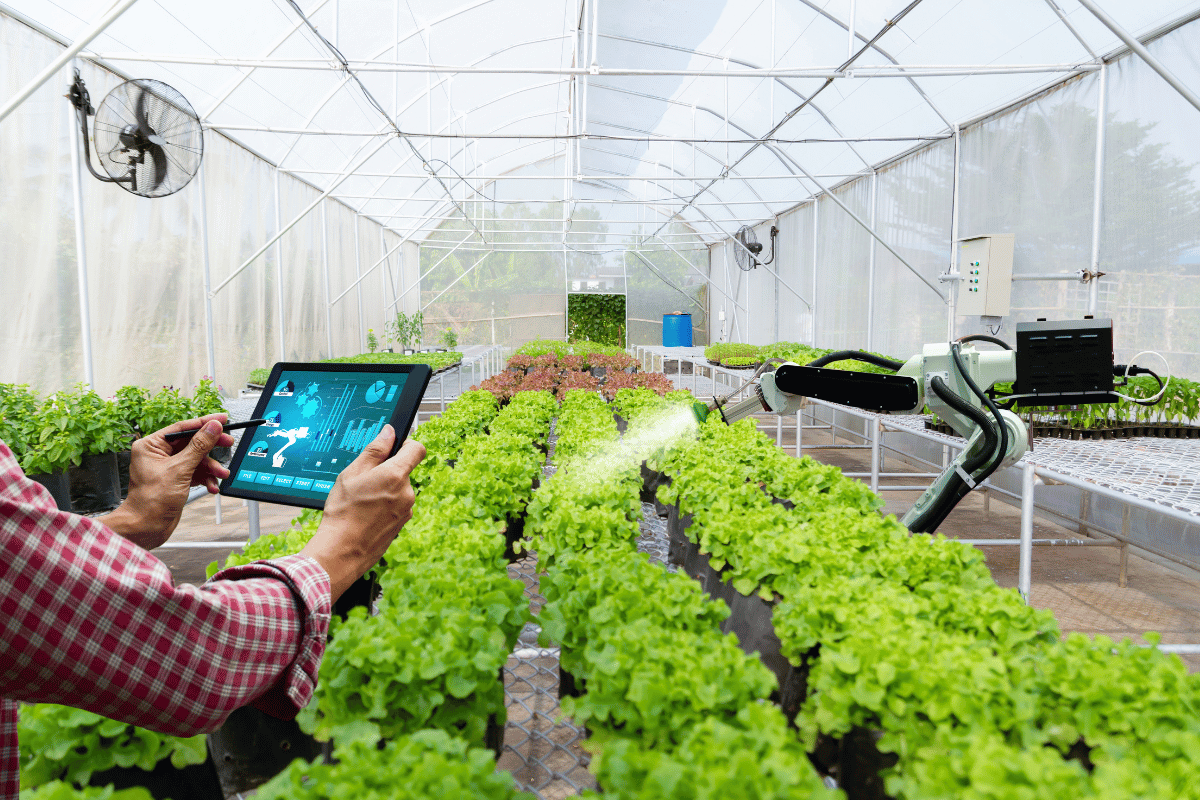
Technology is central to efficient CEA systems, enabling precise control over environmental conditions, resource use, and crop growth. Implementing smart solutions increases yields, reduces costs, and ensures consistent production.
IoT Sensors: Monitor temperature, humidity, pH, electrical conductivity (EC), and light in real-time. Sensors can detect deviations early, preventing crop stress or nutrient deficiencies. Studies show automated monitoring can reduce labor by 30–40% while improving consistency.
AI-Based Growth Optimization: New-day technologies like artificial intelligence can analyze data from sensors to optimize lighting schedules, nutrient delivery, and irrigation.
Automated Nutrient Dosing and Irrigation: Precise delivery of water and nutrients according to crop growth stage reduces waste and prevents over-fertilization. Closed-loop systems recirculating water can save up to 90% of water compared to traditional soil-based farming.[FAO, 2019]
Data Logging and Analysis: Recording growth metrics, energy consumption, and environmental conditions allows for continuous improvement and informed decision-making. Historical data can guide future crop cycles and system upgrades.
Cost-Benefit Considerations:
- Small-scale farms: Automation may require higher initial investment but reduces labor and increases consistency.
- Large-scale farms: Technology integration is crucial for managing complexity and optimizing resource use at scale.
Sustainability & economic viability
Efficient CEA systems boost productivity while reducing environmental impact.
Water Efficiency: Uses up to 90% less water than soil farming through recirculation and precision irrigation.
Reduced Pesticides: Controlled environments lower pest incidence, producing cleaner, safer crops.
Cost Reduction:
- LED lighting cuts electricity costs by ~50%[Gómez & Torres, 2021]
- On-site composting reduces fertilizer dependency.
- Direct-to-consumer sales can raise profit margins by 15–30%.
Economic Balance: High setup costs are offset by higher yields, lower inputs, and automation-driven efficiency.
Conclusion
From my perspective, designing efficient CEA systems is not just about technology—it’s about rethinking urban farming for maximum impact. By optimizing space, energy, water, climate, and crops, cities can produce fresh, local food sustainably. Smart tools like IoT sensors and automated nutrient systems make farming precise and cost-effective, while practices like water recirculation and direct-to-consumer sales improve profitability.
In my view, CEA represents the future of urban agriculture: a way to grow more with less, reduce environmental impact, and make fresh, healthy food accessible to city communities.
References
- United Nations. (2018). 68% of the world population projected to live in urban areas by 2050, says UN.
- FAO. (2019). The future of food and agriculture: Alternative pathways to 2050. Food and Agriculture Organization of the United Nations.
- Despommier, D. (2020). The Vertical Farm: Feeding the World in the 21st Century. Picador.
- Banerjee, C., & Adenaeuer, L. (2014). Up, up and away! The economics of vertical farming. Journal of Agricultural Studies, 2(1), 40–60.
- Gómez, C., & Torres, J. (2021). LED lighting in controlled environment agriculture: Energy efficiency and crop productivity. Horticultural Science Review, 18(3), 112–125.
- Beacham, A. M., Vickers, L. H., & Monaghan, J. M. (2019). Vertical farming: A summary of approaches to growing skywards. The Journal of Horticultural Science and Biotechnology, 94(3), 277–283. https://doi.org/10.1080/14620316.2019.1574214
- Al-Kodmany, K. (2018). The vertical farm: A review of developments and implications for the vertical city. Buildings, 8(2), 24. https://doi.org/10.3390/buildings8020024
- Shamshiri, R. R., Kalantari, F., Ting, K. C., Thorp, K. R., Hameed, I. A., Weltzien, C., Ahmad, D., & Shad, Z. M. (2018). Advances in greenhouse automation and controlled environment agriculture: A transition to plant factories and urban agriculture. International Journal of Agricultural and Biological Engineering, 11(1), 1–22. https://doi.org/10.25165/j.ijabe.20181101.3210
- Barbosa, G. L., Gadelha, F. D. A., Kublik, N., Proctor, A., Reichelm, L., Weissinger, E., Wohlleb, G. M., & Halden, R. U. (2015). Comparison of land, water, and energy requirements of lettuce grown using hydroponic vs. conventional agricultural methods. International Journal of Environmental Research and Public Health, 12(6), 6879–6891. https://doi.org/10.3390/ijerph120606879
- Kozai, T. (2019). Smart plant factory: The next generation indoor vertical farms. Springer.