For a dairy farmer, a ration first has to work in the real world. It must support milk production and cow health, use the available feeds efficiently, and make economic sense.
That is why sustainability can sound like one more demand added to an already complicated equation, and possibly one more cost. Yet economic and environmental goals do not always conflict. As a feed formulator, I find one question particularly useful: are we getting the greatest productive value from the nutrients and feed resources we already use?
Protein is a good place to start. More protein does not automatically make a better ration, and nutrients that are bought but cannot be used efficiently are both an unnecessary cost and a potential environmental burden. The aim is to find where better nutrient use supports farm economics and environmental performance at the same time, rather than to formulate either the greenest ration or simply the cheapest one.
The cheapest ingredient does not make the cheapest ration
Feed prices are easy to compare per tonne, but an ingredient's real value in a dairy ration is more complicated. It has to perform a nutritional function, and what it is worth depends on its nutrient content and availability, its consistency, its inclusion level, how it interacts with the rest of the ration and, in the end, whether the complete ration delivers the expected animal performance.
An ingredient with a low carbon footprint per kilogram is not automatically the better environmental choice either, if the ration built around it cannot maintain intake, health or milk production.
A 2025 experiment with 48 high-producing Swedish Holstein cows is a useful example. The researchers compared diets built on a standard commercial concentrate, a by-product-based concentrate and a concentrate made from domestically grown crops. Dry-matter intake and energy-corrected milk (ECM) yield did not differ between the three, but emissions from feed production came to 254 and 284 g CO₂-eq per kg ECM for the by-product and domestic diets, against 320 g for the commercial diet. Transport emissions were left out of the calculation.
The lesson is not that every dairy farm should copy these diets. It is that feed choices should be judged as part of the complete ration and against what the cows produce.
Protein is one of the first places worth checking
Protein is essential, but more crude protein does not automatically mean better feeding. The aim is an appropriate supply of metabolisable protein and rumen-degradable nitrogen to support both the cow and the rumen microorganisms. When nitrogen is supplied beyond what can be used, part of it is excreted instead of being turned into milk.
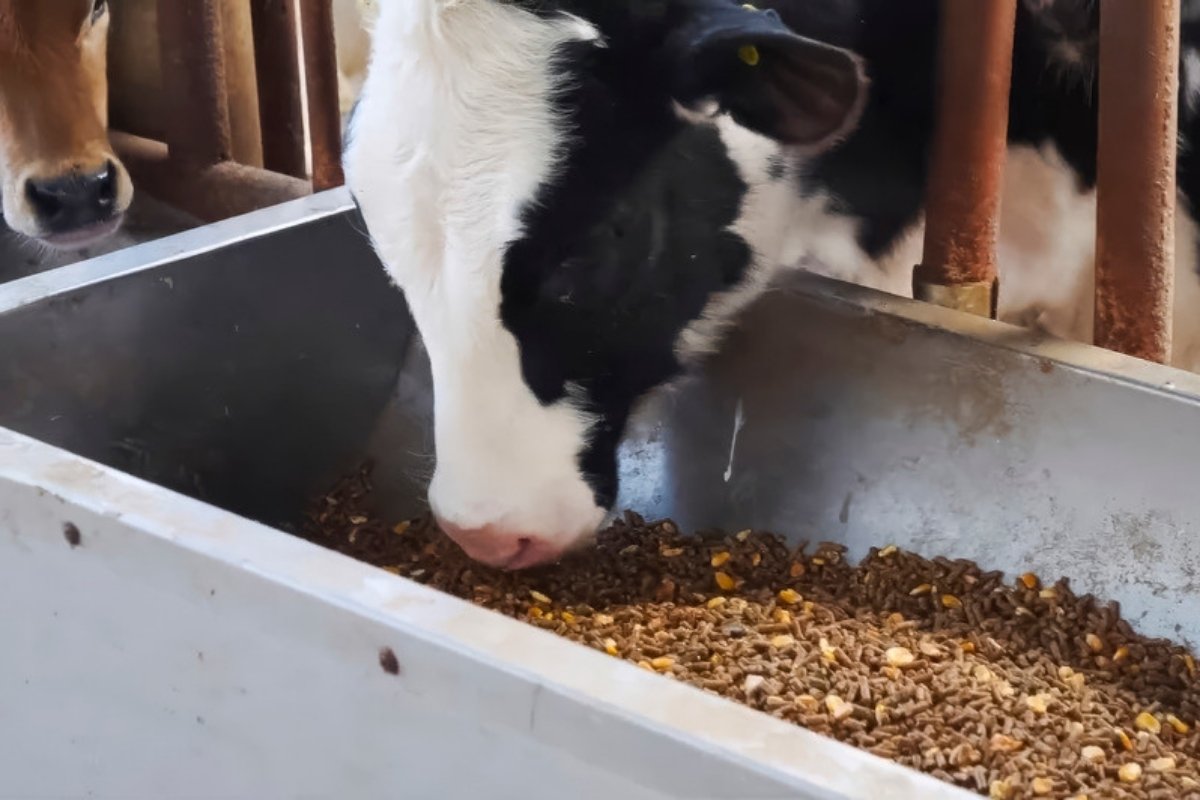
Matching protein supply to what each cow can use can lower both feed costs and nitrogen losses.
Economically, nutrients that are paid for but not used are wasted inputs. Environmentally, excreted nitrogen contributes to nutrient losses and emissions. That makes precision more useful than simply feeding more protein or less.
A 2023 study shows both the potential and the catch. When concentrate was fed according to each cow's individual requirements, urinary nitrogen excretion fell by around 30% and milk urea nitrogen by 40%, while ECM production stayed similar to that of conventionally fed cows. The same study, though, found that methane emissions from the stored manure of the precision-fed cows rose by 55%. Improving one environmental indicator does not guarantee improvement in every other one.
For farmers and nutritionists, the practical questions are these:
- Is protein supply appropriate for the animals' production level?
- Are the higher-cost protein sources providing nutritional value that justifies their place in the ration?
- Could the same requirements be met with a different combination of available feeds?
- Is protein being oversupplied without adding any productive value?
The aim is to use protein more precisely while protecting production and cow health, rather than to cut it at any cost.
By-products are valuable only when the ration makes sense
Ruminants can turn some biomass that people cannot eat directly into valuable food, which makes suitable agricultural and food-industry by-products potentially useful in dairy diets, as FAO's work on livestock in circular bioeconomy systems sets out.
A by-product is not automatically cheap or sustainable, though. It still has to be assessed for nutritional value, consistency, safety, availability, storage, transport and price, and a local feed that makes excellent economic sense on one farm can be impractical on another. In the Swedish experiment, the by-product diet held ECM production steady while cutting feed-production emissions per kilogram of ECM within the study's boundaries.
So the useful question goes beyond whether an ingredient is more sustainable. It is whether the ingredient can reliably do its nutritional job in this ration, and whether it makes economic sense on this farm. Only then does its environmental advantage matter in practice.
Where an ingredient comes from matters too
Two feed ingredients with the same name do not necessarily have the same environmental profile. Production region, crop yield, agricultural inputs, processing and the method used to calculate the impact can all change the result.
A carbon-footprint figure without that context can therefore mislead. Standardised resources such as the Global Feed LCA Institute (GFLI) database help by providing more consistent life-cycle data for feed raw materials from different regions.
Farmers buying compound feed can reasonably ask where the main ingredients come from, whether the footprint information reflects their actual origin, and which stages of production the calculation includes. These questions matter most when several ingredients could do a similar nutritional job.
Lower cost and lower emissions do not always mean the same ration
Least-cost formulation looks for the combination of ingredients that meets nutritional constraints at minimum cost. Once an environmental objective is added, the optimum can shift. Research on dairy ration optimisation has shown that cost and environmental goals can involve trade-offs rather than producing a single best diet, both for diet cost against enteric methane and for crop planning and diets across whole dairy systems.
For farmers, the message is simpler than the mathematics behind these models. A more sustainable ration need not always cost more, and the cheapest ration will not necessarily have the lowest environmental impact. The opportunity lies in changes that improve nutrient use or ingredient choice without an unacceptable cost to the budget or to production.
Five questions before changing a dairy ration
Before replacing an ingredient or reformulating a ration, ask:
- Will the ration still meet the cows' nutritional requirements and support production and health?
- What will it cost per cow per day, and relative to the milk produced?
- Are we buying nutrients that are supplied beyond what the animals can use?
- Could another available feed do the same nutritional job reliably and economically?
- If environmental footprints are being compared, does the calculation reflect productive output, ingredient origin and an appropriate system boundary?
These questions keep the decision centred on the cow and on farm economics, and let environmental information support good nutritional decisions rather than replace them.
Sustainability starts with good formulation
There is no universally cheapest or most sustainable dairy ration. Feed prices change, forage quality varies, available ingredients differ between regions and seasons, and milk production and nutritional requirements vary between farms and between groups of cows. Life-cycle assessment is therefore most useful as a tool to support decisions, not as a replacement for nutrition or farm economics.
Good formulation still starts with the cow. Once her requirements are met, farmers and nutritionists can look for ways to use nutrients more precisely, cut unnecessary inputs, evaluate suitable alternative feeds and understand what sourcing choices mean.
Sometimes lower cost and lower environmental impact will point in the same direction, and sometimes they will not. Good feed formulation is how you find out where they align.
Sources
Food and Agriculture Organization of the United Nations (2025). The role of livestock in circular bioeconomy systems. FAO, Rome.
Global Feed LCA Institute (2026). GFLI methodology and project guidelines, version 4.0. GFLI, September 2026.
Gong, Y., Bellingeri, A., Fumagalli, F., Sechi, G. S., Atzori, A. S., Masoero, F., Gallo, A., and Cabrera, V. E. (2025). A mixed integer linear programming framework for mitigating enteric methane emissions on dairy farms through optimized crop and diet planning. Journal of Cleaner Production, 511, 145636.
Managos, M., Lindahl, C., Agenäs, S., Sonesson, U., and Lindberg, M. (2025). Considering greenhouse gas emissions from feed production in diet formulation for dairy cows as a means of reducing the carbon footprint. Animal, 19(7), 101544.
Moraes, L. E., Fadel, J. G., Castillo, A. R., Casper, D. P., Tricarico, J. M., and Kebreab, E. (2015). Modeling the trade-off between diet costs and methane emissions, a goal programming approach. Journal of Dairy Science, 98(8), 5557-5571.
Morey, L., Bach, A., Sabrià, D., Riau, V., Fernández, B., and Terré, M. (2023). Effectiveness of precision feeding in reducing N excretion in dairy cattle. Animal Feed Science and Technology, 304, 115722.