Protein is one of the most important parts of a dairy ration, and often one of the most expensive. That is why feeding a little extra can feel like useful insurance. If cows need protein to make milk, surely supplying more reduces the risk of holding production back?
Adequate protein is essential. Once supply exceeds what the cow and her rumen microorganisms can use effectively, though, extra dietary nitrogen does not automatically become extra milk or milk protein. Nitrogen that the animal neither retains nor exports in milk has to be excreted.
As a feed formulator, I find this changes the practical question. Instead of asking how much crude protein a ration should contain, it is often more useful to ask what protein supply this cow actually needs, and how efficiently the ration can deliver it. That distinction matters for milk production, for feed costs and for nitrogen losses.
More crude protein does not automatically mean more milk
Crude protein (CP) is still a useful starting point when evaluating a dairy ration, but it is not a direct measure of how much usable protein reaches the cow.
Protein entering the rumen can take different routes. Some is broken down and used by rumen microorganisms, which in turn supply microbial protein to the cow. Another fraction escapes breakdown in the rumen and supplies amino acids after it is digested in the intestine.
Modern dairy nutrition therefore looks beyond CP towards metabolisable protein (MP) and amino-acid supply. A recent review by Martins and Hristov traces this shift from CP-based feeding towards MP- and amino-acid-based systems, designed to match the amino acids the cow absorbs more closely to what she needs.
This matters because two diets with the same CP percentage do not necessarily give the cow the same usable protein or amino-acid supply. The practical goal is to supply enough rumen-degradable nitrogen to support the microorganisms while providing an appropriate supply of absorbable amino acids to the cow, rather than to push up the CP figure on the ration sheet. Efficient protein feeding means hitting neither the lowest nor the highest CP percentage, but the right supply.
Simply cutting protein has a cost too
If excess nitrogen is inefficient, cutting CP looks like the obvious answer. The evidence shows why that also needs care.
A 2025 systematic review and meta-analysis brought together 36 production trials and 102 treatment means for dairy cows fed legume-silage-based diets. On average, reducing dietary CP from 171 to 145 g/kg dry matter, roughly from 17.1% to 14.5%, improved nitrogen use and reduced several measures of nitrogen loss. Milk urea nitrogen fell by 3.47 mg/dL, and urinary and faecal nitrogen excretion also dropped.
There was a trade-off, though. Dry-matter intake fell by 0.62 kg a day and milk yield by 1.41 kg a day. The authors concluded that lower-protein diets can improve nitrogen use efficiency and reduce nitrogen losses, with potential environmental benefits, but may also compromise intake and performance if the reduction is not properly balanced.
A lower-CP ration is therefore not automatically better simply because less nitrogen is excreted. If the change also limits nutrients the cow needs for production, the economic and environmental calculation becomes more complicated. The target is precision, and restriction on its own can cost more than it saves.
What remains in the ration matters when protein is reduced
Cows have no biological requirement for a particular CP percentage printed on a ration sheet. What they need is absorbable amino acids for maintenance, reproduction, tissue metabolism and milk protein synthesis, and those amino acids come largely from microbial protein made in the rumen and from feed protein that escapes the rumen and is digested further down the gut.
Individual amino acids can become limiting depending on the ration, which is one reason modern protein formulation increasingly considers metabolisable amino-acid supply rather than CP alone.
The same research group that produced the meta-analysis shows the difference this makes. In a separate trial using red clover and grass silage-based diets formulated to meet rumen-degradable and metabolisable protein requirements, the researchers reduced CP from 175 to 150 g/kg dry matter without adversely affecting intake, milk yield or milk composition. The loss of performance in the meta-analysis was not an inevitable cost of lower protein. It depended on what the lower-protein diets still supplied.
A 2025 controlled study gives another example. Sixty multiparous Holstein cows were fed diets containing 16% CP, 12% CP, or lower-protein diets supplemented with four rumen-protected essential amino acids. Reducing CP to 12% on its own lowered milk protein yield compared with the 16% diet. With targeted amino-acid supplementation, milk protein yield matched the 16% treatment, while nitrogen use efficiency improved.
That does not mean every lower-protein ration needs amino-acid supplementation, and the study has limitations that call for caution. It illustrates a broader principle of formulation: when protein is reduced, what remains in the ration, and whether it meets the cow's actual amino-acid requirements, matters as much as the CP percentage itself.
Protein cannot be separated from energy
How well protein is used also depends on the rest of the ration. Rumen microorganisms need both nitrogen and fermentable energy to grow and make microbial protein, and at the level of the whole animal, energy supply affects how efficiently absorbed nutrients go into production.
An experiment by Rius and colleagues shows this interaction. Forty mid-lactation cows were fed combinations of higher or lower dietary energy and predicted metabolisable protein. Nitrogen efficiency ranged from about 31% on the lower-energy, higher-protein diet to 43% on the higher-energy, lower-protein diet, and milk protein yield fell when dietary energy was reduced.
The practical message is to judge protein together with the energy available to use it, rather than to copy these particular levels. Extra protein cannot correct every nutritional limitation, so before buying more of it, it is worth asking whether protein is actually the nutrient holding performance back.
Milk urea nitrogen works as a warning light
Milk urea nitrogen (MUN) is attractive because it gives information through something already produced every day, the milk.
A 2025 meta-analysis by Zhao and colleagues analysed 48 research papers on Holstein dairy cows. MUN showed a strong positive relationship with urinary nitrogen excretion and a negative relationship with the share of dietary nitrogen converted into milk nitrogen, which makes it a useful indicator of protein nutrition and nitrogen use.
It should not be read as an instruction to add or remove protein, though. The same meta-analysis identified both dietary CP and non-fibre carbohydrate as important influences on MUN, and restricted energy supply also tends to raise it. The number reflects more than the amount of protein in the ration.
For that reason I treat MUN more like a warning light than a feeding instruction. A persistently unexpected value is a reason to investigate the ration alongside production, intake and diet composition. On its own it is not a diagnosis.
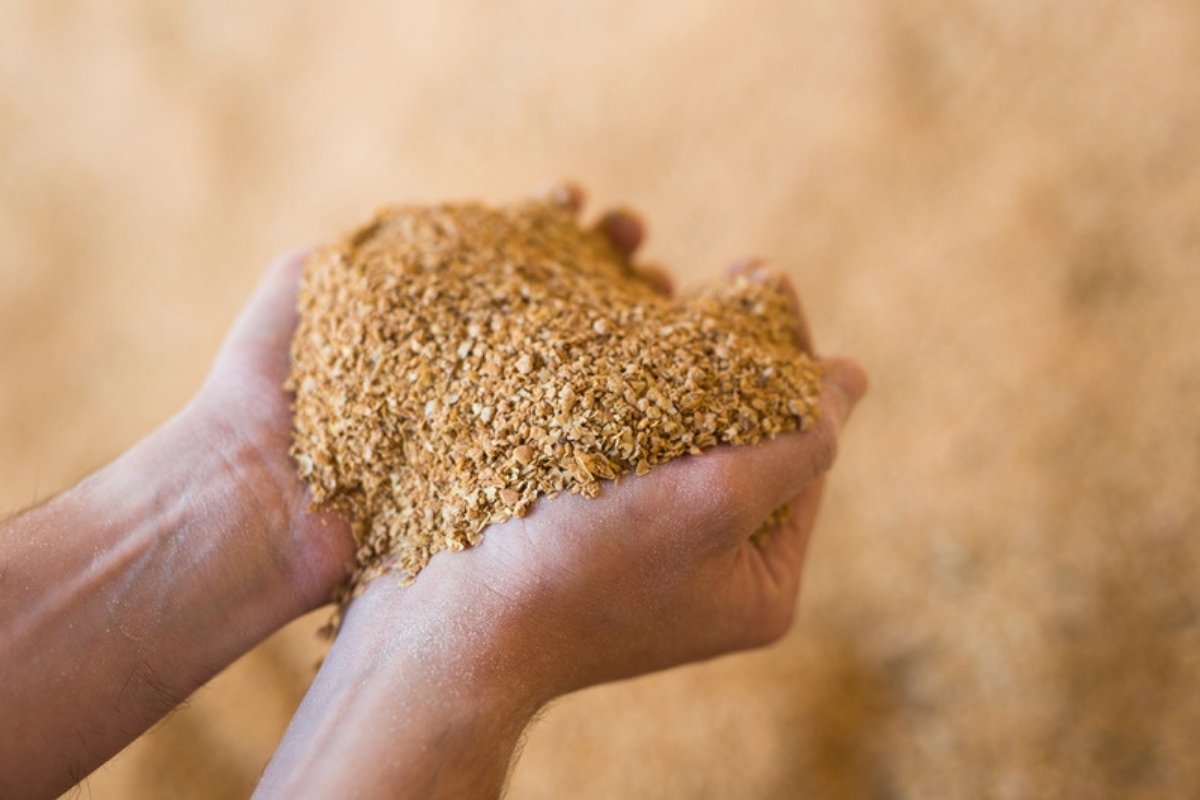
Protein sources are often among the most expensive ingredients in a dairy ration
What are you buying with the extra protein?
This may be the most useful economic question. A higher-cost protein source can be fully justified if it corrects a genuine nutritional limitation and supports profitable production. A cheaper one can still be poor value if its nutrient profile, digestibility, consistency or inclusion limits stop it doing the same job. The comparison that matters goes beyond price per tonne, or even crude protein per kilogram.
Before adding more protein, farmers and nutritionists can ask:
- Is protein actually limiting production in this group of cows?
- Does the ration meet metabolisable protein and amino-acid requirements, rather than simply reaching a CP target?
- Is rumen-degradable nitrogen balanced with fermentable energy?
- What are MUN, intake and production telling us over time?
- Are cows with very different production levels being given the same protein safety margin?
- What does the extra protein cost per cow per day, and what measurable output is it buying?
Feeding more of an expensive nutrient should have a nutritional reason, beyond reassurance, which is why the last question matters most.
Matching protein supply to demand
There is no single crude-protein percentage that suits every dairy cow or every farm. Requirements and responses depend on milk production, dry-matter intake, stage of lactation, ration composition, amino-acid supply, energy and more.
This is also why protein efficiency has an environmental side without having to become an environmental exercise, a point I explored in an earlier article on dairy feed costs and sustainability. Nitrogen that is bought but not turned into useful output has to go somewhere, and much of it leaves the animal in urine and manure.
Cutting unnecessary nitrogen can improve nitrogen use efficiency and reduce losses, but cutting protein too aggressively can compromise intake and milk production. Good formulation sits between those two mistakes. The objective is the right protein supply for the cow in front of you, and knowing what each additional unit of protein is actually achieving.
Important notes
The protein levels and responses above come from specific trials and are not recommended levels for any particular herd. Requirements depend on milk yield, intake, stage of lactation and the rest of the ration, so changes to protein supply are best planned with a qualified animal nutritionist and checked against intake, production and MUN over time.
Sources
Chowdhury, M. R., Wilkinson, R. G., and Sinclair, L. A. (2023). Reducing dietary protein and supplementation with starch or rumen-protected methionine and its effect on performance and nitrogen efficiency in dairy cows fed a red clover and grass silage-based diet. Journal of Dairy Science.
Chowdhury, M. R., Wilkinson, R. G., and Sinclair, L. A. (2025). Performance, metabolism and nitrogen use efficiency in dairy cows fed low protein, legume silage-based diets, a systematic review and meta-analysis. Animal, 19(3), 101433.
Martins, L. F., and Hristov, A. N. (2026). Amino acid nutrition of dairy cows, invited review. Animal Bioscience, 39(8), 260271.
Qin, X., Lin, X., Hanigan, M. D., Zhao, K., Hu, Z., Wang, Y., Hou, Q., and Wang, Z. (2025). Ruminally protected isoleucine, leucine, methionine, and threonine supplementation of low-protein diets improved the performance and nitrogen efficiency of dairy cows. Animals, 15(9), 1210.
Rius, A. G., McGilliard, M. L., Umberger, C. A., and Hanigan, M. D. (2010). Interactions of energy and predicted metabolizable protein in determining nitrogen efficiency in the lactating dairy cow. Journal of Dairy Science, 93(5), 2034-2043.
Zhao, X., Zang, C., Zhao, S., Zheng, N., Zhang, Y., and Wang, J. (2025). Assessing milk urea nitrogen as an indicator of protein nutrition and nitrogen utilization efficiency, a meta-analysis. Journal of Dairy Science, 108(5), 4851-4862.