

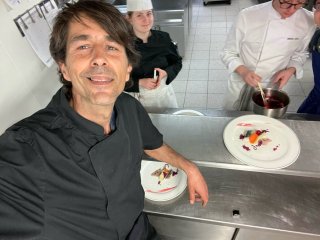
I came to farming the long way. Born in Oregon, raised in France from the age of four after a few years in French Guyana, I trained in French culinary arts and worked my way through every kitchen station that exists, from dishwasher to commis to pastry commis to second to sous chef to head chef. I taught the next generation as a culinary arts instructor. Then I became a farmer. Through all of it, I have tried to share lovely food with the world, and somewhere along that journey I came to believe that the cook and the land are the same conversation held in two different rooms.
Today I plant truffle oaks in the Corbières, a small range of limestone hills between Narbonne and Carcassonne, looking out toward the Mediterranean. I live on a farm I am slowly rebuilding from a stone ruin set among old vineyards. I cleared fields, planted oaks inoculated with Tuber melanosporum spores, and put together a small water retention system to carry the orchard through the dry summers. This is the place where the August 2025 fire came through.
What the fire took
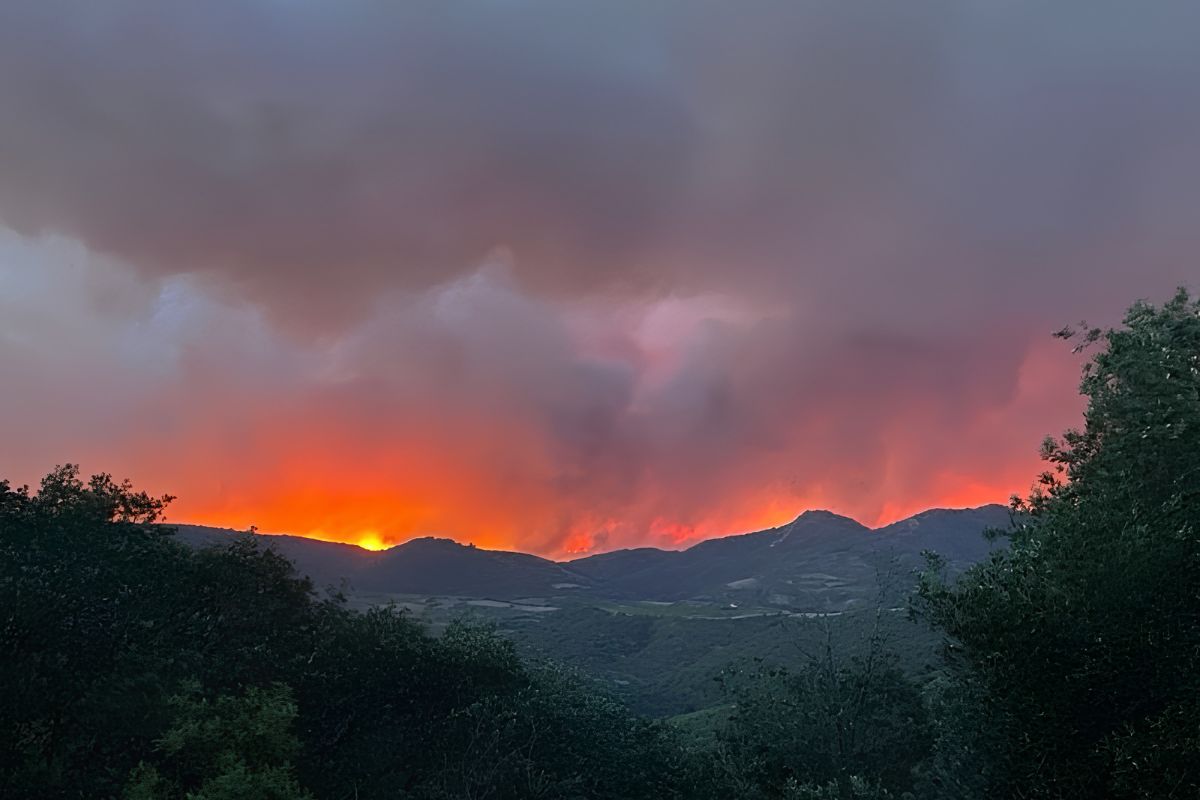
The Corbières fire of August 2025 started on the 5th of August in the village of Ribaute and was officially extinguished on the 28th of August. It burned roughly 17,000 hectares across 16 communes, destroyed 36 houses, took the life of a woman in Saint-Laurent-de-la-Cabrerisse, and consumed close to 12,000 hectares of forest along with 700 hectares of vineyards. It is described as the worst fire in over 50 years on the French Mediterranean coast and the second-largest French fire since the Landes fire of 1949 (Wikipédia, 2025; Aude Departmental Council, 2026). The state has since launched a recovery plan known as Corbières 2032.
What burned, mostly, was pine. Pine forest covers much of what used to be farmland in this region. When small farmers leave the land, pine takes over. Pine is flammable. Pine reproduces through fire. The cycle is now well understood.
What survives a fire like this, in my experience and in the science I have read since, is oak. Oaks resprout from the stump and the root system after a burn. A few of my own trees are blooming this spring, which is the kind of small detail that keeps a farmer going.
Why small farmers matter to the landscape
The argument I want to make is simple, even if the work behind it is not. A landscape with small farmers in it does not burn the same way as a landscape without them. When a farmer is present, the fields are cleared in winter using small controlled burns, the canopy is managed, water is held back so it does not run straight off the limestone, the diversity of trees and crops is maintained, and goats and other livestock keep the undergrowth in check.
When small farmers leave, none of this happens. The fields go to brush, the brush goes to pine, and the pine waits for a hot August afternoon with a tramontane wind. A study published in Agroforestry Systems in 2020 looked at fire incidents across Mediterranean Europe between 2008 and 2017 and found that agroforestry areas, where trees, crops, and sometimes livestock are integrated on the same land, had fewer wildfires than forests, shrublands, or grasslands (Damianidis et al., 2020). The Karlsruhe Institute of Technology geographer Christophe Neff, who has worked in the Corbières for decades, has written that the scale of the 2025 fire was driven by rural abandonment, bush encroachment, and climate change acting together (Neff, 2025).
This is what people mean when they call small farmers the guardians of the ecosystem. The phrase is not romantic. It is a description of what a person with a hoe and a few goats actually does to the fire risk of an entire valley.
Water, canopy, and the truffle
I am not against modern agriculture. I am against the disappearance of the small farm. These are different things. The industrial vineyard and the family-scale truffle orchard can both exist. What cannot continue is a policy environment that allows the small farm to disappear without anyone noticing what goes with it.
In limestone country the water situation is particular. The rock is karst. The water moves underground through cavities and fissures. Above ground the canopy is what keeps the temperature down enough for condensation at night, and the vegetation is what holds whatever water arrives long enough for the soil to take it in. Without the canopy and the vegetation, the rain hits hot rock, runs off, and is gone. The soil dries out, the humus thins, and the conditions that allow a Tuber melanosporum truffle to fruit in symbiosis with the roots of a Quercus pubescens (pubescent oak) or a Quercus ilex (evergreen oak) start to disappear.
The truffle is a slow crop. It takes five to seven years from planting an inoculated seedling before the first fruiting body appears, and a productive orchard can last for decades after that. It is not a crop you grow in opposition to a landscape. It is a crop you grow as a partner with one.
What the small farmer is up against
The work itself is honest. The system around it is harder than the work. Plant a few trees, clear the fields with small fires in winter, put in a water retention system for the summer, rebuild a little stone house, pay a few taxes on the truffles you sell. That is what farming at this scale should be allowed to look like. In practice, the regulations, the bureaucracy, the fuel taxes, and the industrial scale of the agriculture I am supposedly competing with all push in the opposite direction.
I am not asking for any of this to be dismantled. I am asking for the small farm to be allowed to exist on its own terms, with regulation suited to what it actually is. Small social and economic farms and the families on them have an essential relationship with the land. That relationship is not about short-term profit. It is about the long-term wealth of the land and the communities it carries, across generations.
When the countryside becomes unliveable, the consequences reach the city eventually. Water resources, fire risk, food systems, all of it. At a small scale, one farmer's presence looks insignificant. The absence of all the farmers, at the scale we are now seeing, is not.
What comes next on my hectare
I need to find about €5,000 to plant a new hectare. Next autumn I will collect more acorns and have them mycorrhized with truffle spores, which is a slow process that looks something like how bread is leavened, a culture introduced into a young root system that then grows into a working relationship over years.
The trees that burned will not all come back, but the oaks have a chance. A few are already showing leaves this spring. The stone walls of the ruin I am rebuilding are still standing. The water retention works that survived the fire are still doing their job. The Corbières will recover, with or without policy support, because oaks and limestone and farmers are patient in ways that bureaucracies are not.
What I hope is that the next fire, when it comes, finds a landscape with more farmers in it than this one did.
References
- Aude Departmental Council. (2026). Méga feu : les travaux d'exploitation des bois brûlés déclarés d'intérêt général et d'urgence par l'État. Aude.fr.
- Damianidis, C., Santiago-Freijanes, J. J., den Herder, M., Burgess, P., Mosquera-Losada, M. R., Graves, A., Papadopoulos, A., Pisanelli, A., Camilli, F., Rois-Díaz, M., Kay, S., Palma, J. H. N., and Pantera, A. (2021). Agroforestry as a sustainable land use option to reduce wildfires risk in European Mediterranean areas. Agroforestry Systems, 95, 919–929.
- French Ministry of Agriculture. (2026). Plan d'action territoriale « Corbières 2032 ». Agriculture.gouv.fr.
- Neff, C. (2025). Personal perception of the 2025 August wildfire in the Corbières (Aude, Mediterranean France). KIT, Institute of Geography and Geoecology.
- Office National des Forêts (ONF). (2025). Incendies dans le massif des Corbières, le courage et le professionnalisme exemplaires des agents de la DFCI. ONF.fr.
- Wikipédia. (2025). Incendie du massif des Corbières de 2025. Wikipédia, l'encyclopédie libre.