


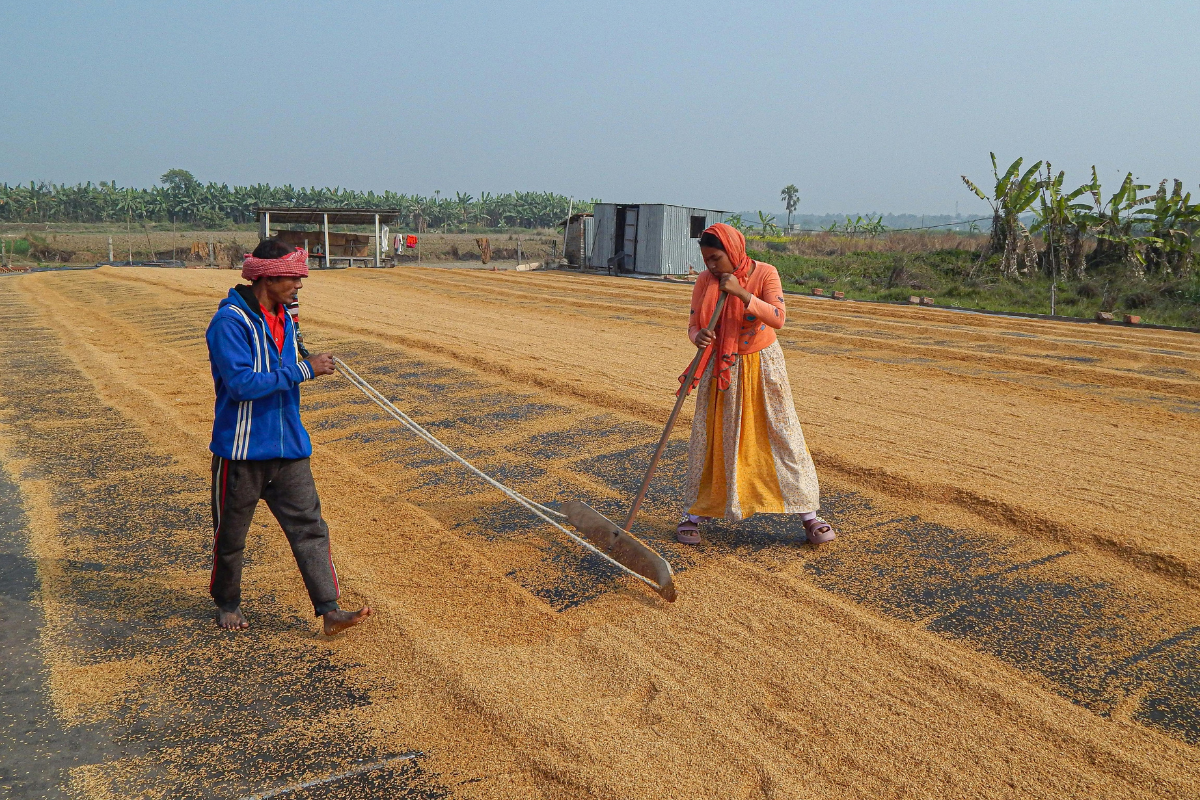
India grows food on over 130 million hectares, and more than half of that land depends entirely on rainfall. When the monsoon arrives two weeks late, or a dry spell stretches through the flowering stage of a crop, there is no switch to flip and no single technology that fixes the problem. Adaptation happens through dozens of small, practical decisions that farmers make before and during every growing season.
When the monsoon stops following the calendar
The Indian subcontinent has always had variable weather, but the pattern has shifted. Dry spells arrive in the middle of what should be rainy weeks. Summers run hotter. Unseasonal rainfall hits during harvest, damaging grain quality and reducing post-harvest shelf life. The India Meteorological Department's forecasts help, but they fail in certain cases, and a farmer planting on two or three hectares cannot hedge the way a commodity trader can.
For the roughly 52% of India's gross sown area that has some irrigation access, there is a buffer. For the rest, which still relies on rainfed farming, every management decision carries higher stakes. The real question is what adaptation looks like when you are actually standing in the field.
Choosing the right crop and the right variety before the season begins
The first decision is what to plant. Farmers in climate-stressed regions increasingly choose short-duration crop varieties that can complete their cycle within a narrower rainfall window. Drought-tolerant lines of rice, millet, and pulses allow a crop to survive a two-week dry spell that would devastate a longer-duration variety at the same growth stage.
Equally important is the sowing window. Rather than following a fixed calendar date, many Indian farmers now adjust their planting based on the actual onset of the monsoon and local water availability. A delay of ten days in sowing can mean the difference between a crop that matures before a late-season heat spike and one that fails during grain filling.
This flexibility requires local knowledge. A farmer in Tamil Nadu makes different calculations than one in Punjab, and no single recommendation works everywhere. The best adaptation strategies are built from specific conditions on specific land.
Micro irrigation and the fight for every drop
India uses over 90% of its freshwater for agriculture, yet micro irrigation covers just 8% of the country's irrigated land, compared with nearly 69% in the United States (India Economic Survey 2024-25). The gap is enormous, and so is the opportunity.
Under the government's Per Drop More Crop (PDMC) scheme, 95.58 lakh hectares (roughly 9.6 million hectares) have been brought under micro irrigation since 2015-16, with subsidies covering 55% of costs for small and marginal farmers. Drip irrigation systems deliver water directly to plant roots, cutting consumption by 50-70% compared to flood irrigation and enabling fertigation that can increase fruit crop yields by 25-30%.
But adoption remains uneven. Gujarat alone has covered over 24 lakh hectares under micro irrigation. States like Jharkhand and Assam remain below 20% irrigation coverage of any kind. And the cost barrier is real. Initial investment for drip irrigation runs around ₹3.93 lakh per hectare, and not every farmer can absorb even the subsidized share.
Soil moisture conservation adds another layer. Practices like mulching in vegetable production and reduced tillage help retain whatever moisture is available, reducing dependence on irrigation frequency. In water-scarce regions, these low-cost practices often make a bigger immediate difference than expensive infrastructure.
Tricking chrysanthemums with light bulbs
One of the most striking examples of crop-level climate adaptation comes from Indian floriculture. Chrysanthemum is an obligate short-day plant, meaning it requires a continuous dark period longer than about 9.5 hours before it will initiate flower buds. During winter in India, when days are naturally short, chrysanthemum plants rush into flowering before they have built enough vegetative growth to support a full flush of blooms.
The fix is surprisingly simple. Farmers provide artificial lighting at night, typically using incandescent bulbs, to break the dark period and simulate long-day conditions during the early vegetative stage. Research at Punjab Agricultural University found that 60 minutes of night interruption produced the best flower quality in potted chrysanthemum, while 120 minutes delayed flowering excessively and reduced bloom size.
This practice allows growers to control when their crop flowers, extending the production window and meeting off-season market demand. It is a small-scale, affordable intervention, and it works because it is built on understanding the biology of a specific crop rather than relying on a general recommendation.
Protected cultivation as a buffer against the unpredictable
Polyhouses, greenhouses, and shade-net structures give farmers partial control over temperature, humidity, and pest exposure. India's Mission for Integrated Development of Horticulture (MIDH) has facilitated protected cultivation across approximately 2.51 lakh hectares since 2014-15, with an investment of ₹2,963.91 crore. Greenhouse-grown tomatoes in India can yield up to 100 tonnes per acre, and the payback period for a commercial polyhouse runs between two and four years.
Yet the picture is complicated. A Dutch government-funded survey of Indian greenhouses found that roughly 70% of constructed greenhouse area was inactive or abandoned, mostly due to poor management knowledge, pest outbreaks, and weak market linkages. Protected cultivation works when farmers have training and ongoing technical support. Without those, even subsidized infrastructure fails.
The lesson applies broadly. Technology adoption without knowledge transfer is hardware without software.
The gap between what exists and what reaches the field
India has agricultural research institutions developing drought-tolerant varieties, improved irrigation methods, and season-extension techniques. Government schemes offer substantial financial support. Extension activities run across the country.
The gap is in the last mile. In remote areas, many farmers lack access to timely information about available technologies and the practical training needed to use them. A polyhouse requires management skills that open-field farming does not. A drip system requires maintenance to prevent emitter clogging. Even choosing the right crop variety demands access to trial data that may exist only in a university database.
Adaptation to climate change in Indian agriculture is real, and it is happening. But it is a combination of flexible decisions, local knowledge, and access to practical support. No single technology solves the problem. The farmers who adapt best are those who can combine multiple low-cost practices (variety selection, adjusted sowing dates, efficient water use, soil moisture conservation) and adjust them season by season based on what the weather actually delivers.
Sources
- Press Information Bureau, Government of India. (2025). Coverage of Irrigation Area Increased Between FY16 and FY21 From 49.3 Per Cent to 55 Per Cent of Gross Cropped Area: Economic Survey 2024-25.
- Press Information Bureau, Government of India. (2024). Micro Irrigation.
- Mongabay India. (2024). Explainer: What is Micro Irrigation?.
- Punjab Agricultural University, Ludhiana. (2016). Effect of Duration of Night Interruption on Growth and Flowering of Chrysanthemum cv. Kikiobiory. Journal of Applied and Natural Science, 8(2).
- Embassy of the Kingdom of the Netherlands in India. (2022). Survey of Protected Cultivation in India.