


Agriculture is the backbone of Nigeria's economy. It contributes roughly a fifth of national GDP, with some estimates putting it closer to a quarter, and it employs about 34% of the workforce, according to World Bank estimates, making it the country's largest single employer. Rural areas account for most of that activity, where small-scale food production and livestock rearing are the primary occupations for the majority of households.
For all that potential, Nigerian agriculture faces serious constraints: limited technological uptake, inadequate financing, poor rural infrastructure, and, increasingly, climate change. Climate pressure manifests as land degradation, rising sea levels, floods, droughts, and, above all, shifting rainfall. Rainfall is the single most important climate variable for rain-dependent farming, and across Nigeria it has become markedly less predictable in its onset, frequency, volume, and duration.
That unpredictability matters more here than in many places, because most Nigerian production depends on seasonal rain. Irrigation and off-season farming contribute little to the annual total. The result is falling productivity, lost investment, crops destroyed by flood or drought, and mounting pressure on the food security of rural households that live on what one season produces.
Nigeria's climate zones, from the wet south to the dry Sahel
Nigeria's climate shifts gradually from the humid coastal south to the arid north, and the farming in each zone follows the rain.
The southern coastal and mangrove zone, which includes Niger Delta states such as Rivers, Bayelsa, Delta, Akwa Ibom, and Cross River, receives the most rainfall, between about 2,000 and 2,500 mm a year. Tropical rainforest and mangrove swamp dominate, and the characteristic crops are oil palm, rubber, and cocoa.
The Guinea Savanna covers the Middle Belt, in states such as Benue, Kogi, Kwara, Niger, Nasarawa, and parts of Taraba, with moderate rainfall of roughly 1,000 to 1,500 mm a year. Open woodland and tall grasses support extensive cultivation, particularly of yam and cassava.
The Sudan Savanna, across states such as Kano, Kaduna, Katsina, Bauchi, Gombe, Sokoto, and Zamfara, records between 600 and 1,000 mm annually, with grassland vegetation and drought-tolerant trees.
The Sahel Savanna, in parts of Borno, Yobe, Jigawa, and Kebbi, is the driest zone in the country, receiving less than 600 mm of rainfall per year. The rain is concentrated into a short wet season, and the long dry season and high temperatures make farming considerably harder. Arable crops such as maize, rice, and cowpea dominate production across these northern zones.
What the rainfall record shows
The north-south contrast is stark. Southern Nigeria averages around 1,800 mm a year, falling between February and November, while the north averages closer to 550 mm across a shorter May to October season, on 1981 to 2020 figures. The coastal southeast exceeds 2,000 mm, and the arid far north sits near 500 mm.
The pattern has been shifting for decades. Analysis of rainfall trends across Nigeria's Savanna zones documents changes in distribution and rates of change, and a longer study of rainfall from 1901 to 2000 found that the rainy season in northern and central Nigeria started later and ended earlier, with the onset delayed by 10 to 20 days relative to the long-term mean. In the southwest and the coastal zone, rain has become more intense, arriving in shorter, heavier bursts, a pattern consistent with what the IPCC reports for heavy precipitation across the region.
Even a season that looks favourable on paper can harbour damaging extremes. NiMet's assessment of 2024 recorded rainfall generally above normal to near normal nationwide, yet the season included a mid-season dry spell of 2 to 3 weeks between June and August, along with several extreme rainfall events. Warri in Delta State registered a daily total of about 208 mm.
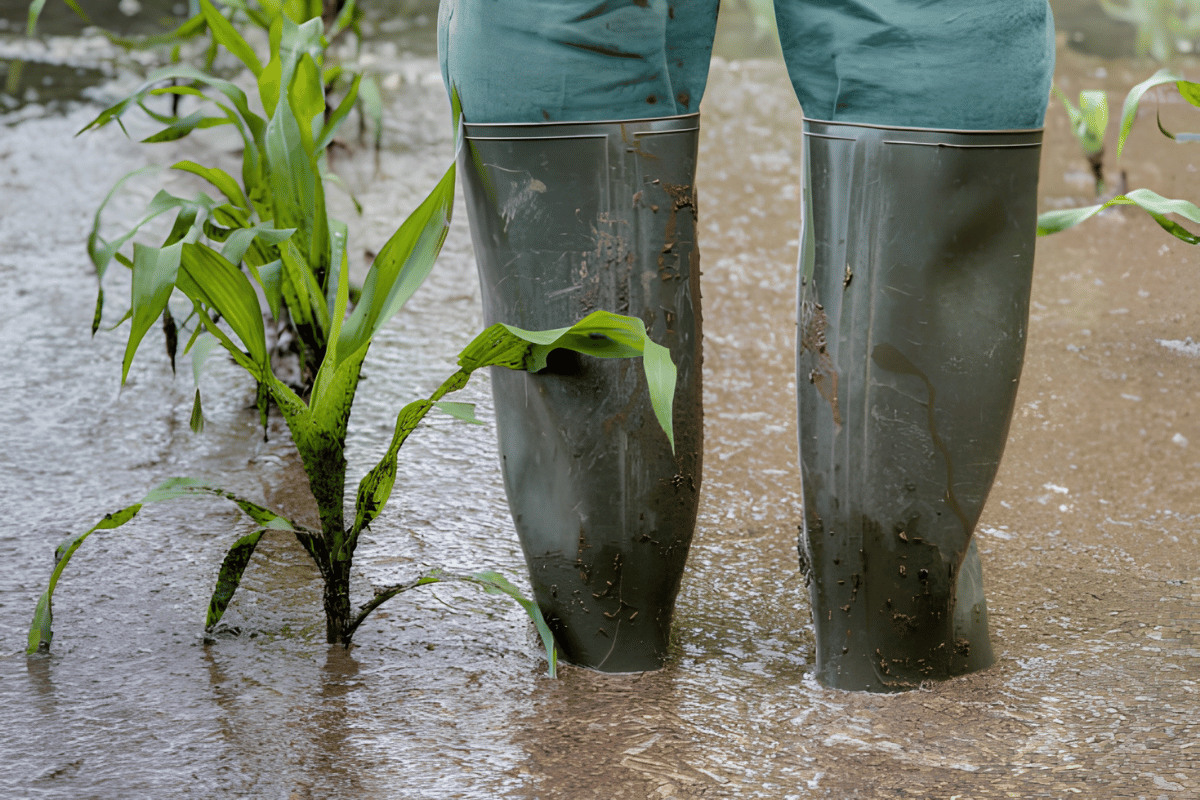
The flooding that followed shows the scale of what is at stake for farmers. FAO recorded 1.3 million hectares of land submerged by 10 September 2024, including 558,000 hectares of cropland, and warned that the loss of farmland would deepen an already severe food-security problem, with nearly 32 million Nigerians at risk of acute food insecurity. Across the year, humanitarian reporting put the number of people affected in the millions, across 34 of Nigeria's 36 states.
What rainfall variability does to crops
A late start, an early finish, and a dry spell in the middle are a damaging combination, particularly in the north where arable production dominates. Crops that cannot complete their reproductive cycle show stunted growth, flower failure, and shallow rooting, and they become more vulnerable to pests and disease. The outcome is poor yield or outright crop failure.
Different crops fail in different ways. Yams have fairly exact water requirements and suffer badly from drought during tuber initiation and from saturation during bulking. Cassava, though drought-tolerant, develops root rot and loses starch content when waterlogged by unseasonal downpours. Legumes and vegetables are highly sensitive to moisture, and the excess humidity that follows heavy rain can lead to fungal disease.
Why does this hits smallholders hardest
Smallholders make up the large majority of Nigeria's farmers and produce most of its food, largely for their own households, and they depend on rain rather than irrigation. That combination leaves them exposed to every shift in the pattern, and the consequences compound:
- Production becomes far less certain from one year to the next, with output and gross margins swinging accordingly
- Repeated losses discourage farmers from continuing to invest in production at all
- Because agriculture is the largest employer, falling productivity costs jobs along rural value chains, not only on farms
- Erosion in flood-affected areas takes agricultural land out of use permanently
- Food insecurity worsens in households whose entire food supply depends on one unstable season
What farmers can actually do
Some of this is beyond a single farm's control, but a good deal is not. The measures below are the practical responses that make the most difference in rainfed systems like Nigeria's.
Use the seasonal forecast, and plant to it. NiMet publishes a seasonal climate prediction each year with expected onset, cessation, and dry-spell risk by zone. Farmers who follow it and adjust their planting dates accordingly avoid the most common and most costly mistake, which is planting on the calendar date that worked in previous years rather than on the rain that has actually arrived. Waiting for established rains before sowing is usually better than gambling on the first shower.
Choose early-maturing and drought-tolerant varieties. This matters most in the Sudan and Sahel zones, where the wet season is short. Improved short-duration varieties of maize, sorghum, millet, and cowpea can complete their cycle inside a shortened rainy season, and Nigerian research institutes and seed companies supply varieties bred for exactly these conditions. It is worth asking an extension agent what has performed locally rather than choosing on reputation alone.
Spread the risk rather than concentrating it. Staggering planting dates across a few weeks, and intercropping a cereal with a legume, both reduce the chance that a single dry spell or downpour takes the whole harvest. A split planting that loses half a field is a far better outcome than a single planting that loses all of it.
Hold water in the field. Tied ridges, contour ridging, planting pits, and mulching all slow runoff and give rain time to soak in, which directly buffers a crop against a two or three week dry spell. Building organic matter improves both infiltration and how much water the soil can store, so the same rainfall goes further.
Add even modest irrigation where it is feasible. Full irrigation schemes are out of reach for most smallholders, but a shallow well, a small pump, or a shared water source used to carry a crop through a mid-season dry spell can be the difference between a reduced harvest and none. Small-scale supplementary irrigation is often the highest-value investment available.
Stay in contact with extension services. Regular contact with extension agents and farmer groups is how forecasts, variety recommendations, and pest and disease warnings actually reach the field. It is also the cheapest of all these measures. Broader climate-smart and precision approaches build on this foundation, and the experience of smallholders adopting these techniques elsewhere shows that access to advice and trusted local demonstration matters as much as the technology itself.
None of these measures makes a farm immune to a bad season. Together, they change the odds, which for a household living on one harvest is the difference that counts.
Sources
Ibrahim, I., Usman, M. T., Abdulkadir, A., and Emigilati, M. A. (2018). Analysis of rainfall distribution, temporal trends, and rates of change in the Savannah zones of Nigeria. Atmosphere-Ocean, 58(5), 351-360.
Oguntunde, P. G., Abiodun, B. J., and Lischeid, G. (2011). Rainfall trends in Nigeria, 1901-2000. Journal of Hydrology, 411(3-4), 207-218.
Intergovernmental Panel on Climate Change (2022). Climate Change 2022, Impacts, Adaptation and Vulnerability. Working Group II contribution to the Sixth Assessment Report.
Food and Agriculture Organization of the United Nations (2024). FAO warns of worsening food insecurity in Nigeria as devastating floods continue.
World Bank. Employment in agriculture, percentage of total employment, modelled ILO estimate, Nigeria. World Bank Open Data.
World Bank. Agriculture, forestry, and fishing, value added, percentage of GDP, Nigeria. World Bank Open Data.
Nigerian Meteorological Agency. Seasonal Climate Prediction reports and State of the Climate in Nigeria annual reports. Abuja.