


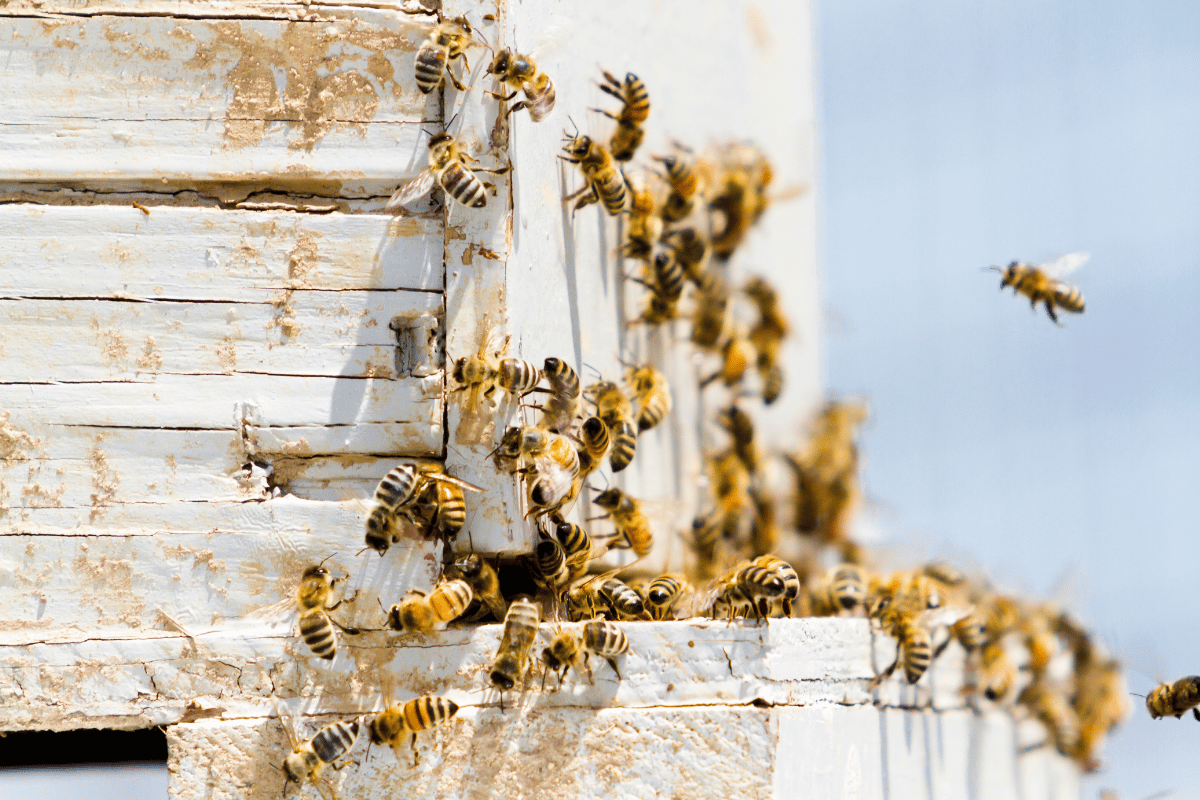
Reading colonies from the outside in
Instinctive beekeeping starts at the entrance. Before cracking the lid, you read the colony by watching flight lines, listening to the hive's "tone," and noticing scent and clustering patterns. This low-impact, time-savvy style rests on core bee biology: the colony operates as a superorganism, with the queen, workers, and drones acting like interdependent organs within one living body (Winston, 1987). When you connect entrance cues to how bees actually function, thermoregulation, information sharing, and brood rearing, you improve interventions, avoid unnecessary disturbance, and learn faster (Seeley, 1995; Seeley, 2010).
Stepping back, honey bees are one lineage within a vast radiation of bees worldwide. Scientists have described more than 20,000 bee species across seven families: Andrenidae, Apidae, Colletidae, Halictidae, Megachilidae, Melittidae, and Stenotritidae, with many additional species likely still undescribed, especially in under-sampled regions (Michener, 2007; Ascher & Pickering, 2023). Most bees are solitary and nest in soil or pre-existing cavities; only a minority are eusocial (notably honey bees, bumble bees, and stingless bees).
Against this backdrop of incredible diversity, the European honey bee, Apis mellifera, stands out for one key reason: its highly social nature makes its colony uniquely 'legible' to an observant beekeeper. That is precisely why the outside-in approach works so well: the visible signals at the entrance are rich readouts of a eusocial superorganism in action. Therefore, before exploring management techniques, a foundational knowledge of the colony's internal structure and the life of the bee is essential.
Understanding how bee colonies work
Honey bees (Apis mellifera) are eusocial, in colonies of between 10,000-60,000 insects, thriving through division of labour. A colony is divided into three different castes: queen, workers, and drones. The drones are male bees, while the queen and the workers are female bees. A keen beekeeper needs to learn and recognize these different castes for proper colony management. Workers (sterile females) handle nearly all daily tasks, the queen lays eggs and coordinates the colony via pheromones, and drones (males) exist primarily for mating with queens from other colonies (Winston, 1987). Colonies hold brood at roughly 34–35°C, ventilate by fanning, and dehydrate nectar to make honey, behaviours often visible from outside as smooth traffic, fanning “ranks” at the entrance, or bearding in hot weather (Heinrich, 1981; Stabentheiner et al., 2010).
Bees communicate through odours and dances. Inside, the waggle dance advertises profitable forage, while alarm and orientation pheromones shape entrance behaviour. From the landing board, patterns emerge: calm, purposeful comings and goings indicate routine foraging; looping, hovering "practice" flights mark young bees orienting; frantic darting and scuffles suggest robbing pressure. Learning these few signatures helps you choose when to open and when to let the bees get on with it (von Frisch, 1967; Seeley, 1995).
Queen
The queen is the colony's reproductive engine. She lays fertilized eggs (workers or queens) and unfertilized eggs (drones). Her pheromones help maintain social order and suppress worker ovary development, which is why a queen-right colony typically feels steady and focused (Slessor et al., 1988; Winston, 1987). You won’t see her at the entrance, but you can infer her presence from consistent pollen intake, a relaxed, even flight tone, and well-organized traffic.
Entrance shifts can flag queen issues: a restless, higher-pitched buzz; weak pollen inflow despite good weather; and muddled traffic can indicate queen lessness or queen failure. In spring, crowding, heavy traffic, and abundant drones often accompany swarm preparation; if bearding appears in only moderate weather, that’s an additional hint. These are times to plan a targeted inspection, add space, or implement swarm-prevention, rather than opening at random (Seeley, 2010; Winston, 1987).
Workers
These are the largest group of bees in the hive – up to 60,000 in a reasonably strong colony. They are the engine room of the superorganism, changing jobs as they age. Newly emerged workers are cleaners and nurses. Mid-aged workers build a comb, ripen nectar, and guard. Older workers forage for nectar, pollen, water, and propolis (Winston, 1987). This age-based structure explains daily entrance rhythms: guards’ posture and check arrivals; foragers shoot straight in and out; younger bees hover as they map their surroundings.
From outside, workers narrate the colony’s story. Pollen loads on returning foragers point to active brood rearing. Lines of fanning bees signal ventilation and nectar processing. A low, steady hum indicates contentment; a sharp, anxious buzz can mean disturbance, queen trouble, or robbing (Seeley, 1995). On hot afternoons, workers may beard on the front to shed heat; brief bearding is normal, but persistent bearding plus congestion suggests the need for space or better airflow (Heinrich, 1981; Stabentheiner et al., 2010).
Workers also reveal resource dynamics. During a nectar flow, traffic is brisk and purposeful, and colonies gain weight daily. In dearth, traffic slackens, tempers may rise, and robbing risk climbs. A quick “heft” of the box on each visit trains your hands to sense whether stores are rising or falling, guiding feeding or supering without constant intrusive inspections (Seeley, 2010; Brodschneider & Crailsheim, 2010). As workers age, their roles within the hive change dramatically, following a predictable timeline as summarized in Table 1.
Table 1: Summary of worker bee tasks
|
Days |
Task |
|
1-2 |
Cleaning cells and keeping the brood warm |
|
3-5 |
Feeding older larvae (on a mixture of honey and water) |
|
6-11 |
Feeding young larvae (on royal jelly). The hypo-pharyngeal glands start to secrete. |
|
12 |
Wax glands activate. Food glands start to disappear. |
|
12-15/17 |
Enzyme glands developed. Transporting food within the hive, producing wax, building combs. The first orientation flights happen. |
|
18-21 |
Guarding the hive entrance |
|
22-35 (end of life) |
Visiting flowers, pollinating them, collecting pollen, nectar and water. |
Table 2: Functions of worker bee parts
|
Tool |
Use |
|
Antennae |
Responsive to stimuli of touch and odour |
|
Antennae cleaner |
Cleans antennae |
|
Proboscis |
Ingests liquids: nectar, honey and water |
|
Mandible |
Eating pollen, collecting propolis, working the wax in comb building |
|
Head & Thoracic Labial Glands |
Produce substances used in grooming, cleaning and feeding |
|
Mandibular Glands |
Preparation of wax by kneading, softening it |
|
Wax Glands |
Four pairs of glands produce wax |
|
Hypopharyngeal Glands |
Four sets of paired glands produce sticky milky fluid (“bee milk”/royal jelly). Responsible for enzymes diastase and invertase for nectar sugar digestion |
|
Pollen baskets (Corbiculae) |
Carry pollen and propolis to the hive |
|
Pollen Press |
Transfer of pollen from the brushes to the baskets |
|
Wings |
Flight, movement, fanning the hive (inside) |
|
Honey Stomach (Crop) |
Carrier of nectar, honey, and water. Food store |
|
Honey stopper (Proventriculus) |
Valve — prevents collected nectar flowing into the stomach. Comprises filter for extracting pollen from nectar |
|
Nasonov Glands |
Produce pheromones — scent gland secretions for orientation |
|
Sting apparatus |
Defense of the colony; produce pheromones: alarm odour (defence alarm) and alarm tag odour (mark site of attack) |
Drones
Drones are the male caste. They develop from unfertilized eggs, have larger eyes and bulkier bodies than workers, and lack stingers. Their primary purpose is reproduction: they fly to drone congregation areas and mate on the wing with virgin queens from other colonies, dying after mating (Winston, 1987). You’ll notice drones loafing near the entrance or taking short flights; unlike foragers, they don’t bring in pollen or nectar.
Drone production reflects resource abundance. Rising drone numbers in spring and early summer often coincide with strong nectar flows and the onset of swarming. In autumn, many colonies evict drones to conserve food, so seeing drones pushed out or blocked at the entrance is normal. Tracking this seasonal pulse helps you read the colony’s priorities and local forage (Seeley, 1995; Seeley, 2010).
Drone flight follows a distinct rhythm. After maturing (often 10–14 days post-emergence), drones fly on suitable afternoons to congregation areas—stable outdoor “meeting points.” For the beekeeper, observing regular drone flights signals an active mating season, relevant for queen rearing or anticipating swarms in your area (Winston, 1987; Seeley, 2010).
Drones matter for health management. Varroa mites reproduce most successfully in drone brood because of its longer capping, enabling more mites to mature. Some beekeepers provide a drone foundation frame as a “mite sink,” then remove capped drone brood to lower mite levels, one integrated pest management tactic when applied carefully (Rosenkranz et al., 2010). From outside, many visible drones don’t prove mite levels, but they can prompt timely in-hive monitoring.
Drones also contribute to climate control. Their larger bodies help generate heat, sharing the thermoregulation load in strong colonies during heavy brood rearing (Stabentheiner et al., 2010). If you see sustained bearding and fanning along with plentiful drones in hot weather, the colony is actively managing temperature and humidity, consider shade, added ventilation, or more space if the behaviour persists.
Developmental timelines by caste
Honey bees pass through egg, larva, pupa, and adult stages, with caste-specific timing. Temperature and nutrition fine-tune these schedules, but the typical ranges are reliable planning tools (Winston, 1987).
Table 3. Development stages of each caste
|
Caste |
Egg-Larvae |
Larva-Pupa |
Pupa-Adult |
Total |
|
Queen |
3 days |
5 days |
7 days |
15 days |
|
Drone |
3 days |
7 days |
14 days |
24 days |
|
Worker |
3 days |
6 days |
12 days |
21 days |
What this means for outside-in beekeeping: if you see steady pollen coming in today, expect new adult workers roughly three weeks after those eggs were laid. A surge in drones at the entrance signals the colony began investing in males at least three to four weeks earlier, often pointing to rising reproductive intent and good forage. Linking these simple timelines to entrance cues helps you anticipate needs, adding space, planning splits, or scheduling mite checks, without constant, disruptive inspections (Seeley, 1995; Seeley, 2010).
References
- Breed, M. D., Guzmán-Novoa, E., & Hunt, G. J. (2004). Defensive behavior of honey bees: Organization, genetics, and comparisons with other bees. Annual Review of Entomology, 49, 271–298.
- Brodschneider, R., & Crailsheim, K. (2010). Nutrition and health in honey bees. Apidologie, 41, 278–294.
- Heinrich, B. (1981). Insect Thermoregulation. Wiley.
- Rosenkranz, P., Aumeier, P., & Ziegelmann, B. (2010). Biology and control of Varroa destructor. Journal of Invertebrate Pathology, 103(S1), S96–S119.
- Seeley, T. D. (1995). The Wisdom of the Hive. Harvard University Press.
- Seeley, T. D. (2010). Honeybee Democracy. Princeton University Press.
- Slessor, K. N., Kaminski, L.-A., King, G. G. S., & Winston, M. L. (1988). Semiochemicals of the honeybee queen: Mandibular pheromone components. Journal of Chemical Ecology, 14, 301–317.
- Stabentheiner, A., Kovac, H., & Brodschneider, R. (2010). Honeybee colony thermoregulation—Regulatory mechanisms and contribution of individuals. Journal of Insect Physiology, 56, 549–557.
- von Frisch, K. (1967). The Dance Language and Orientation of Bees. Harvard University Press.
- Winston, M. L. (1987). The Biology of the Honey Bee. Harvard University Press.