Introduction
In an agricultural country like India, farmers are constantly searching for alternative ways to increase their income. If an activity can be added to traditional farming that both improves earnings and benefits the environment, then beekeeping is one of the best options. It not only provides additional income but also enhances crop production through pollination. This article discusses the benefits of beekeeping, its process, costs, market opportunities, challenges, and socio-economic impacts.
What is beekeeping?
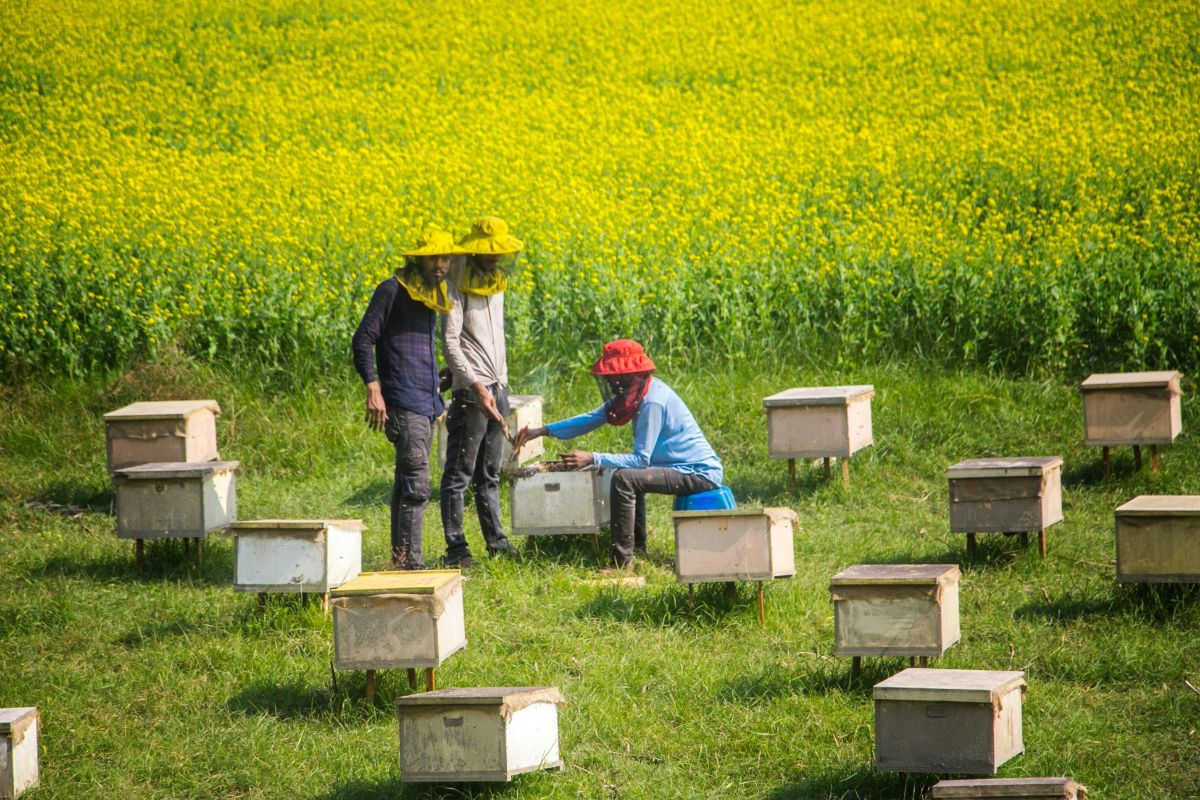
Beekeeping is the scientific practice of rearing bees in apiary boxes (wooden hives) to produce honey, wax, propolis, royal jelly, and bee venom. Farmers can generate additional income by selling these products. At the same time, bees pollinate crops, which improves both the quality and quantity of yields.
Why is it beneficial for farmers?
1. Additional income
Pure honey and wax obtained from beekeeping fetch good prices in the market. A single bee box can produce 30–40 kg of honey annually. At a market price of ₹150 per kg, a farmer with 10 boxes can earn ₹45,000–60,000 per year just from honey sales. Additional income can also be generated from wax, propolis, royal jelly, and bee venom.
2. Government assistance and training
The Government of India and several state governments support farmers with free training programs, subsidized bee boxes, and market linkages. A prime example is the National Beekeeping and Honey Mission (NBHM).
Training is also available at Central Agricultural Universities, State Agricultural Universities, and Krishi Vigyan Kendras (KVKs).
Central schemes in India include:
- National Beekeeping & Honey Mission (NBHM)
- Mission for Integrated Development of Horticulture (MIDH)
- KVIC Honey Mission
- National Livestock Mission – Apiculture Development
- Bihar Government’s Beekeeping and Honey Production Programme (temporarily closed)
How to start beekeeping in India?
1. Get training
It is recommended that you take a 5–7-day training course from an agricultural university or government institution such as a KVK (Krishi Vigyan Kendra).
Major institutes for beekeeping training:
- Central Bee Research and Training Institute (CBRTI), Pune
- Basic and Advanced Apiculture courses, honey processing training
- Krishi Vigyan Kendras (700+ centers nationwide)
- Examples: KVK Bareilly, KVK Solan, KVK Jhansi, KVK Saharanpur, KVK Sitapur, KVK Barabanki, KVK Sabour
- Khadi and Village Industries Commission (KVIC) – zone-wise training centers
- Centre of Excellence for Beekeeping, Kurukshetra (Haryana) – scientific breeding, modern hive management
- ICAR – National Research Center for Litchi, Muzaffarpur (Bihar) – basic and advanced courses
Free registration is usually available via the concerned KVK or institute’s website.
2. Buy equipment and bee boxes
Essential equipment includes: bee boxes/hives, wax sheets, mouth guards, gloves, hive tools, smokers, honey extractors, feeders, pollen traps, and queen excluders.
Beginners are advised to start with 5–10 colonies, which typically costs ₹15,000–25,000. Equipment can be purchased locally or from experienced beekeepers.
3. Select a suitable location
Beekeeping requires areas with abundant nectar- and pollen-rich plants within a 1–2 km radius. A clean water source should be nearby, or arrangements must be made to provide water.
4. Market linkage
Honey offers diverse marketing opportunities. Farmers can sell their produce through local markets, mandis, cooperatives, online platforms, or directly to private companies. Forming Farmer Producer Organizations (FPOs) enables collective marketing, which can improve bargaining power, reduce costs, and open access to larger buyers.
Practical tip: Combining online and offline channels can maximize reach. For instance, an FPO in India increased sales by selling bulk honey to a food processing company while maintaining a small online shop for direct customers, ensuring both stability and higher profit margins.
Selling options and market opportunities
Beekeepers have multiple avenues to reach consumers. These include online marketplaces, personal websites, social media channels, and collaborations with food companies or local retailers. Combining several sales channels can enhance market reach, diversify revenue streams, and increase overall profitability.
Practical tip: Participating in government or NGO training programs can improve hive management and colony health, while connecting with FPOs or cooperatives can expand market access. For example, in Kenya, beekeepers trained through cooperative programs reported up to 30% higher yields and more stable sales.
Challenges in beekeeping
Beekeeping holds significant potential but faces several challenges. Bees are increasingly vulnerable due to pesticide exposure, habitat loss, and climate-related environmental changes. Natural disasters such as floods or droughts can also lead to severe colony losses. Additionally, many beekeepers struggle with limited access to organized markets, lack of training in modern hive management, and shortages of technical support.
To mitigate these challenges, government and institutional initiatives often provide targeted training programs, awareness campaigns, and technical guidance. These efforts focus on improving hive management practices, maintaining colony health, and expanding market access for honey producers.
Environmental and social benefits
- Bees play a vital role in conserving biodiversity and supporting pollination for food crops.
- Pollination improves crop yields, contributing to local food security.
- Beekeeping creates self-employment opportunities in rural areas.
- The activity is particularly suitable for women, as it can be managed near the home with relatively low investment.
Practical tip: Highlighting these benefits when marketing honey—such as “supporting local biodiversity” or “women-led honey production”—can attract environmentally conscious buyers and add value to your product.
Success stories
Many farmers in Uttar Pradesh, Bihar, and Uttarakhand have doubled their income by integrating beekeeping with traditional farming. Some have even built organic brands and started exporting honey.
Example: Mr. Devaraj, Kasargod (Kerala)
After receiving training from ICAR-KVK Kasargod, Mr. Devaraj obtained 10 bee colonies on a 40% subsidy and expanded them to 30 through scientific management. Formerly employed in catering, he now fully practices farming and beekeeping.
Alongside cultivating coconut and betel nut on one acre, and vegetables on leased land, he earned an additional ₹79,500 from selling 2.4 quintals of honey. His total annual income reached ₹2.19 lakh, significantly higher than the previous year.
Inspired by his success, over 30 rural youths are now undergoing beekeeping training at KVK. Today, Devaraj is considered a role model farmer.
Conclusion
Beekeeping is a low-cost, low-risk, and high-return enterprise for farmers. Beyond income generation, it plays a vital role in crop production and environmental sustainability. With proper training, resources, and market support, it can become one of the best complementary businesses alongside traditional farming.