
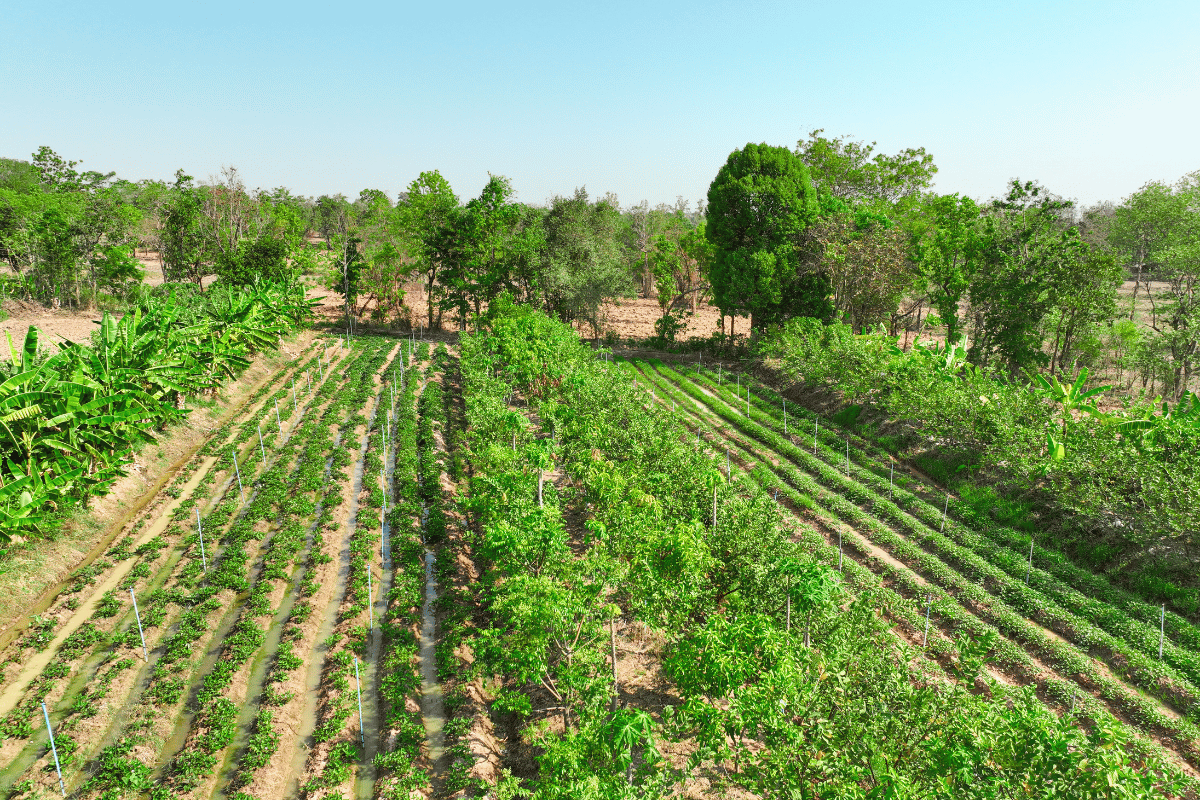
Agriculture in East India is at a turning point. Smallholder farmers face mounting pressure from a changing climate, declining soil fertility, rising cultivation costs, labour shortages, and unpredictable markets. For millions of rural families, leaning on a single seasonal crop has become a risky way to make a living. In thirty years as an agronomist working with farming communities across West Bengal, I have watched many agricultural programmes come and go. Some helped for a while, others faded the moment the project funding stopped. One approach has held its value across all of it, and that is agroforestry.
Agroforestry is far more than planting trees on a farm. It is the deliberate integration of trees, crops, and sometimes livestock into a single productive system. Designed well, it raises farm income, improves soil health, protects biodiversity, and strengthens a farm against climate shocks, all while keeping land that keeps producing food.
Why East India is well-suited to it
Eastern India has good conditions for agroforestry. Rainfall is reasonably reliable, and the soils are varied, from the lateritic soils of Birbhum to the Gangetic alluvium of Murshidabad, which, between them, support a wide range of tree species for both commercial and ecological purposes. Yet most farmers still rely mainly on paddy. Rice remains the backbone of food security and that will not change, but depending on it entirely leaves a household exposed to weather shocks and price swings. A diversified farm is a stronger farm, and trees provide a second source of income while protecting the land's productive capacity.
Start with what farmers actually need
The most important lesson I have learned is that successful agroforestry begins with the farmer's priorities, not the agronomist's. A smallholder cannot afford to give up annual income while waiting years for trees to mature, so any model has to be practical, economically sound, and matched to local conditions.
Through our work at Kopa Krishi Utpadak Farmer Producer Company in Birbhum and Murshidabad, we have found that farmers take up agroforestry far more readily once three things are clear to them. Tree planting must not cut significantly into their crop production. There has to be a reliable market for the timber, fruit, or bamboo that the trees will eventually yield. And technical support has to be there through the first few years, when survival rates are decided. When those three conditions are met, adoption tends to follow naturally.
Choosing the right trees for the right place
Species selection makes or breaks an agroforestry programme. Fast-growing timber species, fruit trees, bamboo, medicinal plants, and indigenous multipurpose trees all perform well when matched to local soil and climate. For small farms in particular, boundary and bund plantations work well, because they let a farmer keep growing crops across almost all the land while building valuable tree assets along the edges. Homestead plantations earn their place too, supplying fruit, fuelwood, fodder, shade, and nutrition for the household. The guiding rule is simple: the right tree in the right place.
Agroforestry works best inside a wider system
Agroforestry should not stand alone. Its biggest benefits come when it is combined with the other practices that build a healthy farm. In our fields, we see strong synergy between trees and practices such as alternate wetting and drying in paddy, crop residue management, composting, and careful nutrient management.
Trees do a great deal of work below and above the soil. Their leaf litter feeds soil organic matter, their roots recycle nutrients from deeper layers that annual crops cannot reach, and their canopy and root systems together reduce erosion and help water soak in rather than run off. On the rice-dominated land that covers so much of eastern India, a wider package builds soil carbon while keeping the land productive: keeping crop residues on the field instead of burning them, turning surplus straw into biochar where it is feasible, growing a green manure such as dhaincha before rice, reducing tillage, bringing legumes into the rotation, and planting trees on the field bunds. Taken together, these lower production costs and make a farm far more resilient to a bad season.
The carbon opportunity, kept in proportion
Climate change has opened a new possibility for farmers. Trees pull carbon dioxide from the air and store it in wood and soil, and as voluntary carbon markets grow, agroforestry may become a genuine source of environmental income. The market is still developing and the returns are uncertain, so I am careful about how I present it to farmers. Carbon income should never replace agricultural production. It works as an extra incentive to adopt sustainable land use, not as the reason to do it. Where it does pay, Farmer Producer Companies and community organisations are well placed to do the organising that individual farmers cannot: registering members, keeping the records, and connecting them to credible carbon programmes.
Why rural institutions decide whether it scales
One conclusion from the field is hard to avoid. Individual farmers often struggle to take up agroforestry on their own. The gap is usually institutional, not agronomic. A working Farmer Producer Company can run awareness programmes, procure quality planting material, coordinate technical training, raise nurseries, build market links, and connect farmers to government schemes and private partners. At Kopa Krishi, farmers gain confidence when the technical guidance and the collective marketing support both come through their own institution. The future of agroforestry rests as much on strong rural organisations as on the farmers themselves.
The barriers that still hold it back
For all its potential, agroforestry adoption remains below what it could be, and the reasons are consistent. Many farmers cannot easily get quality planting material or reliable technical advice. Timber returns take years, which makes long-term investment hard for a resource-poor household. Markets for timber, bamboo, and non-timber forest products are still underdeveloped in many areas. Policy support has improved a good deal in recent years, including state programmes in West Bengal that encourage tree planting, but putting that support into practice at village level still needs strengthening. Extension services, in particular, need to shift from promoting single technologies toward promoting whole farming systems.
Looking ahead
The future of agriculture in East India cannot rest solely on higher crop yields. Sustainability, climate resilience, and diversified livelihoods have to become central goals of rural development, and agroforestry offers a practical way to reach them. It restores degraded land, improves biodiversity, conserves water, strengthens rural incomes, and contributes to national climate commitments. For a young farmer, it is an investment in the future, for an experienced one, it is stability and lower risk, and for a rural community, it opens work, value addition, and enterprise.
After three decades with farmers, I remain optimistic. Rural communities take up new ideas readily when those ideas are practical, profitable, and backed by strong institutions. The real measure of agroforestry is not the number of trees planted. It is healthier soils, stronger farmer organisations, more diversified incomes, and rural families able to face an uncertain climate with more confidence. If East India is to build a resilient agricultural future, agroforestry should not be an optional add-on. It should be a core part of rural development strategy, tying together farming, environmental restoration, and economic growth. That is where the future of sustainable farming here truly lies.
Sources
Rice sustainable farming and the System of Rice Intensification. Wikifarmer Library.
Carbon farming, an overview. Wikifarmer Library.
Voluntary carbon markets in agriculture, how farmers can benefit from carbon credits. Wikifarmer Library.