People often ask me why I chose to work in agroforestry rather than conventional farming. The honest answer is that the more time I spent with farmers, forests, and agricultural landscapes, the more it became clear that agriculture is not only about producing food. It is about the relationship between people and the land that feeds them. Healthy soils, clean water, biodiversity, productive farms, and prosperous communities are connected, and when one is damaged the others suffer. That conviction is what moved me from agriculture in general toward agroforestry in particular, and this is what I have learned about how it works in practice.
The problem with clearing more land
My work began with a simple observation across many farming communities. Land was usually managed as monoculture, a single crop worked hard across the whole field, while the spaces between rows sat empty and unused. At the same time, farmers who wanted to grow more often did it by clearing forest, through logging or burning, to open new ground.
The logic seemed sound: more land, more income. But the environmental cost was rarely counted. Every tree removed took wildlife habitat with it. Every burned patch of forest weakened the biodiversity around it. And every degraded landscape became more exposed to erosion, drought, and an unstable climate. The question I kept coming back to was whether the answer really lay in taking more from the forest, or in making better use of the land already cleared. Agroforestry is the second answer.
How an agroforestry system is put together
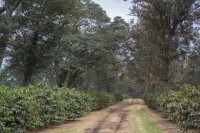
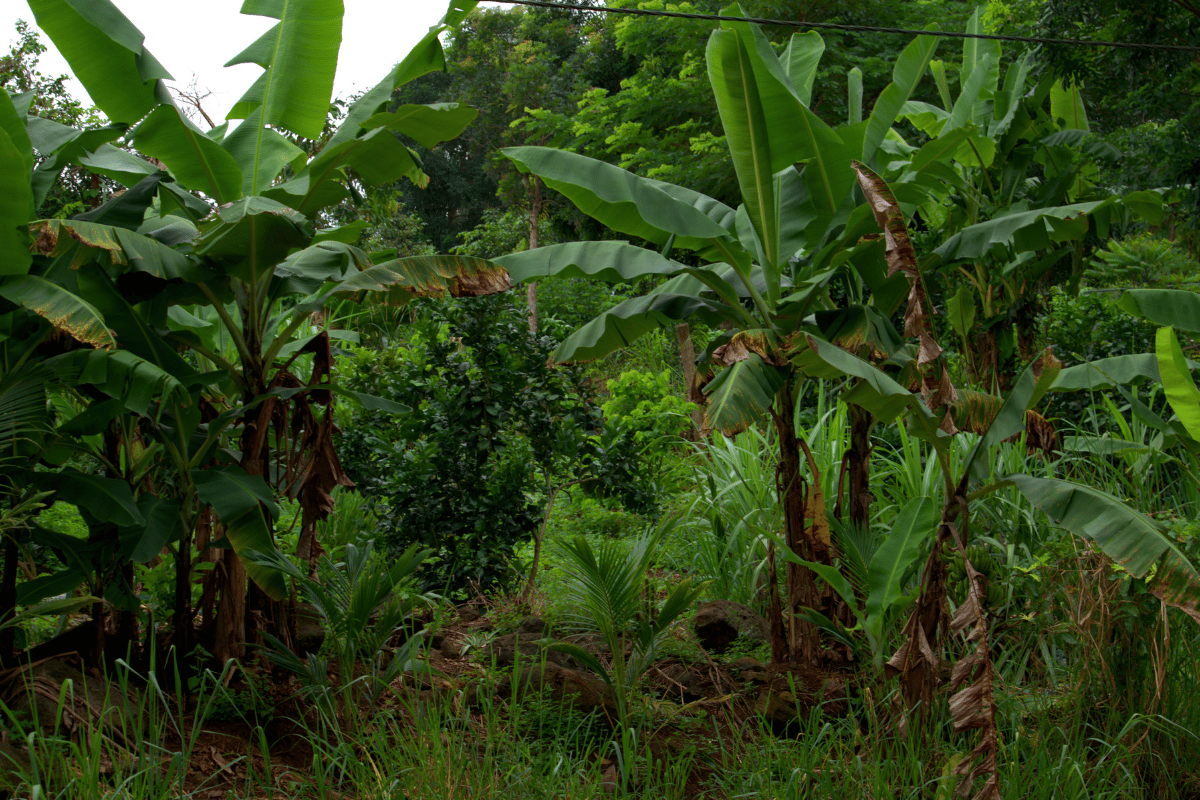
Agroforestry means growing trees and crops together in the same space, in deliberate layers, instead of depending on one crop across a bare field. In the Indonesian systems I work with, the structure usually looks something like this.
Tall trees form the canopy and cast shade. Coffee grows beneath them, which suits it well, since Arabica in particular evolved as a forest understorey plant and performs well under shade trees that moderate temperature and protect the soil. Black and white pepper climb living supports rather than dead poles, so the support tree earns its place too. Between and below, farmers grow cinnamon, cacao, nutmeg, cloves, avocado, durian, moringa, and taro beneng, along with other locally adapted species. Each layer occupies a different height, a different root depth, and a different niche, so the same piece of ground does far more work than a single crop ever could.
Every species also plays a role beyond its harvest. Some improve soil fertility, particularly the legumes and the leaf litter that builds organic matter. Some provide long-term income, like the tree spices that yield for decades. Some strengthen a household's own food security. Others protect biodiversity and hold the soil against erosion. Together they make a system that is more productive, more diverse, and more resilient to a bad season than a monoculture can be. This is the same principle behind the multi-species smallholder systems documented elsewhere in the tropics, where pairing crops like coffee and bananas raises both income and land productivity.
Why Indonesia is suited to this
Indonesia is one of the most biodiverse agricultural countries in the world, and its fertile soils and tropical climate let an unusual range of commodities grow well together. For centuries, Indonesian spices, black and white pepper, cinnamon, cloves, and nutmeg, linked distant civilisations through trade, and cloves and nutmeg in particular have deep roots in the Maluku Islands, where farmers have long grown them within tree-based systems rather than open plantations.
These crops carry generations of knowledge, culture, and identity, so protecting the way they are grown also protects a heritage. Alongside them, crops that were once overlooked are finding new value. Taro beneng, a large taro native to the Pandeglang area of Banten, has moved from a subsistence crop toward a commercial one, with demand for its tubers and dried leaves supporting new income for growers. Moringa is following a similar path on the strength of its nutritional value. The future of Indonesian agriculture is stronger if it treats this diversity as an asset instead of narrowing toward uniformity.
Value does not end at harvest
Supporting farmers should not stop when the crop comes in, because some of the biggest gains come after harvest. Coffee can be processed into specialty products. Black and white pepper can reach premium markets when quality and traceability are good. Cinnamon, cacao, moringa, and taro can be turned into food products that earn more than the raw commodity and waste less of it. Value-added processing of this kind creates local employment, keeps more of the final price in the community, and reduces the post-harvest losses that eat into smallholder income. Sustainable agriculture, to me, is measured not only in yield but in how much of the value chain the farming community actually holds.
What the land and the farmers taught me
Much of what I know came from farming communities themselves. Working through the Rizqi Aulia Group and its community-based initiatives, alongside farmers, nursery teams, researchers, universities, and government partners, I have seen that the hardest problems, climate change, land degradation, food security, and rural livelihoods, are shared across regions and cannot be solved by any one person or institution.
The most useful lesson I keep relearning is that progress starts with listening. Before offering a solution, you have to understand the local reality, the soil, the market, the labour a household can spare, and the crops people already trust. Farmers are not simply the recipients of a project. They are partners and the day-to-day custodians of these landscapes, and good systems are built with them rather than handed to them.
Agroforestry will not fix everything, and it asks patience, since the trees that anchor a system take years to mature. But on tired or fragile land, in a country as rich in species as Indonesia, growing in layers instead of clearing more forest is one of the most practical paths I have found toward farms that stay productive and communities that stay on their land. Every seedling raised in a nursery and planted into one of these systems is a small, concrete step in that direction.
Sources
Regenerative agroforestry, lessons from Western Uganda. Wikifarmer Library.
Shade-grown coffee in an agroforestry system. Wikifarmer Library.
Windarsih, G., et al. (2023). Utilization of beneng taro (Xanthosoma undipes) based on local knowledge, Pandeglang, Indonesia. Biodiversitas, 24(12).