


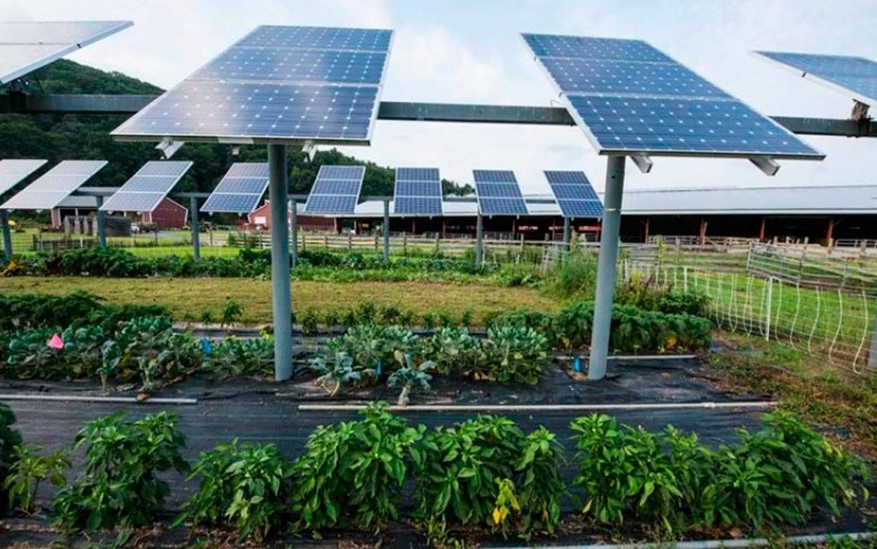
What are agrivoltaics?Source of cover picture (Macknick et al. 2022)
Introduction to Agrivoltaics: Dual Use of Land for Food and Energy
Agrivoltaics, also known as agrophotovoltaics or solar sharing, refers to the practice of using solar photovoltaic (PV) panels and food crops on the same land unit, generating both food and energy. This concept was first theorized in Germany in 1981 and piloted in France in 2010, and it addresses the increasing pressure on agricultural systems due to climate change and the global demand for renewable energy.
Climate Change Challenges and the Need for Innovative Solutions
The agricultural sector faces vulnerabilities from climate change, such as precipitation variability, droughts, and rising temperatures. Water supply for food production is under pressure globally, and traditional large-scale PV installations can create land-use conflicts with agriculture. Agrivoltaics offers an integrated solution, bringing food, energy, and water security together on the same land.
How Agrivoltaics Works: Integrating Solar Panels with Crop Production
Agrivoltaics involves placing elevated solar panels above crops, allowing both to coexist efficiently. The panels provide shade, reducing heat and light stress on plants, minimizing water evaporation, and enabling the use of modern farming equipment beneath them. This system can result in the same or even higher crop yields, especially under drought conditions.
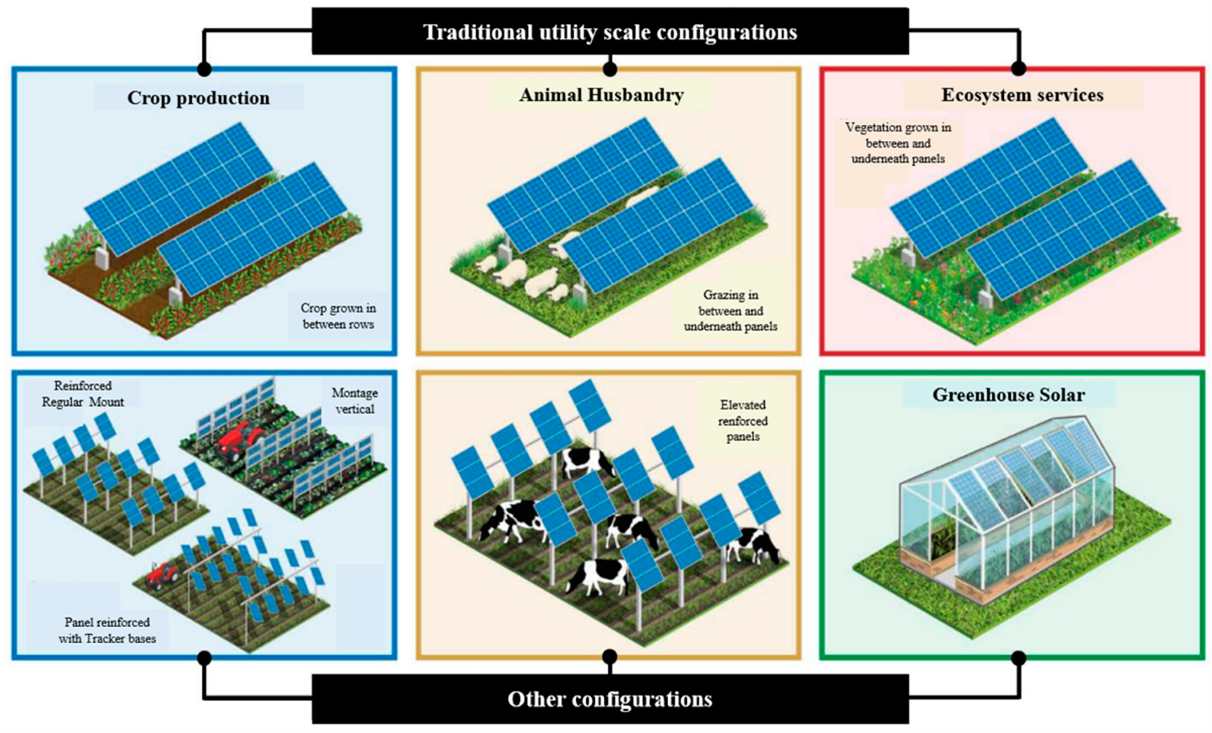
Source: (Macknick et al. 2022)
Benefits of Agrivoltaics: Increased Productivity and Water Conservation
Agrivoltaics maximizes land use and productivity, with early models suggesting global land productivity increases of 35-73%. The system enhances crop productivity, conserves water by reducing evaporation and transpiration, and provides diversified income for farmers through electricity sales. It also improves PV efficiency through natural cooling from crop transpiration and is considered a climate-smart agricultural pattern.
Global Examples and Crop Suitability in Agrivoltaic Systems
Countries like Japan, the USA, Italy, the Netherlands, Austria, and Germany have successfully implemented agrivoltaic systems, cultivating a variety of crops such as ginger, rice, mushrooms, tomatoes, and lettuce. Crop selection and system design are critical to ensure both energy generation and optimal crop growth, especially since some crops may be sensitive to shade.
Challenges and Considerations in Agrivoltaic Implementation
The main challenges include higher initial setup costs compared to traditional PV systems, the need for careful crop selection, and potential long-term maintenance issues. Policy support, subsidies, and ongoing research are essential for wider adoption and to address technical and economic barriers.
Future Innovations and Policy Support for Agrivoltaics
Emerging technologies like partially transparent PV modules, dynamic panel placement, and spectral splitting are making agrivoltaics more efficient and adaptable. Supportive policies, such as feed-in tariffs and incentives for using idle or degraded farmland, are crucial for scaling up this sustainable practice.
Conclusion: Agrivoltaics as a Climate-Smart Agricultural Practice
Agrivoltaics represents a revolution in sustainable agriculture and energy generation, maximizing land use, increasing resilience to climate change, and providing new income opportunities for farmers. With continued innovation, research, and policy support, agrivoltaics can play a pivotal role in building climate-smart, resilient food and energy systems for the future.
References
1. Amaducci, Stefano, Xinyou Yin, and Michele Colauzzi. 2018. “Agrivoltaic Systems to Optimise Land Use for Electric Energy Production.” Applied Energy 220:545–61.
2. Barron-Gafford, Greg A, Patrick Murphy, Alyssa Salazar, Kai Lepley, Nesrine Rouini, Isaiah Barnett-Moreno, and Jordan E Macknick. 2025. “Agrivoltaics as a Climate-Smart and Resilient Solution for Midday Depression in Photosynthesis in Dryland Regions.” Npj Sustainable Agriculture 3 (1): 1–11.
3. Barron-Gafford, Greg A., Mitchell A. Pavao-Zuckerman, Rebecca L. Minor, Leland F. Sutter, Isaiah Barnett-Moreno, Daniel T. Blackett, Moses Thompson, et al. 2019. “Agrivoltaics Provide Mutual Benefits across the Food–Energy–Water Nexus in Drylands.” Nature Sustainability 2 (9): 848–55. https://doi.org/10.1038/s41893-019-0364-5.
4. Dupraz, Christian, Hélene Marrou, Grégoire Talbot, Lydie Dufour, A Nogier, and Yoann Ferard. 2011. “Combining Solar Photovoltaic Panels and Food Crops for Optimising Land Use: Towards New Agrivoltaic Schemes.” Renewable Energy 36 (10): 2725–32.
5. Liu, Wen, Altyeb Ali Abaker Omer, and Ming Li. 2023. “Agrivoltaic: Challenge and Progress.” Agronomy 13 (7): 1934.
6. Tajima, Makoto, and Tetsunari Iida. 2021. “Evolution of Agrivoltaic Farms in Japan.” In . Vol. 2361. AIP Publishing.
7. Toledo, Carlos, and Alessandra Scognamiglio. 2021. “Agrivoltaic Systems Design and Assessment: A Critical Review, and a Descriptive Model towards a Sustainable Landscape Vision (Three-Dimensional Agrivoltaic Patterns).” Sustainability 13 (12): 6871.
8. Macknick, J.; Hartmann, H.; Barron-Gafford, G.; Beatty, B.; Burton, R.; Choi, C.S.; Matthew, D.; Davis, R.; Figueroa, J.; Garrett, A.; et al. The 5 Cs of Agrivoltaic Success Factors in the United States: Lessons From the InSPIRE Research Study; National Renewable Energy Laboratory: Golden, CO, USA, 2022; NREL/TP-6A20-83566. Available online: https://www.nrel.gov/docs/fy22osti/83566.pdf (accessed on 3 November 2022).
Further reading
Agrovoltaics: How They Benefit Farmers and the Climate
Agrivoltaic Systems: Sustainable Agriculture with Renewable Energy Solutions