African Indigenous Vegetables
Many African communities heavily rely on African Indigenous Vegetables (AIVs), yet these nutrient-rich crops are often overlooked in favor of globally popular staples. Despite their underutilization, AIVs offer significant benefits beyond mere sustenance—they contribute to nutrition, cultural heritage, economic growth, and food security, particularly with advancements in biotechnology.
AIVs encompass various plants whose leaves, fruits, or roots are traditionally consumed as vegetables by both rural and urban populations. Historically, Africans gathered wild leafy greens, which were well known in rural areas and often intercropped with staple crops in home gardens. Women played a central role in cultivating, preparing, and selling these vegetables in local markets, making them a vital part of cultural traditions and household diets.
Although AIVs have long been staple foods, their systematic promotion in production and marketing is relatively recent. The introduction of exotic crops led to a decline in their popularity despite their deep-rooted significance in African cuisine. With over half of the population living below the poverty line, there is a growing need to reconsider agricultural production patterns to enhance food security and economic stability.
Research indicates that Africa has around 1,000 indigenous plant species used as leafy vegetables, yet only a small fraction—about 5%—are widely cultivated and marketed. In Kenya alone, 210 species have been fully domesticated. Some of the most common indigenous vegetables in Kenya include cowpeas (Kunde), amaranth (Mchicha), black nightshade (Managu), spider plant (Saga), and jute mallow (Mrenda).
The Importance of the African Indigenous Vegetables (AIVs)
Nutritional Importance of African Indigenous Vegetables
AIVs have many nutritional benefits; they contain essential vitamins, minerals, and antioxidants. Vegetables like cowpeas, amaranth, black nightshade, spider plant, and jute mallow are good sources of Vitamin A, Vitamin C, and Iron. Their inclusion in diets substantially contributes to addressing micronutrient deficiencies, which are particularly frequent in impoverished groups. This nutritional richness is particularly essential in areas with limited access to diverse and nutritious foods.
Cultural Importance
AIVs are profoundly ingrained in the cultural fabric of many African cultures. They are frequently associated with traditional activities, ceremonies, and social gatherings that foster community bonds and protect cultural heritage. Knowledge of their production, preparation, and use is frequently passed down through generations, constituting an important form of traditional knowledge. Maintaining this information is critical for preserving biodiversity and assuring the ongoing supply of these crops.
Food security
Agronomically, AIVs are well-adapted to harsh climatic conditions and disease infestations. They're easier to grow than exotic vegetables. Their seeds can be grown locally, whereas exotic vegetables must be imported. They have shorter growing seasons, with most ready for harvest within 1-4 weeks. Can thrive in sustainable and environmentally friendly cropping systems such as intercropping and organic farming. Most have not been intensively selected, resulting in a diverse genetic background that will be useful in sourcing new varieties for climate change adaptation. Also, AIVs require low input requirements like water, fertilizer, and pesticides, thus promoting climate-resilient agriculture.
Potential for Biotechnology
Likely, Agri-biotechnology will eventually take root in Africa. However, in Africa, it is and will continue to be based on people's needs rather than being supply-driven. The greatest challenge is to raise crop yield rather than expand the area under cultivation. Yields can be raised through seed-based technologies, which are relatively easily disseminated and that farmers find easy to acquire and use. Biotechnology may offer a way forward where conventional selection and breeding techniques are challenging to apply. Since biotechnology is indeed a logical response to the farmer's needs, it follows that the means of developing and delivering biotechnology solutions need to be in place, e.g., mutational breeding to increase drought tolerance. In Kenya, mutational breeding is currently applied on Amaranthus species, African nightshade, cassava, and cowpea for enhanced drought tolerance and change in taste.
Challenges and Opportunities - How to facilitate the broad adoption and cultivation of indigenous vegetables in Africa
Several major difficulties stand in the way of the broad adoption of African Indigenous Vegetables (AIVs). The scientific community and the general public's neglect and stigmatization of AIVs is a serious barrier. This manifests in limited research funding, a shift in dietary tastes towards temperate crops, and many AIVs considered weeds. Policymakers, educational institutions, academics, consumers, and traders all have a role in this ongoing neglect.
The short shelf life of many AIVs, often less than 24 hours at room temperature, poses significant post-harvest challenges. Another major constraint is the widespread practice of farmers saving and reusing seeds from one season to the next, which reduces purity and viability and causes dormancy issues. Market instability further complicates AIV cultivation. Seasonal fluctuations in supply, with abundance during the rainy season and scarcity during the dry season, create market inefficiencies.
The absence of robust government policies and support systems, coupled with a lack of supply regulation and value-added processing capacity, enhances these issues. Limited access to credit and market information also hinders farmers' ability to succeed. Governments, research institutions, and non-governmental organizations must collaborate to promote AIVs through targeted educational programs, capacity-building initiatives, and the development of sustainable market systems to address these issues. Only by working together can the enormous potential of AIVs be realized and contribute to both economic growth and food security.
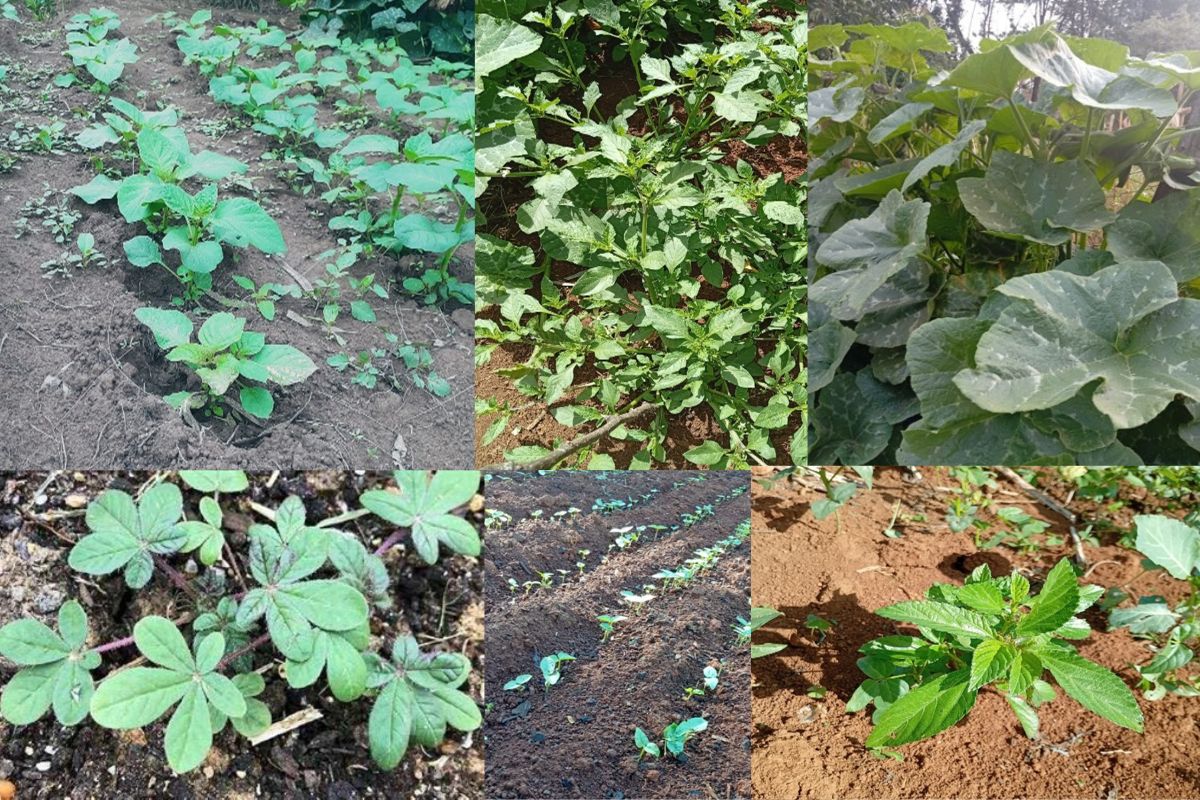
At the top (from lest to right): Amaranthus, Black nightshade, Pumpkin
Bottom (from lest to right): Spiderplant, Cowpeas, Jute mallow
African indigenous vegetables are an invaluable resource with enormous potential to improve food security, nutrition, and community well-being. By utilizing their resilience, nutritional richness, and cultural importance, as well as biotechnology developments, Africa can realize the full potential of these crops, paving the way for a more food-secure and affluent future, promoting Sustainable Development Goal number 2(Zero Hunger),3(Good Health and Well-being),9(Industry, Innovation and Infrastructure),12(Responsible Consumption and Production),13(Climate Action), and 17(Partnerships for the Goals). More study and investment in AIVs are required to realize their full potential and ensure their sustained contribution to the livelihoods and well-being of African people.
References
Journal Articles
- Jansen van Rensburg, W.S., Venter, S.L., Netshiluvhi, T.R., van den Heever, E., Vorster, H.J., de Ronde, J.A., & Bornman, C.H. (2004). Role of indigenous leafy vegetables in combating hunger and malnutrition. South African Journal of Botany, Role of indigenous leafy vegetables in combating hunger and malnutrition — South African Journal of Botany
Books
- Wambugu, F. (2001). Modifying Africa: How biotechnology can benefit the poor and hungry, a case study from Kenya. Nairobi, Kenya.
-Abukutsa-Onyango, Mary. (2010). African indigenous vegetables in Kenya: strategic repositioning in the horticultural sector.
Other
- Habwe, F. O., Walingo, M. K., Abukutsa-Onyango, M. O., & Oluoch, M. O. (2009). African Indigenous Vegetables. Afr. J. Food Sci., 3, 393–397.
Further reading
Unlocking Africa’s Potential: Overcoming Challenges in Exporting Dried Cassava Chips to China
Food Insecurity in Africa: Can Insect Consumption Bridge the Protein Gap?
Growing Melons Outdoors for Profit - Complete Growing Guide from Start to Finish
How to Start and Maintain a Vegetable Garden: Benefits and Practical Tips
Yam: History, uses, and plant information
Potato Losses Across the Value Chain: Causes, Impacts, and Solutions
Potato Weed Management Practices in Kenya
Pumpkin Yield, Harvest and Storage
Plant Information and Variety Selection of Pumpkins