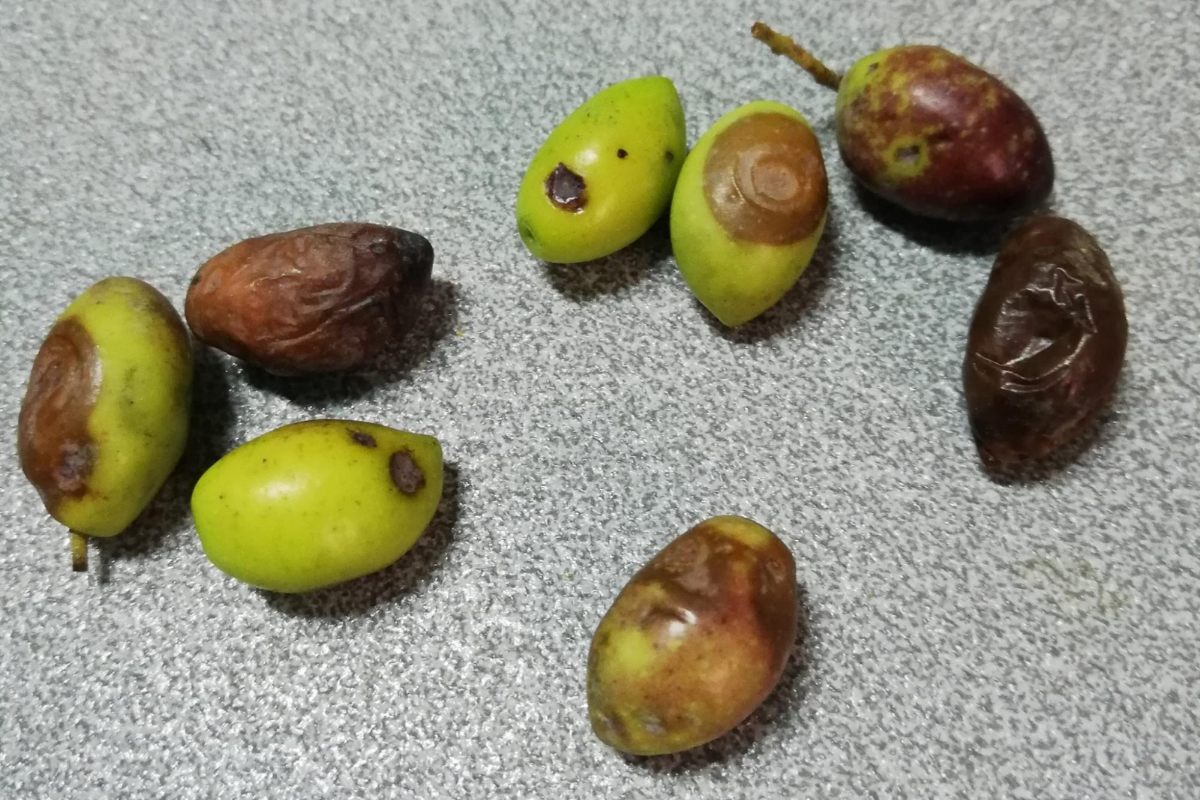
Anthracnose is the most important disease of the olive fruit and has been expanding across Mediterranean growing regions in recent years. The damage does not stop at the fruit that drops. Oil pressed from infected olives carries high acidity and a reddish colour, and in severe outbreaks it is unfit for human consumption under Regulation (EC) No 1989/2003. This guide covers how the disease is recognised, why a grove can already be infected without showing it, how it connects with the olive fly, and exactly when the sprays go on.
Which fungi cause it
The disease is fungal and caused by several species of the genus Colletotrichum. These are asexual fungi, the anamorph, which rarely show in nature the perfect form of the genus Glomerella, which belongs to the ascomycetes. After many changes in the taxonomy of the group, the predominant pathogens are considered to be the species complexes C. acutatum s.l. and C. gloeosporioides s.l., while older literature attributed the disease to Gloeosporium olivarum, a name corresponding to what is now C. clavatum.
The distinction matters in practice because the species differ in aggressiveness. Work that included Greek samples found that in southern Greece, the dominant causal agent is the C. acutatum complex, which ranks alongside C. nymphaeae among the more virulent species, in contrast with weaker pathogens such as C. karsti.
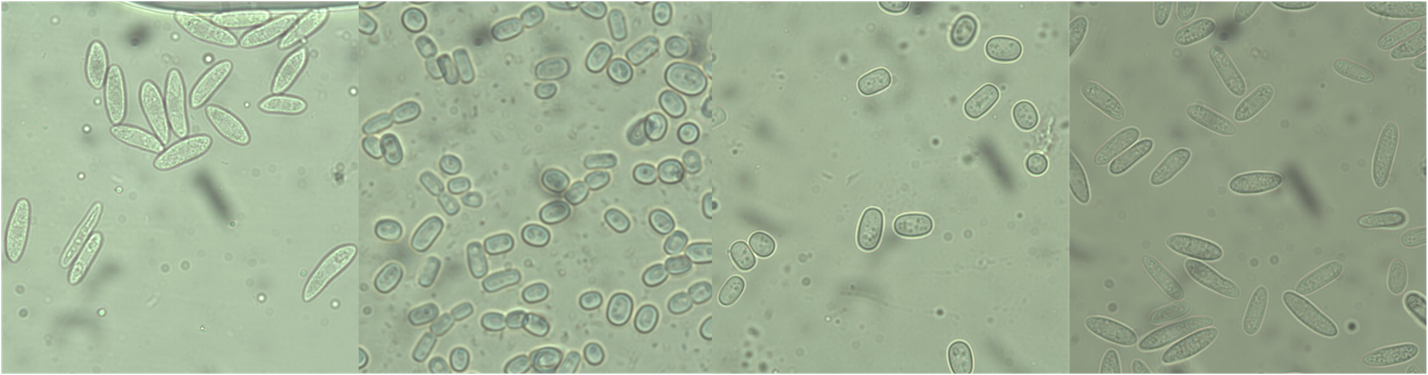
Photo by Stefanos Kolainis
Symptoms on the fruit
An affected fruit first shows a reddish-brown spot that spreads across the surface and sinks. The infected tissue wrinkles, and in high humidity the spot is covered by orange masses of conidia, the most distinctive sign of the disease. From there the fruit takes one of two paths. It either drops to the ground and rots, or it shrivels, mummifies and stays attached to the tree.
Those mummified fruits still hanging in the canopy are the critical point, because they are the source of infection for the following spring. The fungus attacks mainly the fruit, and appears more rarely on leaves, twigs and fruit stalks.
What happens to the olive oil
Infection causes losses in both quantity and quality. In an outbreak, the oil produced is of low quality, with high acidity, a cloudy appearance and a reddish colour, characteristics that make it unfit for human consumption under Regulation (EC) No 1989/2003. The degradation is just as extensive for olives destined for table use. The pattern resembles what the olive fly does to oil composition, except that here the deterioration sets in more abruptly.
Latent infection
The most misunderstood feature of the disease is that infection precedes symptoms by months. Conidia infect the flowers in spring, with nothing visible appearing, and the disease only expresses itself much later, as the fruit approaches maturity.
How widespread this is is shown by a survey of 908 orchards in Portugal, where 41% displayed symptoms, while in a further 14% of orchards the pathogen was detected in symptomless plants. Average disease severity reached 36% and frequently 100%. In practice, a grove that looks clean in June may already be infected, which is why the spring spray at flowering is worthwhile even when nothing appears wrong.
Conditions and disease cycle
Growth of the fungus is optimal at 10 to 25°C, ideally 25°C, stops at 0°C and is minimal at 29°C. Those temperatures occur in spring, autumn and on cool summer days. Combined with high relative humidity and rainfall, infection spreads and can develop into an epidemic across a whole region.
The cycle starts in spring as temperatures rise. Conidia are released from the acervuli formed on the previous year's fruit and infect flowers and immature fruit. Through summer, with relatively low temperatures and high humidity, the disease develops on unripe fruit. Later, in autumn and winter, fruit approaching maturity becomes the most vulnerable of all. That produces the two peaks of the year, spring at flowering and autumn at ripening.
The role of the olive fly
Infestation by the olive fly contributes to the development of the disease, since punctured fruit ripens faster and the wounds ease the entry of spores. The insect is not, however, a necessary factor for infection, meaning anthracnose also breaks out in groves with no fly pressure. In practice, olive fly control doubles as an anthracnose measure, so the two programmes are planned together.
Cultural measures
The purpose of every cultural measure is to reduce humidity within the canopy and cut the initial inoculum:
- Planting distance: wider spacing dries faster and carries noticeably lower disease severity
- Pruning for airflow: opening the centre of the canopy lets air and sun dry the fruit quickly after rain
- Site selection: when establishing a new grove, choose a field in an area with lower humidity
- Removing mummified fruit: from the tree and from the ground, to cut the inoculum carried into the next season
- Early harvest: harvesting on time gets ahead of the disease and delivers higher quality oil at the same time
The spray programme
| Spray | When | What it protects |
|---|---|---|
| Spring | March to early April, on new growth and shortly before or during flowering | The flowers and new growth against the initial, latent infections |
| Autumn | From September to October, as the fruit starts to ripen and before the first rains | The fruit at its most vulnerable stage, the most critical spray of the year |
| Repeat autumn | 2 to 3 weeks after the first, and always at least 3 weeks before harvest | The period of prolonged rain, where humidity persists |
| Post-harvest | Immediately after picking | The wounds left by harvesting, covering the peacock spot and olive knot at the same time |
In regions where the disease is established, a total of three to four sprays a year is recommended, two of them in early autumn before the rains begin. Each application lasts for roughly 20 days, so the interval is adjusted to the weather. Spraying is done to full coverage, wetting the whole tree to run-off, because partial coverage leaves fruit exposed and those fruits become new infection foci.
Which active groups are used
Copper products remain the backbone, meaning Bordeaux mixture, copper hydroxide and copper oxychloride, which act preventively by forming a protective film. Beyond copper, the international literature and national registrations cover strobilurins, triazoles, guanidines with both preventive and curative activity, dithiocarbamates and phthalimides.
Rotating active ingredients from different groups, for example, a triazole with a strobilurin, is recommended to manage pathogen resistance. In organic production, products containing essential oils and terpenes are considered effective against these pathogens.
In every case, use only products registered for olive in your country, respecting the maximum number of applications per season and the pre-harvest interval.
Frequently asked questions
When should olives be sprayed for anthracnose?
Twice at minimum. In spring, from March to early April, around flowering, and in autumn, from September to October, as ripening starts and before the rains. In problem regions, the programme runs to three or four sprays.
Is copper enough for anthracnose?
In most cases, yes, provided the sprays go on at the right time with full coverage. In groves with established disease, registered products with curative activity are added, in rotation between active groups.
How do I tell anthracnose from peacock spot?
Anthracnose hits the fruit, with sunken reddish-brown lesions and orange spore masses, while peacock spot hits the leaves, with circular lesions and concentric rings. Both are managed with the same copper-based programme.
Is oil from infected olives usable?
In severe infections, no. The oil develops high acidity, a reddish colour, and a cloudy appearance, characteristics that render it unfit for human consumption under Regulation (EC) No 1989/2003.
Why did anthracnose appear so suddenly in my grove?
Because flowers are infected in spring with no visible symptoms, the disease only expresses months later at ripening. Surveys show a significant share of orchards carry the pathogen while looking symptomless.
Does the olive fly cause anthracnose?
No, but it makes it worse. Punctured fruit ripens faster, and the wounds ease spore entry, so fly control also reduces anthracnose pressure, even though the insect is not required for infection.
Important notes
Conditions differ from grove to grove, and spray dates shift by region and season, so build the programme with a local agronomist and follow regional plant protection guidance.
Use only products registered for olive in your country, follow the label and the maximum number of applications per season, and apply cultural preventive measures first.
References
- Talhinhas P., Loureiro A., Oliveira H., Olive anthracnose, a yield and oil quality degrading disease caused by several species of Colletotrichum, Molecular Plant Pathology, 2018.
- Talhinhas P. et al., Epidemiology, histopathology and aetiology of olive anthracnose, Plant Pathology, 2011.
- An integrated approach to improve plant protection against olive anthracnose caused by the Colletotrichum acutatum species complex, PLOS One, 2020.
- Riolo M. et al., Susceptibility of Italian olive cultivars to various Colletotrichum species, Plant Pathology, 2023.