


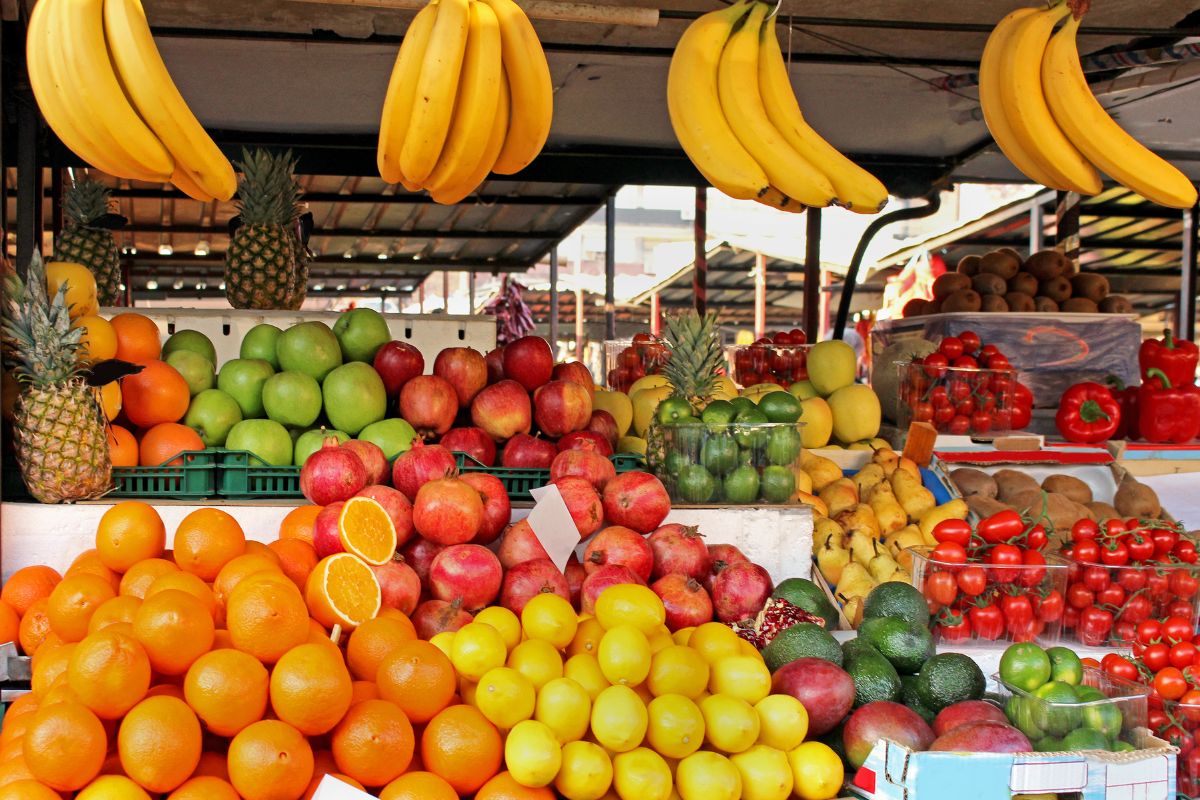
Most farmers in Zimbabwe often joke that growing food is the easy part. The market is another beast. I experienced this secondhand when my grandmother grew cotton in the early 2000s. It was a fine Grade A crop, but when it came time for a payout, there was nothing but crickets. This was made worse by the fact that farmers could only sell through a single parastatal.
I then experienced it firsthand when I grew sweet potatoes between the 2020 and 2022 seasons and failed to sell the crop profitably. Yes, as a first-time farmer, some production mishaps had happened, but the crop was also a fine Grade A. The production level was not what my colleagues and I had hoped for, but it was still a good crop.
The first barrier is getting into the market
For many small-scale farmers, production is only a small part of the bigger challenge. Accessing profitable markets is often the bigger hurdle. For us in Zimbabwe, Mbare Musika is the oldest and largest fresh produce marketplace in Harare, serving as the primary distribution hub linking rural farmers with urban retailers and consumers. Despite the large volumes of produce and money that move through the market daily, farmers often capture the smallest share of the value.
How market barriers shift profits away from farmers
The middlemen squeeze
How does this happen? One main challenge is that farmers have very little negotiating power and often end up selling at prices that are significantly below the final retail value of the produce they have spent their blood, sweat, and tears to produce. The mechanism is straightforward. Intermediaries procure the farmer's produce at low prices, then resell it to consumers at inflated prices. The farmer absorbs all the risk in this setup.
Perishability as a weapon
Why don't farmers sell directly to consumers? There isn't a direct terminal, at least a safe one, where the farmer can connect with the consumer at a fair price. Here's how it happens. Accessing direct consumers in Mbare Musika is somewhat tedious for the farmer, as many of them (including me) have described pressure, intimidation, and coordinated buying practices that eventually isolate them from the market. Since they are in the perishable business, it is easier to comply than risk losing it all.
What could improve market access
Now that we have painted a picture of the reality of market access, let us look at how lifting these barriers can protect a farmer's bottom line.
Decentralisation efforts
As mentioned before, the market is a beast, and every beast meets its fate. For farmers, that turning point is the decentralization of these big markets and the creation of smaller, distributed hubs that bring markets closer to where production happens. More access points mean more room for fair exchange between farmer and consumer. This is not to say that we are totally dismantling the existing system of farmer-to-middleman-to-consumer. The point is to make it so that all players have the power of choice.
Marketing and value addition, promote, promote, promote
Our farmers need education when it comes to understanding promotion and marketing. In Zimbabwe, you only know it's mango season when you see yellow juices running down a toddler's arms and cheeks. Creating anticipation has not been our strong suit, and it matters. So much value is unlocked when deliberate steps are taken to reach, inform, and then properly deliver the product to the consumer. This is where the value chain gets blocked. So much potential, yet so little knowledge of this subject has resulted in significant value lost along the way. The product exists, but the value slips away from the farmer somewhere between the farm gate and the consumer.
Take blueberries. They are among Zimbabwe's fastest-growing agricultural sectors, but most Zimbabwean farmers have not been part of that story. This is not because the opportunity was missing. It is because they did not have the capital, network, and information to enter that value chain. This is exactly where promotion becomes the farmer's entry point. When a farmer understands what their product could become and who would pay for it in that form, they stop waiting to be included in someone else's value chain and start building their own.
It is the same with mangoes. The only way the average Zimbabwean eats a mango is fresh, yet mangoes can be pureed, dried, and turned into multiple delicacies that command a much higher price. The day I tasted a dried, frozen mango from a packaging that cracked and crinkled with each slice I took out, I saw heaven for those first few seconds. It was music to my taste buds, and something I splurge on to this day. So many products like this exist right here in Zimbabwe. They are waiting to be promoted, marketed, and sold in ways that open and improve their market value. The farmer who understands that he is not just growing mangoes understands he is sitting on a money-maker.
I should point out that efforts have been made to get farmers to showcase their produce and sell through digital platforms such as Kurima Mari and eMkambo. These have done a good job of decentralizing and providing a platform to bring farmers closer to markets that would otherwise be unreachable. We still have a long way to go, especially with digital literacy gaps and data costs, which remain major barriers to small-scale farmers' access to markets. That is why the solution cannot be digital alone.
Three questions to shift your mindset from volume to value
Change doesn't have to start with a big investment. It can start with three honest questions.
Am I selling a secret, or am I creating a market? If no one knows your crop is coming until the day you load the truck, then you are entirely at the mercy of intermediaries.
Am I at the mercy of a three-day ticking clock? Do you have a preservation plan for your perishables? What can you invest in to increase the shelf life of your crop or turn it into a value-added product?
Does my produce look like a commodity or a premium product? Order and organization will always win over consumers. There is a reason why a truck selling unpackaged sugar plums has to price them at 50 cents for 15, while the truck selling clean, packaged sugar plums at one dollar for 12 sells out faster. Presentation, order, and discipline matter.
Bringing cooperatives back in action
My grandmother was in a dairy cooperative, and I remember that is where she got her sweet but stubborn cow, Jenny, who ended up giving us six calves in total. This was very common back in the 80s, 90s, and early 2000s. Over the years, many farmers have lost confidence in cooperatives, largely due to economic instability, political interference, and a lack of trust among members, among other factors. You cannot deny the power of pooled resources for farmers who otherwise would not have the means to produce, let alone access the markets.
What can be done differently this time is the combination of cooperatives with digital tools and platforms. In the case of Zimbabwe, this is how farmers can implement this plan.
Use platforms collectively: a cooperative can use eMkambo to check prices as a group before deciding where to sell, so each farmer no longer arrives at Mbare individually with no information.
Pool resources to cover data costs: bridge the data cost gap by covering costs individual smallholders cannot afford. This directly addresses the digital literacy and access barrier. Markets and market information require that a farmer stay up to date, and pooling makes that possible.
Negotiate as one large seller: in Mbare, it is usually the middlemen who set the price for the farmer. With well-established cooperatives, farmers are in a stronger position to negotiate as a single large seller rather than dozens of small ones, fundamentally changing the power dynamic described earlier.
Cooperatives, on their own, are not new, but we can turn them around and give them a new, accountable approach that can make both the digital space and the market more accessible to small-scale farmers. The cooperative becomes the vehicle. The digital platform becomes the road. With this combination, reaching the market destination becomes inevitable.
The chain is as strong as its weakest link.
My grandmother never grew cotton again after her debacle with the cotton board that season. I walked away from sweet potato production after two seasons of trying. It was only as I was writing this article that it occurred to me why the market had beaten my colleagues and me, and my grandmother before us. The value chain breaks at the point where the farmer runs out of information, ideas, options, and power. We need to create more entry points that give farmers the power to produce, ideate, and choose how, when, and where the produce they work so hard to grow is sold.
Farmers deserve a fair shot at the market, and decentralization, combined with smarter promotion and reimagined cooperatives, can give them the strength to take it. Every farmer who understands and controls the market is one huge step closer to feeding a nation.
References
- Chikulo, S., Hebinck, P., and Kinsey, B. (2020). 'Mbare Musika is ours', an analysis of a fresh produce market in Zimbabwe. African Affairs, 119(476), 311–337.