


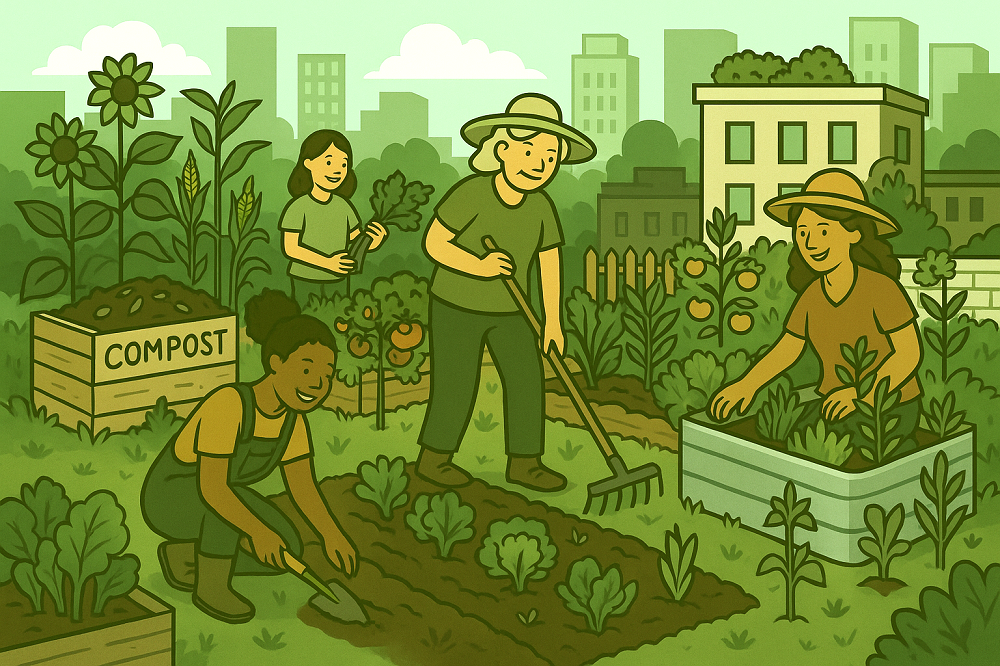
Women Leading Urban Regeneration: How Female Farmers Transform Cities with Sustainable Agriculture
Introduction
Across cities worldwide, women are at the forefront of a powerful movement – regenerative agriculture. In neighborhoods historically shaped by disinvestment, food insecurity, and environmental injustice, women are restoring land, building food systems, and creating community resilience through farming practices rooted in ecological principles and cultural care. These women are transforming broken spaces into thriving ecosystems, not just growing food but nurturing a new vision of urban life.
While regenerative agriculture is often associated with rural areas, women in cities are adapting its principles to rooftops, schoolyards, vacant lots, and small plots of land. These efforts demonstrate that regeneration is not limited by geography but is defined by determination, creativity, and a deep sense of responsibility. In doing so, women are committed to community healing while fostering environmental and social transformation.
What is Regenerative Agriculture?
Regenerative agriculture is a farming approach that prioritizes soil health, biodiversity, water management, and long-term ecosystem resilience. It goes beyond sustainability by seeking to restore and improve the ecosystems. Common regenerative practices include composting, crop rotation, cover cropping, no-till or low-till methods, agroforestry, perennials, and integrating livestock or pollinator-plant species.
In urban contexts, these practices take on new forms. Limited space, degraded land, and zoning regulations mean that regenerative principles are often applied on a smaller scale but with notable ingenuity. Urban farmers repurpose or reuse materials, collect rainwater, establish compost systems, and grow food intensively in limited spaces. For many communities, especially those in food deserts or historically marginalized areas, these practices are not only environmentally significant but also vital acts of resistance, nourishment, and survival.
Women's Leadership in Urban Food Systems
Women have long been central to food production, preparation, and distribution in urban spaces, often informally and outside of market economies. Today, they are leading organized efforts to transform vacant land into gardens, schools into food education centers, and neighborhoods into centers of ecological and social sustainability (Sachs et al., 2016). Their leadership is not always visible, but it is deeply embedded in everyday acts of cultivation, caregiving, and community building (Batrićević & Paunović, 2019).
In U.S. cities like Detroit, Philadelphia, and Columbus, Ohio, women coordinate community-supported agriculture (CSA) programs, operate farmers' markets, and advocate for land and food justice. Many of these women come from the communities they serve, which allows them to address food insecurity with cultural relevance and relational depth. Globally, cities in Latin America, Sub-Saharan Africa, and Southeast Asia reflect similar dynamics (Goeury, 2023; Poulsen et al., 2015).
Women's Community Care
Urban women farmers often work in difficult environments, particularly in neighborhoods with contaminated soils, limited access to clean water, and minimal local government support. Despite these challenges, many women are growing food, organizing community events, mentoring youth, and educating neighbors about sustainable practices. Their work blends environmental stewardship with education, public health, racial equity, and cultural preservation.
For example, in Columbus, Ohio, one urban farmer described the difficulty of getting fresh produce into corner stores. She even offered to pay for shelf space but was still turned away. Instead of giving up, she redirected her efforts toward educating her neighborhood, building partnerships, and growing resilience, both in soil and spirit.
In Youngstown, Ohio, another farmer recounted how repeated acts of vandalism damaged her garden. A community resident shared, “That made me feel mad. We should be supporting each other, not tearing each other down.” This sentiment reveals how regenerative agriculture mirrors broader social dynamics. When women grow food, they also cultivate a sense of belonging, trust, and shared responsibility. Their gardens become spaces of healing, not just from food apartheid or environmental degradation, but from community disconnection and historical trauma.
Barriers Faced by Women in Urban Regenerative Agriculture
While their leadership is evident, women in urban regenerative farming face persistent and structural challenges that limit their reach and impact. These barriers are embedded in broader systems of gender inequality, urban planning, and economic exclusion.
1. Land Access and Tenure
Most urban agriculture projects operate on borrowed or temporarily leased land, often through city programs or private agreements that offer little long-term security. This instability discourages long-term investment in soil improvement, infrastructure, or educational programming. For women, especially Black, Indigenous, and immigrant women, this issue is compounded by systemic discrimination in land access and urban development policies that prioritize commercial over community use.
2. Access to Capital and Resources
Women urban farmers often operate with minimal funding, relying on personal savings, volunteer labor, or community donations. Grant opportunities typically prioritize commercial-scale farming, leaving many small, women-led operations underfunded. Moreover, complex application processes and eligibility criteria exclude women with limited time, digital access, or grant-writing experience.
3. Labor Burden and Invisibility
Women in urban agriculture frequently juggle multiple roles, e.g., farmer, caregiver, and educator, all while receiving little or no compensation. Their work is often seen as an extension of traditional women's work rather than as skilled labor deserving of institutional support (Dentzman & Lewin, 2024). This invisibility contributes to emotional burnout and restricts opportunities for professional development.
4. Environmental and Social Stressors
Urban farms in low-income areas often contend with polluted soils, limited green infrastructure, unsafe neighborhoods, and rising displacement pressures due to gentrification. These stressors, coupled with the emotional labor of community caretaking, place a significant burden on women trying to maintain consistent food production and social engagement.
Building a Supportive Ecosystem
For women to thrive as leaders in urban regenerative agriculture, support systems must be intentionally designed with equity, sustainability, and cultural relevance in mind. These systems must center the voices and visions of women who have long been stewards of community food systems.
- Secure Land Access: Cities can establish urban land trusts or offer long-term leases for community gardens and farms to ensure women farmers have the security needed to invest in regenerative practices.
- Flexible Funding Opportunities: Funding programs should include microgrants, local partnerships, and culturally competent outreach to prioritize small, women-led initiatives that may not fit into traditional funding models.
- Policy Inclusion: Women urban farmers should be represented on food policy councils, zoning boards, and urban planning committees. Their firsthand knowledge can guide more equitable and effective decision-making.
- Training and Peer Support: Knowledge sharing in regenerative agriculture should be accessible through peer-to-peer learning, community workshops, and support networks that respect cultural traditions and lived experiences. Such knowledge should also be made available in accessible formats.
- Shared Infrastructure and Resources: Cities and community organizations can establish compost hubs, tool libraries, seed banks, and cold storage facilities that serve multiple farms and reduce individual burden.
Conclusion
Women in urban communities are not only growing food but also growing futures. Their regenerative practices heal degraded soil, revitalize disinvested neighborhoods, and reconnect people to land and each other. Their leadership is grounded in lived experience, ancestral knowledge, and a deep understanding of their communities' needs to survive and thrive. Women’s knowledge, labor, and leadership must be centered and rooted to build resilient and equitable urban food systems. Supporting urban women in regenerative agriculture is not only a matter of justice, but it is essential for our cities' ecological and social regeneration.
References
Batrićević, A., & Paunović, N. (2019). Ecofeminism and environmental security. Facta Universitatis, Series: Law and Politics, 125-136. ECOFEMINISM AND ENVIRONMENTAL SECURITY — Facta Universitatis, Series: Law and Politics
Dentzman, K., & Lewin, P. (2024). A fair comparison: Women’s and men’s farms at seven scales in the United States. Rural Sociology, 89(1), 3–39. https://doi.org/10.1111/ruso.12512
Goeury, H. (2024). Food security, food sovereignty, and urban agriculture in Cuba. Latin American Perspectives, 51(1), 225–247. Food Security, Food Sovereignty, and Urban Agriculture in Cuba — Latin American Perspectives
Poulsen, M. N., McNab, P. R., Clayton, M. L., & Neff, R. A. (2015). A systematic review of urban agriculture and food security impacts in low-income countries. Food Policy, 55, 131–146. A systematic review of urban agriculture and food security impacts in low-income countries — Food Policy
Sachs, C., Barbercheck, M., Braiser, K., Kiernan, N. E., & Terman, A. R. (2016). The rise of women farmers and sustainable agriculture. University of Iowa Press.