


A practical farmer’s guide
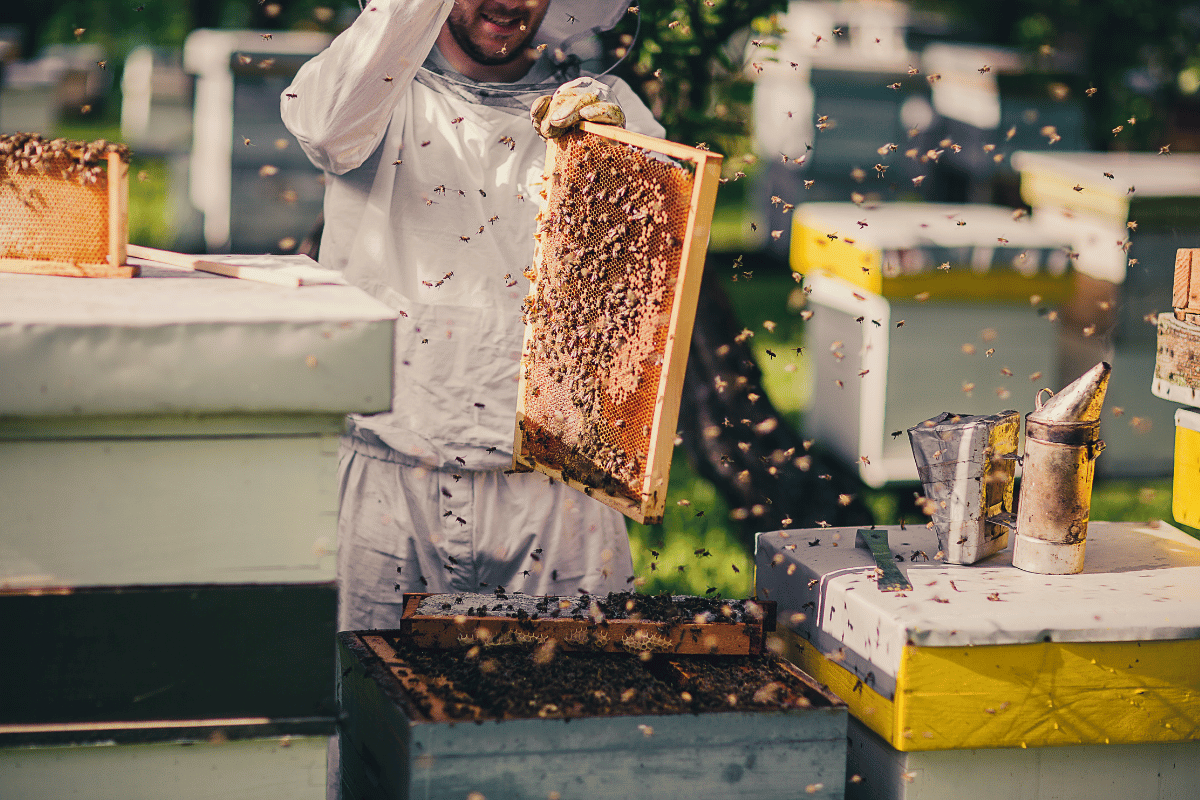
Few farmers realize their own beehives can double as sensitive environmental samplers, quietly mapping what drifts across fields and forage within a few kilometers. Honey bee colonies can help farmers track pesticide drift, detect contaminants in the landscape, and spot forage gaps that affect yield and bee health. This guide shows what to sample (pollen, bee bread, beeswax, plus honey, propolis, and adult bees), how far results “see” from your hives, when and how to sample, how many hives to use, and what to do with the findings. Everything is practical and referenced for farmers and beekeepers worldwide. (Cunningham et al., 2022).
Why use them as sentinels
Bees range widely, contact many plants and surfaces, and bring tiny traces of the landscape back to the hive in pollen, bee bread, wax, and honey. That makes colonies useful “biomonitors” of pesticides and, in some settings, metals and airborne dust. Classic field demonstrations go back decades and include quality work by Dr. Jerry J. Bromenshenk on regional pollution monitoring, Dr. James Devillers on methods and risk, and on-farm applied trials shared by Randy Oliver for beekeepers (Bromenshenk et al., 1985; Devillers, 2003; Devillers, 2023; Oliver, 2009, 2010).
How far do hive results “see”?
Waggle-dance studies show recruited foraging distances are usually within 1 to 3 kilometers, with occasional longer trips when forage is scarce (Couvillon et al., 2014; Shackleton et al., 2023). Across bee species, realized ranges track body size and sociality (Kendall et al., 2022). In practice, treat any signal from one apiary as a summary of roughly the nearest 1–3 km, expanding when flowers are limited.
What should you sample, and why?
Fresh pollen shows very recent field exposure over days. It lines up with bloom and spray windows but can vary day to day (Topitzhofer et al., 2021).
Bee bread (stored pollen plus nectar) captures diet over recent weeks. Fermentation tends to smooth extreme spikes (Schaad et al., 2023).
Beeswax integrates cumulative, fat-loving residues over months to years. Many pesticides that enter via pollen end up in wax, and surveys often detect several compounds in a single sample (Kast et al., 2024; Bischoff et al., 2023).
Other helpful matrices
Honey is best for consumer-facing questions and broad-area exposure (weeks to months), not for detecting “this-week” drift events. Neonicotinoid surveys, for example, show many honey samples carry multiple residues (Mitchell et al., 2017; Casula et al., 2024).
Propolis is useful for tracking metals and particulates because sticky resins trap local dust (Matuszewska et al., 2021; Glevitzky et al., 2025).
Adult bees are appropriate for measuring on-bee or ingested residues and/or sampling after incidents. Collect a composite of workers, keep cool, and send to the lab promptly (Hung et al., 2023).
When should you sample?
At minimum, you should sample twice per season: (1) before the main flow, in spring, and after it (in late summer or autumn). In intensive cropping regions, the best practice is to add a mid-season sample. Summer often shows longer foraging trips (bees travel farther when forage is limited), so it’s a good time to sample pollen or bee bread (Couvillon et al., 2014).
How many hives do I need?
Replication gives steadier, more useful results across colonies and time. Here’s a practical ladder for smallholders up to commercial beekeepers:
- Minimum viable (small apiary): Pool material from three healthy colonies into one composite sample (per matrix and date).
- Better: Collect three composite samples per site/date (each composite from three different colonies). That gives you n=3 replicates for basic comparisons and simple stats.
- Best (research-grade): Sample five or more colonies per site and date, or use multiple apiaries per land-use type, repeated across the season (Ostiguy et al., 2019; Svečnjak et al., 2019).
|
Minimum Viable (Small Apiary) |
Better |
Best (Research-Grade) |
|
|
Description |
Pool material from three healthy colonies into one composite sample per matrix/date |
Collect three composite samples per site/date, each from three different colonies |
Sample five or more colonies per site/date or use multiple apiaries per land-use type, repeated across season |
|
Sampling Structure |
3 colonies, |
3 colonies |
≥5 colonies per site/date, across multiple times/sites |
|
Replicates (n) |
n = 1 |
n = 3 |
n ≥ 5 |
Studies often pool across colonies to lower variability. For example, Ostiguy et al. (2019) pooled pollen from five colonies per apiary. Large residue surveys have collected dozens of wax or bee bread samples across sites and dates. If you only have one or two hives, you can still learn something. Treat results as site-specific snapshots and repeat later to identify patterns.
Field steps you can trust
Follow your lab’s instructions first. The outline below condenses widely adopted approaches (USDA-APHIS protocols, EU SANTE method-validation principles, and national incident schemes such as the UK’s WIIS).
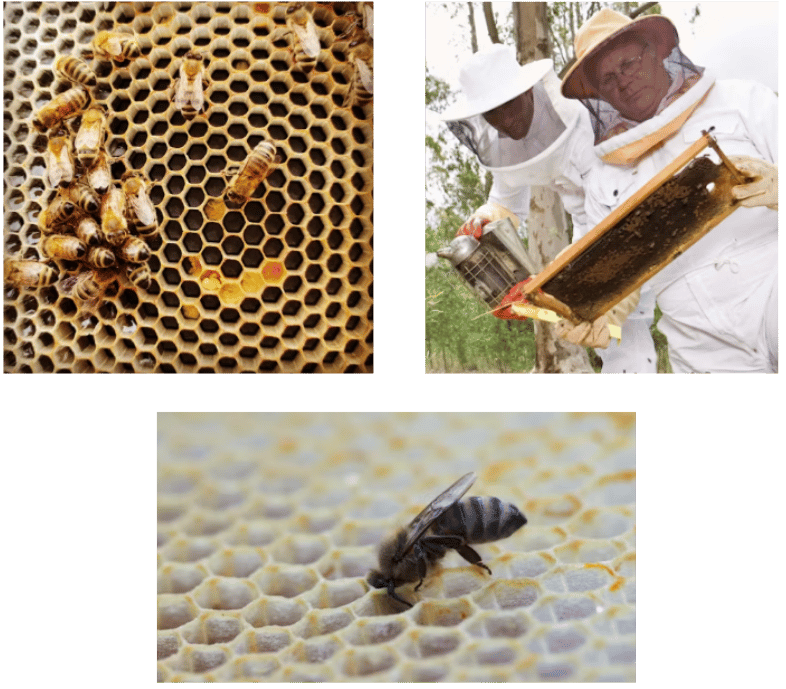
Beeswax (brood comb). Wearing clean gloves, take a small chip from drawn brood-chamber comb with little or no brood, nectar, or pollen. Place in a clean 50 milliliter (mL) tube. Keep cool and dark. Ship chilled.
Bee bread. Scrape at least several cells per colony to make a composite. Keep cool. Ship per lab instructions.
Fresh pollen (optional “this-week” snapshot). Collect across colonies. Entrance pollen traps collect corbicular pellets efficiently; fit traps correctly and note they can change foraging if bees find alternative entrances (Topitzhofer et al., 2021).
Adult bees (optional). For incidents or particulate checks, collect a small composite of workers following your national protocol. Keep cool and ship promptly.
Approximate sample quantities
- Fresh pollen: 3-5 grams (g); about one teaspoon (tsp)
- Bee bread: 3-5 g from several cells
- Wax: 5-10 g chip of comb
- Honey: 20-50 g
- Propolis: 2-5 g
- Adult bees: 30-50 workers (about 3 g)
- These amounts meet most ISO/IEC 17025 lab requirements.
Labels that save headaches. Apiary and Hive ID, date and time, matrix (pollen, bee bread, wax, honey, adult bees), crop stage, weather and wind, and any nearby operations.
Plain language on “detection limits.” Labs list a limit of detection (LOD, the smallest amount they can detect) and a limit of quantification (LOQ, the smallest amount they can measure with confidence). If a result is below LOQ, it may still be present, just too low to measure precisely.
Where do I send samples?
Pick ISO/IEC 17025-accredited residue labs when you can. Before collecting, ask the lab the following: What chemicals do they test for? How much product sample do they need? What shipping conditions (cold, etc.)? What are the limit of detection (LOD) and limit of quantitation (LOQ) ? Does the lab require chain-of-custody forms?
European Union. Many national food-safety or university labs follow EU SANTE guidelines for quality control. European Reference Labs (EURLs) advise on honey and related matrices.
United Kingdom. The National Bee Unit guides bee-health monitoring. Suspected pesticide incidents go through the Wildlife Incident Investigation Scheme (WIIS). Accredited labs (public or private) handle analyses.
United States. The USDA's Animal and Plant Health Inspection Service (APHIS)protocols are widely used; state labs, universities, and private labs run pesticide and metals panels for honey bee matrices.
Canada. Provincial and university labs and accredited private labs handle pesticide testing; the Canadian Food Inspection Agency (CFIA) and AAFC provide guidance on sampling.
Latin America, Oceania, Africa, Asia. Work with national veterinary or public-health labs and university chemistry departments. If local capacity is limited, regional centers and FAO/IAEA partner labs can advise on sampling methods and shipping requirements.
per- and polyfluoroalkyl substances (PFAS) testing. PFAS analysis is optional and mainly needed if you suspect fluorinated foam use, industrial discharge, or biosolids in the area. Coordinate with the lab in advance because PFAS work often requires specific containers. This includes high-density polyethylene HDPE or polypropylene. Never utilize polytetrafluoroethylene (PTFE or Teflon) and very low LOQs. Include field blanks.
How to read the results
- Expect mixtures. Wax samples often show several fungicides, herbicides, and insecticides. The pattern across sites and dates matters more than a single number (Bischoff et al., 2023; Schaad et al., 2023).
- Focus on exposure and risk. Look at which compounds are present, how bees contact them. Note which compounds are present, how bees contact them (oral or contact), and whether exposure is likely acute (high short-term) or chronic (low-level over time).
- Watch seasonal signatures. Compare spring vs. late-season results. Many systems show different residue profiles across the year (e.g. Kast et al., 2024). For instance, some pesticides may peak in spring bloom vs. others in mid-summer.
- Think spatially. Since most recruited foraging is within ~1-3 km, a spike in residues usually points to management within that near-farm halo. Scarce forage (e.g. drought) can widen bees’ range, so be aware of that when interpreting distant sources. Lean seasons can also widen the radius (Couvillon et al., 2014; Kendall et al., 2022).
- Verify before big decisions. If you see a red flag (e.g. an unexpected insecticide), re-sample to confirm. Small management changes (nozzle type, adjuvant use, buffer strips, spray timing) often show up in follow-up samples (Butts et al., 2022; USDA-ARS, 2024; Oliver, 2009, 2010).
What to do with the findings
Talk timing, not blame. Share spray schedules with neighbors and applicators. Favor evening or other low-bee activity times for spraying flowering crops. Use drift-reducing nozzles or hoods, maintain correct pressure, and utilize weather windows with low wind and no inversions. Additionally, keep buffers between flowering margins and apiaries (Butts et al., 2022; USDA-ARS, 2024). Build forage resiliency within 1-3 km of your apiary; mid- to late-season is often the tightest for bees (Couvillon et al., 2014).
Quick start guides
For smallholders
- Use ~3 hives at one site.
- Sample key materials (e.g. pollen or bee bread, plus wax) twice per year (pre- and post-flower).
- Pool each material from the 3 hives into one composite sample per date (send 1 sample in spring, 1 in fall). Even just 2 dates will reveal major seasonal differences.
- Label everything (site, hive IDs, date, sample type) and follow lab shipping guidelines.
For commercial operations
- Plan for replicates.
- At each site and date, prepare at least 3 composite samples (from 3-5 different colonies).
- Sample multiple times (e.g. early, mid, late season) across your major cropping cycle.
- Sample pollen/bee bread and wax each time for comprehensive coverage.
- Use the same sampling protocol each time and record field maps or GPS. This lets you compare over time and space with statistics.
In both cases, coordinate with your lab on volumes and shipping conditions before you start.
The better you plan (e.g. how many hives and how to pool), the more power your results will have.
References
- APHIS (USDA). 2013. Sampling Pollen for Pesticide Residue (PDF). Sampling Pollenfor Pesticide Residue (PDF) — USDA APHIS
- APHIS (USDA). 2020. Bee Bread Sampling Protocol (PDF). Bee Bread Sampling Protocol (PDF)
- APHIS (USDA). 2025. Wax Sampling Protocol (PDF). Honey Bee Wax Sampling Protocol (PDF)
- Bischoff, K., Baert, N., McArt, S. H., et al. 2023. Pesticide contamination of beeswax from managed honey bee colonies. Journal of Veterinary Diagnostic Investigation 35(6):617-624. Pesticide contamination of beeswax from managed honey bee colonies in New York State — Journal of Veterinary Diagnostic Investigation
- Bromenshenk, J. J., Carlson, S. R., Simpson, J. C., Thomas, J. M. 1985. Science 227:632–634. (Classic demonstration of honey bees used for regional pollution monitoring.)
- Butts, T. R., et al. 2022. Herbicide spray drift from ground and aerial applications. Scientific Reports 12:18258. Herbicide spray drift from ground and aerial applications: Implications for potential pollinator foraging sources. — Scientific reports
- Casula, M., et al. 2024. Multiresidue analytical approaches for contaminants in honey (review). Foods. Multiresidue Methods Analysis to Detect Contamination of Selected Metals in Honey and Pesticides in Honey and Pollen. — Foods (Basel, Switzerland)
- Couvillon, M. J., Schürch, R., Ratnieks, F. L. W. 2014. Waggle dance distances as indicators of seasonal foraging challenges. PLOS ONE 9:e93495. Waggle Dance Distances as Integrative Indicators of Seasonal Foraging Challenges — PLoS ONE
- Cunningham, M. M., Tran, L., McKee, C. G., et al. 2022. Honey bees as biomonitors of environmental contaminants. Ecological Indicators 134:108457. Honey bees as biomonitors of environmental contaminants, pathogens, and climate change — Ecological Indicators
- Devillers, J. (Ed.). 2003. Honey Bees: Estimating the Environmental Impact of Chemicals. CRC Press.
- Devillers, J. 2023. In Silico Bees: Arguments, Methods, Applications, and Perspectives. Open-access monograph. Residual Governance — OAPEN Library
- Di Fiore, C., et al. 2022. Honeybees as bioindicators of heavy metal pollution in the Molise region (Italy). Atmosphere 13(4):624. Honeybees as Bioindicators of Heavy Metal Pollution in Urban and Rural Areas in the South of Italy — Atmosphere
- Glevitzky, M., et al. 2025. Propolis as a bioindicator of environmental pollution (review). Environments 12(4):105. Propolis: Biological Activity and Its Role as a Natural Indicator of Pollution in Mining Areas — Environments
- Hung, C.-C., et al. 2023. Using honeybees as bioindicators of pesticide exposure (review). Toxics 11(8):655. Availability of Using Honeybees as Bioindicators of Pesticide Exposure in the Vicinity of Agricultural Environments in Taiwan. — Toxics
- Kast, C., Müller, J., Fracheboud, M. 2024. Temporal entry of pesticides through pollen and fate in beeswax. Environmental Science and Pollution Research 31:61060-61072. Temporal entry of pesticides through pollen into the bee hive and their fate in beeswax — Environmental Science and Pollution Research
- Kendall, L. K., Mola, J. M., Portman, Z. M., et al. 2022. Potential vs. realized foraging movements of bees. Ecology 103(11):e3809. The potential and realized foraging movements of bees are differentially determined by body size and sociality — Ecology
- Mitchell, E. A. D., et al. 2017. A worldwide survey of neonicotinoids in honey. Science 358:109-111. A worldwide survey of neonicotinoids in honey — Science
- Oliver, R. 2009. The Learning Curve – Part 3: The Natural Miticides. Scientific Beekeeping. The Learning Curve Part 3 the Natural Miticides
- Oliver, R. 2010. The Learning Curve – Part 4: The Synthetic Miticides. Scientific Beekeeping. The Learning Curve Part 4 the Synthetic Miticides
- Ostiguy, N., et al. 2019. Pollen nutrition and colony growth: field design and pooling across five colonies per apiary. PLOS ONE 14(8):e0220703. Influence of chronic exposure to thiamethoxam and chronic bee paralysis virus on winter honey bees — PLOS ONE
- Schaad, E., et al. 2023. Quantitation of pesticides in bee bread from honey bee colonies. Analytical and Bioanalytical Chemistry 415:4319-4334. Quantitation of pesticides in bee bread collected from honey bee colonies in an agricultural environment in Switzerland. — Environmental science and pollution research international
- Shackleton, K., Balfour, N. J., & Al Toufailia, H. 2023. Honey bee waggle dances facilitate shorter foraging distances and increased aggregation. Animal Behaviour 198:11-19. Honey bee waggle dances facilitate shorter foraging distances and increased foraging aggregation — Animal Behaviour
- Svečnjak, L., et al. 2019. Standard methods for Apis mellifera beeswax research. Journal of Apicultural Research 58:1-108. (Methods framework; see journal.)
- Topitzhofer, E., Lucas, H., Carlson, E., Chakrabarti, P., Sagili, R. 2021. Collection and identification of pollen from honey bee colonies. Journal of Visualized Experiments 167:e62064. Collection and Identification of Pollen from Honey Bee Colonies — Journal of Visualized Experiments
- USDA-ARS. 2024. Pesticide drift may endanger pollinators. Pesticide Drift May Endanger Pollinators — USDA Agricultural Research Service