



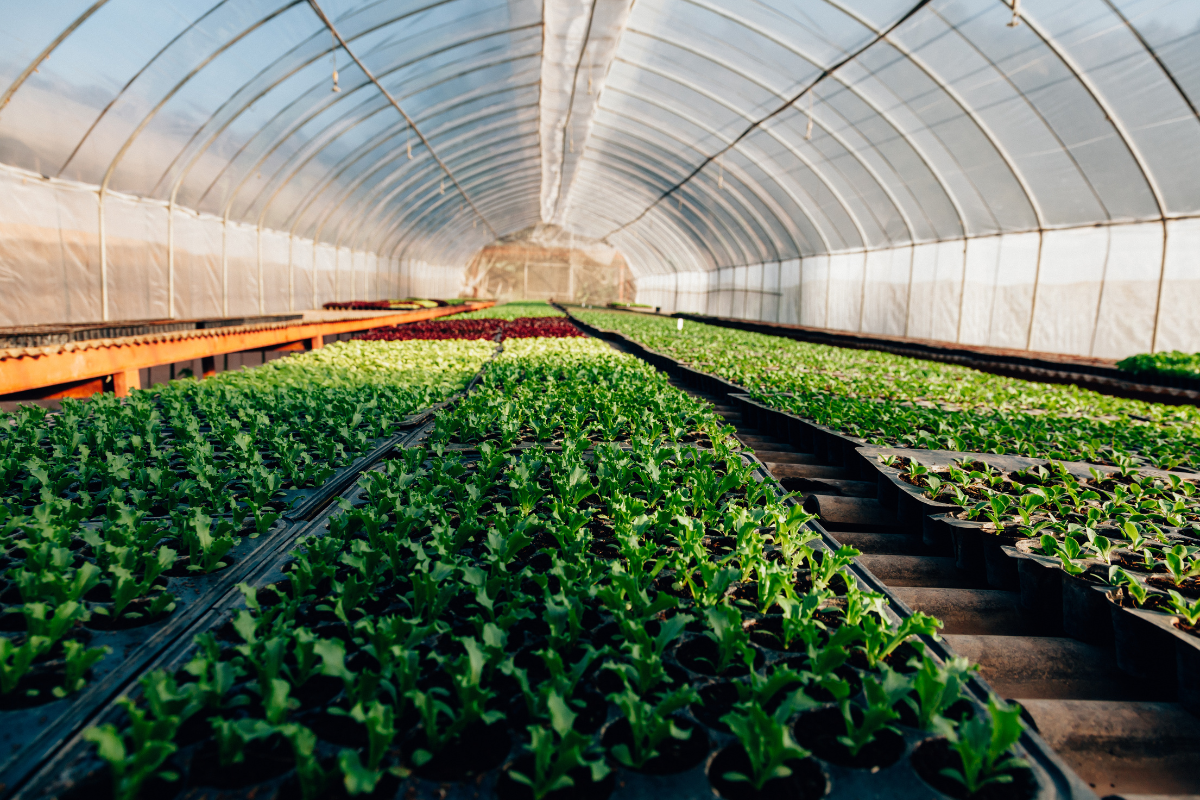
How physics speaks to leaves, how VPD translates the air’s message, and why stomata ultimately determine growth, nutrition, and resilience.
Energy arrives fast, and the leaf must shed heat
At sunrise, the greenhouse receives short-wave radiation. This is not merely “light” in a visual sense. It is a rapid influx of energy that reaches the leaf surface almost instantly. Inside the leaf, photons are absorbed and only a small fraction is used directly for photosynthesis. The majority of the incoming energy is converted into heat within the leaf tissue.
In practical terms, the primary question is often not “Is there enough light?” but “Can the plant remove surplus energy fast enough to keep leaf temperature within a safe biochemical range?” This is where energy balance becomes a prerequisite for growth and, first of all, for survival.
The three cooling pathways
A plant has only a limited set of physical pathways to dissipate excess heat. Some heat can be exchanged via long-wave radiation and via Convection, but the most effective mechanism at the leaf level is transpiration.
Although water loss may appear counterintuitive, it is the cost of thermal stability. The internal air spaces of the leaf are near saturation; cell walls remain moist, and water vapour conditions inside the leaf are effectively close to 100% relative humidity.
When stomata open, the saturated internal environment connects to the external air. If the external air is less saturated, water vapour diffuses out, driven by a gradient in vapour pressure. Each unit of evaporated water removes a substantial amount of latent heat, cooling the leaf and protecting proteins and enzymes from heat stress.
Stomata are the plant's control interface
Stomata are not simple holes. They are an integrated control interface. At the same time, they regulate water vapour loss (cooling), CO₂ uptake (carbon supply), and leaf thermal status.
If stomata remain open, transpiration is sustained, leaf temperature stabilizes, CO₂ uptake continues, and carbon compounds (assimilates) can be produced for growth and defence. If stomata close to prevent dehydration, cooling is reduced, the leaf warms, internal CO₂ declines, and photosynthesis drops, even under high radiation.
In other words, the plant may accept a carbon shortage to avoid a water crisis, and this trade-off is strongly shaped by the surrounding air.
Humid air is not the background
This is why humid air is not just “background.” It is the stage on which leaf physiology operates. The immediate microclimate around the leaf is characterized by psychrometric properties such as air temperature (Tair), relative humidity (RH), absolute humidity (AH), and air movement.
RH alone can be misleading because it can shift sharply with temperature even when the actual moisture content is unchanged. AH reflects the true water vapour content of the air and therefore its capacity to accept additional vapour from the leaf.
The boundary layer problem
Insufficient air movement allows a localized, near-stagnant layer to build up at the leaf surface. That near-stagnant layer is the boundary layer. It becomes quickly enriched with water vapour, reducing the effective vapour gradient at the stomata.
As a result, VPD at a climate sensor is not necessarily the same as VPD at the stomatal pore. Breaking the boundary layer requires sufficient air movement, suitable canopy structure, and favourable temperature gradients. Without it, the system can show a “theoretical VPD” while the leaf experiences a much weaker local driving force for transpiration.
VPD as a driving force, not a simple target
Within this context, VPD (vapour pressure deficit) is best understood not as a target number but as a physical driving force. It is the difference between water vapour pressure inside the leaf (linked to leaf temperature and near-saturated internal air) and vapour pressure in the surrounding air.
A critical implication is that “true” VPD depends on leaf temperature (Tleaf), not only on air temperature (Tair) and relative humidity (RH). Leaves may be warmer or cooler than the bulk air depending on radiation load and transpiration cooling, and that difference materially changes vapour pressure and therefore the driving force for water loss.
What happens when VPD is very low
When VPD is very low, the driving force for water vapour diffusion is weak. Transpiration slows or nearly stops, and this can be deceptively “quiet”: the plant may appear calm while internal transport processes degrade. With low transpiration, the upward pull of water from the roots declines, and the movement of dissolved minerals diminishes.
What happens when VPD is very high
Conversely, when VPD is very high, the external air can pull water rapidly, increasing the risk of hydraulic stress. The plant often responds by reducing stomatal aperture; Stomatal Closure lowers transpiration, but it also restricts CO2 Uptake, raises Leaf Temperature, and reduces Photosynthesis.
This is why high VPD does not guarantee high transpiration; the plant may down-regulate the pathway itself.
The physiological trust zone
Between these extremes lies a physiological “trust zone,” where VPD is moderate enough to allow steady transpiration without forcing defensive stomatal closure. In that zone, cooling, carbon supply, and growth can proceed in a more stable manner.
Importantly, VPD is often better treated as a diagnostic indicator than as a direct control knob, because plant-driven changes in stomatal conductance and leaf temperature feed back into VPD itself.
Why transpiration shapes mineral nutrition
The story becomes especially consequential when we consider mineral nutrition. Transpiration is not only a cooling mechanism; it is also a primary driver of xylem flow. Many nutrients move with the transpiration stream, and some are particularly sensitive to reduced flow.
Calcium (Ca) is a classic example. It is delivered mainly via xylem transport and is not readily re-mobilized within the plant. When transpiration is frequently interrupted by low VPD, high humidity microclimates, or chronic stomatal closure, calcium delivery to rapidly expanding tissues can become insufficient, increasing the risk of physiological disorders.
In such cases, the root cause is often not the fertilizer concentration, but the disruption of water-driven transport.
The root zone follows the leaf
The root zone is equally part of the narrative. Roots do not “pump” water upward to compensate for weak transpiration. Instead, they rely on the transpiration-driven pull to renew water uptake and move dissolved nutrients.
When transpiration is stable, roots can take up fresh water and maintain ionic balance more effectively. When transpiration collapses, the plant may lean more on root pressure, which does not replicate continuous xylem flow.
Thus, climate and leaf processes frequently determine whether a perfectly adequate nutrient solution translates into actual nutrition at the growing points.
Night conditions and the hidden condensation trap
Night conditions provide a silent stress test. After sunset, short-wave radiation disappears, the greenhouse cover can cool, and the crop may lose energy via long-wave radiation. If leaf surfaces cool to the dew point, condensation can form.
Under condensation, transpiration is effectively suppressed and mineral transport is curtailed, while wet surfaces elevate disease risk. For this reason, night strategy, often including energy screens and measures that reduce radiative cooling, plays a direct role in maintaining a minimum functional balance in energy, moisture, and transport.
Putting the chain together
In the end, the greenhouse balance journey is a single connected chain:
- Radiation load increases the need for evaporative cooling
- Cooling capacity depends on air humidity, air movement, and microclimate dynamics
- VPD expresses the driving force for water loss, but leaf temperature and the boundary layer can shift what the plant truly experiences
- Stomatal behaviour determines whether the plant can cool and assimilate carbon
- Transpiration-driven xylem flow largely determines whether minerals reach young tissues
When the chain is balanced, the plant remains open, hydrated, fed, and productive. When any link breaks, such as stagnant air, extreme VPD, persistent stomatal restriction, or night-time condensation, downstream consequences can unfold quickly as heat stress, carbon limitation, disrupted transport, nutritional disorders, and higher disease pressure.
References
- van Weel, P. A., et al. (2021). Plant Empowerment: The Basic Principles (3rd ed.). Plant Empowerment Academy.
- ASHRAE. ASHRAE Handbook Online (Fundamentals includes psychrometrics).
- Inoue, T., et al. (2021). Minimizing VPD Fluctuations Maintains Higher Stomatal Conductance and Photosynthesis, Resulting in Improvement of Plant Growth in Lettuce. Frontiers in Plant Science, 12, 646144.
- Hubbard, R. M., et al. (2016). Stomatal acclimation to vapour pressure deficit and implications for transpiration and conductance. Plant, Cell & Environment.
- Plant Physiology (Oxford Academic). Characterizing the breakpoint of stomatal response to vapor pressure deficit.