


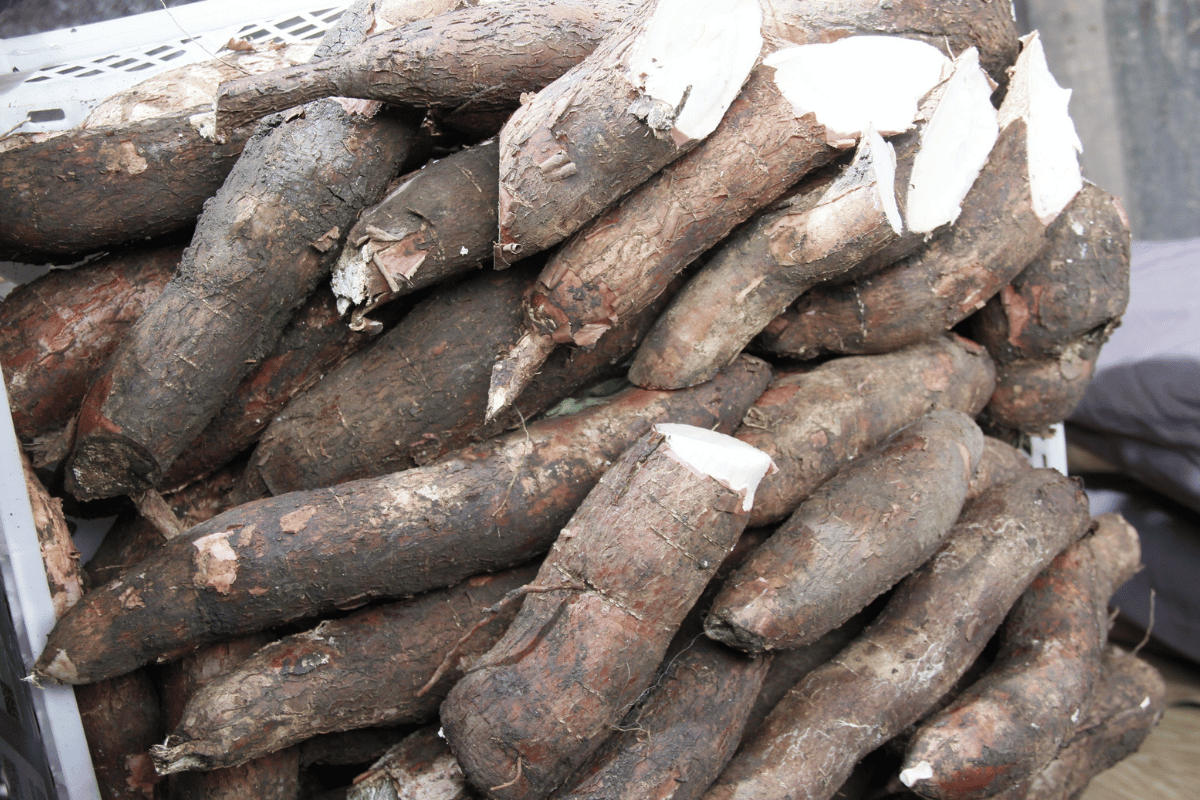
If you want to understand Ghanaian food, start with cassava. More than 70% of our farmers grow it, it is planted across most of the country, and it makes up around 22% of our agricultural GDP, enough to put Ghana among the top five cassava producers in Africa. We eat it, we feed it to animals, and we turn it into starch, flour, and other products that industry depends on. For many households, including those I have worked with, cassava is not a side crop. It is the crop that pays the school fees and fills the pot.
What I want to share here is less a textbook account and more what I have come to see matters most if cassava is going to keep doing that job: a few practical things that separate a good field from a poor one, and the women who carry so much of the work and rarely get the credit.
Why cassava carries so much weight
Cassava earns its place because it is forgiving. It tolerates poor soils and dry spells better than most of our staples, so a household with marginal land and no irrigation can still get a harvest from it, and it is one of the few crops expected to hold up reasonably well as the climate grows harder. That reliability is exactly why so many families lean on it.
But the crop has a weakness that shapes everything about how it is handled. Once you lift the roots, they start to spoil within a few days. That single fact is why so much of cassava's value lives after harvest, in turning the roots quickly into gari, flour, dough, and starch that will keep. And that is where the women come in.
Why I call cassava a woman's crop
People often call cassava a woman's crop in Ghana, and in the processing yard, that is simply true. Women run the transformation of raw roots into gari, flour, and fufu, the stage that decides how much money a field actually brings home. A sack of fresh roots is worth little and spoils fast. The same roots processed well are worth far more and can be stored and sold over time. That value is created mostly by women's hands, and much of the hand-weeding that protects the crop in the field is done by women too.
I have found that this has a very practical consequence that outsiders miss. When researchers have asked men and women separately what they want from a new cassava variety, the answers differ. Women weigh the traits tied to processing and food quality more heavily, such as how well a root turns into good gari, because they are the ones who will process it. A variety bred without that in mind gets adopted slowly, however good its yield looks on a research station. Yet women usually have less secure access to land, to credit, and to extension advice than men, which limits what they can invest in better cuttings or equipment. In my experience, improving women's access to those things is one of the most direct ways to lift the whole system, not only their own plots.
The practical lessons that matter most
If I had to tell a fellow grower what actually makes cassava sustainable, it would come down to a handful of things.
Begin with clean, improved planting material. Cassava is grown from stem cuttings, so whatever is in the parent plant, including disease, travels straight into the next crop. Taking cuttings from healthy plants, and where possible from certified or improved cassava varieties, is the most important decision a farmer makes all season. Use cuttings from the lower part of a mature stem, at least ten months old, since they root and yield better than the soft upper stem.
Take cassava mosaic disease seriously, because it is the crop's biggest threat. Cassava mosaic disease, or CMD, is widespread here. A national survey found the disease in the large majority of fields it checked, and across Africa it takes a heavy share of the potential harvest every year. It spreads two ways, through infected cuttings and through tiny whitefly insects, which is again why clean planting material matters so much. The affordable defence is to plant CMD-resistant varieties, use disease-free cuttings, and pull out and destroy badly infected plants instead of taking cuttings from them. Every grower should learn to spot the yellow-green leaf mosaic, the distorted leaves, and the stunting early.
Prepare the land and match the crop to it. Cassava does best on loose, well-drained loamy soil, and proper land preparation through ploughing and ridging improves both root growth and weed control, which is one of the heaviest jobs in the crop. A soil test before planting tells you what the ground actually lacks, so any fertiliser goes where it earns its cost. Good planting practice, with the right spacing and planting at the start of the rains, sets the crop up for the long season it needs.
Do not lose the harvest after all that work. Because the roots spoil so quickly, losses between field and market are high wherever processing and transport cannot keep up. Closer processing, better storage, and better roads keep more of the harvest and more of its value with the farmer. Since women run most of the processing, anything that strengthens that stage reaches them first.
What will keep Ghana's cassava strong
Our governments have already helped, most clearly by releasing improved, higher-yielding varieties that have raised both production and profit for the farmers who took them up. The way forward builds on that: keep getting resistant, good-quality planting material into farmers' hands, widen access to markets and better transport, teach agronomy that takes climate and disease seriously, and improve how the crop is processed and stored. If we do those things, and if we do them with real attention to the women who grow and process cassava, the crop will keep doing what it has always done in Ghana. It will feed families, supply industry, and hold steady even as the seasons turn harder.
Sources
Frimpong, J. M., Kuutoume, J., and Ofori, I. (2023). Food losses along the cassava supply chain in Ghana, causes and solutions. Policy paper.
Oppong, A., et al. (2021). Cassava mosaic virus disease in Ghana, distribution and spread. Journal of Plant Physiology & Pathology, 9(8).
Pinamang Acheampong, P., Owusu Danquah, E., Agyeman, K., Obeng Dankwa, K., and Addison, M. (2021). Research and development for improved cassava varieties in Ghana, farmers' adoption and effects on livelihoods. In Cassava, Biology, Production, and Use. IntechOpen.
Teeken, B., et al. (2018). Cassava trait preferences of men and women farmers in Nigeria, implications for breeding. Economic Botany, 72(3), 263-277.
Nwaobiala, C. U., Alozie, E. N., and Anusiem, C. N. (2019). Gender differentials in farmers' involvement in cassava production activities in Abia State, Nigeria. Agrosearch, 19(1), 72-86.